Flateyjarbók, the Book of Flatey: 225 vellum leaves written in Iceland in the fourteenth century
The Flateyjarbók is an Icelandic manuscript of 225 vellum leaves, written and illustrated by two priests between 1387 and 1394. See what the source consulted gathers on who commissioned it, what it contains, how it ended up in Copenhagen and when it returned to Iceland.
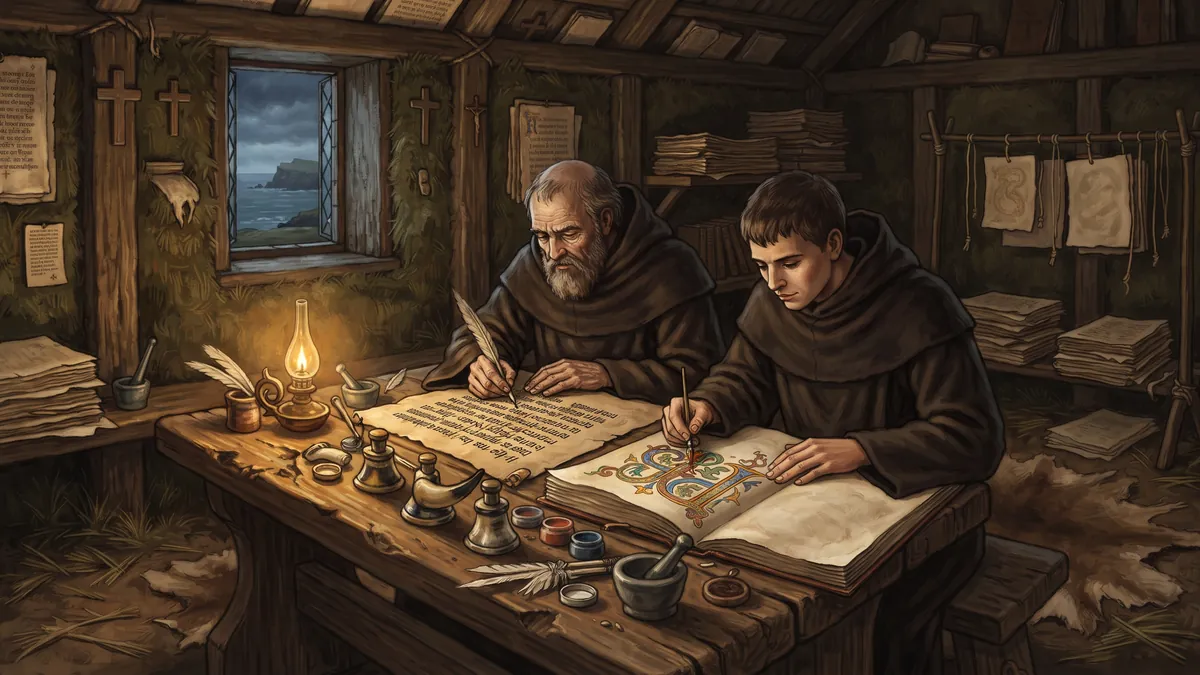
The Flateyjarbók, also called GkS 1005 fol. and Codex Flateyensis, is a medieval Icelandic manuscript of 225 vellum leaves, written and illustrated. According to the source consulted, it was commissioned by the knight and lawspeaker Jón Hákonarson.
Who wrote it
The scribes were two priests, Jón Þórðarson and Magnús Þórhallsson. Jón wrote from the tale of Eiríkr the Traveller to the end of the two Olaf sagas. Magnús wrote the earlier and later material and made the illustrations.
When
The writing is dated to 1387, and the completion to 1394 “or very soon after”. The article observes that these dates rest on internal evidence, that is, they are deduced from the text itself, not documented by another source. More material was added toward the end of the fifteenth century.
What it contains
A good part is expanded royal sagas: Olaf Tryggvason, St Olaf, Sverre, Hákon the Old, Magnus the Good and Harald Hardrada. There is also the only copy of the Eddic poem Hyndluljóð, annals from creation to 1394 and the Nornagests þáttr. It contains the Grœnlendinga saga and the only Icelandic versions of the Orkneyinga saga and the Færeyinga saga. Eiríks saga rauða, according to the article, is discussed as a separate saga that differs from the Greenland account, and is not listed as part of the manuscript.
The journey
In 1651, Bishop Brynjólfur Sveinsson asked for old manuscripts. Jon Finnsson of Flatey gave the book to the bishop, who presented it to King Frederick III in 1656, for the Royal Library in Copenhagen. The manuscript survived the Copenhagen fire of 1728 and the battle of 1807, and returned to Iceland in 1971. Today it is kept by the Árni Magnússon Institute.
Translation
The Saga Heritage Foundation is translating the work into English, with Alison Finlay, and a six-volume Norwegian edition was completed in 2019. The article marks the progress of the English translation as uncertain.
Why it matters
The manuscript is the work of two hands, Jón’s in the central stretch and Magnús’s in the earlier and later material and the illustrations. For three texts the article points to it as the sole source: the Hyndluljóð exists only in it, and the Orkneyinga saga and the Færeyinga saga appear only in it in Icelandic versions. That makes it a source on which other work depends, and explains the interest in modern editions and translations.
What remains uncertain
The writing dates are inferred. The article does not give the size of the leaves or say how many skins were used, and it is prudent not to invent those numbers. Nor does it deal with the farm where the book would have been made.
To fill leaves, square by square, with the help of the numbers on the edges, play The leaves of the Flateyjarbók.
Sources.
- Wikipedia, "Flateyjarbók" (commission, scribes, dates, contents, path to Copenhagen and return in 1971)