Heimskringla, the "orb of the world": the sagas of the kings of Norway attributed to Snorri Sturluson
Heimskringla is a set of Norse kings' sagas, linked to Snorri Sturluson around 1230, running from the legendary Ynglings to 1177. See what the source consulted gathers on the name, the authorship, the manuscripts, the sources and how historians read it today.
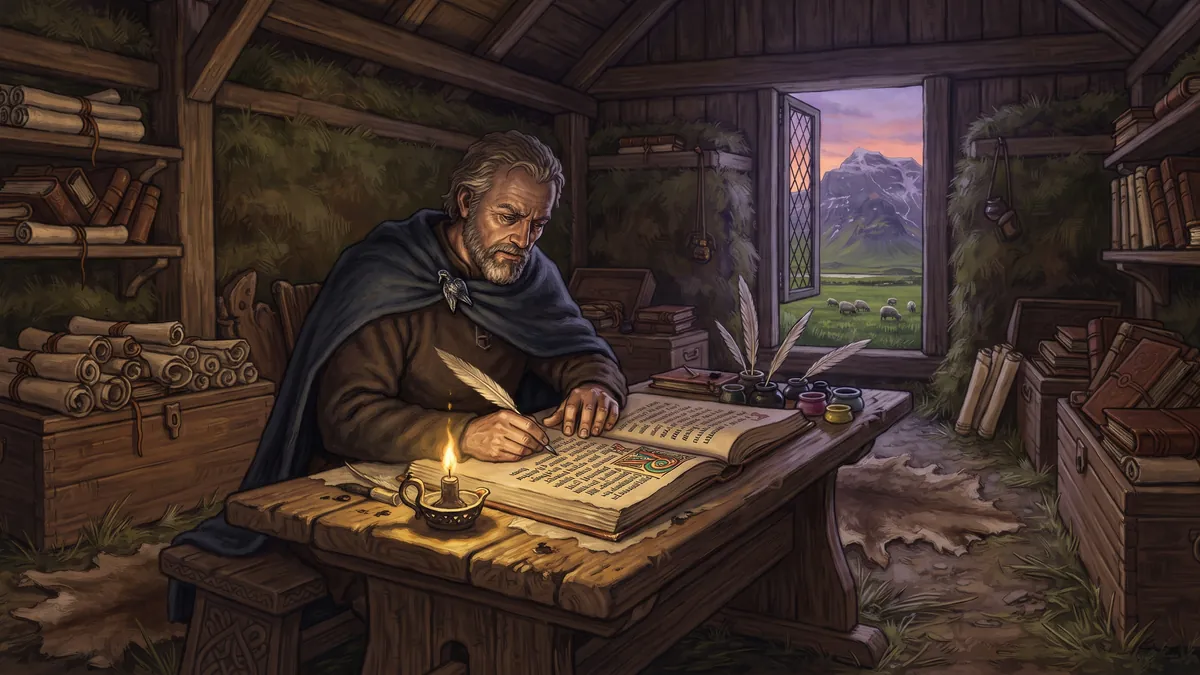
Heimskringla is a set of Norse kings’ sagas. The source consulted notes at the outset that no surviving manuscript or text names an author. Some scholars assume the work was written by Snorri Sturluson, who lived from 1178/79 to 1241, around 1230, and the first works that credit him as author are sixteenth-century Danish translations.
The name
The title comes from the opening words of the Ynglinga saga, kringla heimsins, “the orb of the Earth”, and came into use only in the seventeenth century.
The scope
The work runs from the legendary Ynglings to the death of the pretender Eystein Meyla, in 1177. The last saga deals with Magnús Erlingsson, who died in 1184. The Óláfs saga helga is the central part: Olaf’s fifteen-year reign takes up about a third of the whole. The saga of Haraldr harðráði covers his eastern expedition, his exploits in Constantinople, Syria and Sicily, and his death at Stamford Bridge, in 1066, a few days before Harold’s death at Hastings.
The manuscripts
The earliest copy is the Kringla leaf, a single vellum leaf of about 1260, kept by the National and University Library of Iceland. The rest of that manuscript burned in 1728. The Jofraskinna manuscript was the basis of Peder Claussøn Friis’s translation, of about 1600, printed in 1633, and the Stockholm manuscript was translated by Johan Peringskiöld and published in 1697.
The sources
Among the sources are Hryggjarstykki, the Skjǫldunga saga and the Jarlasǫgurnar, besides general histories such as the Ágrip, the Morkinskinna and, perhaps, the Fagrskinna. Snorri also used the lost saga of Olaf by Styrmir Kárason, the life of Olaf Tryggvason by Oddr Snorrason and skaldic verse.
A web of borrowings
Heimskringla leans on earlier works, among them Morkinskinna, and Morkinskinna, in turn, was also used by Fagrskinna. The kings’ sagas thus form a web of borrowings, not isolated texts, and so it is hard to say, in each passage, where each piece of information comes from.
How historians read it
Until the middle of the nineteenth century, historians trusted the sagas as fact. Saga criticism, begun by Lauritz and Curt Weibull in the early twentieth century, rejected that trust. Today little truth is seen in the earliest sagas, but they remain valuable for understanding medieval Norwegian society. The later ones are considered more reliable because they deal with events closer to when they were written.
What remains uncertain
The authorship is an assumption, not a datum. The title is much later than the work. And the distance between the events and the text is great, so each saga should be read according to the period it narrates.
To take pegs off an orb of pegs, until only a few remain, play The pegs of the orb.
Sources.
- Wikipedia, "Heimskringla" (authorship, title, manuscripts, scope, Óláfs saga helga, Haraldr harðráði, sources, historical criticism)