Morkinskinna, the "mouldy parchment": the saga of the kings of Norway written in Iceland around 1220
Morkinskinna is a Norse kings' saga written in Iceland around 1220, preserved in a manuscript of about 1275. See what the source consulted gathers on the name, the period it covers, the 270 stanzas cited, the short tales and the relation to the Heimskringla.
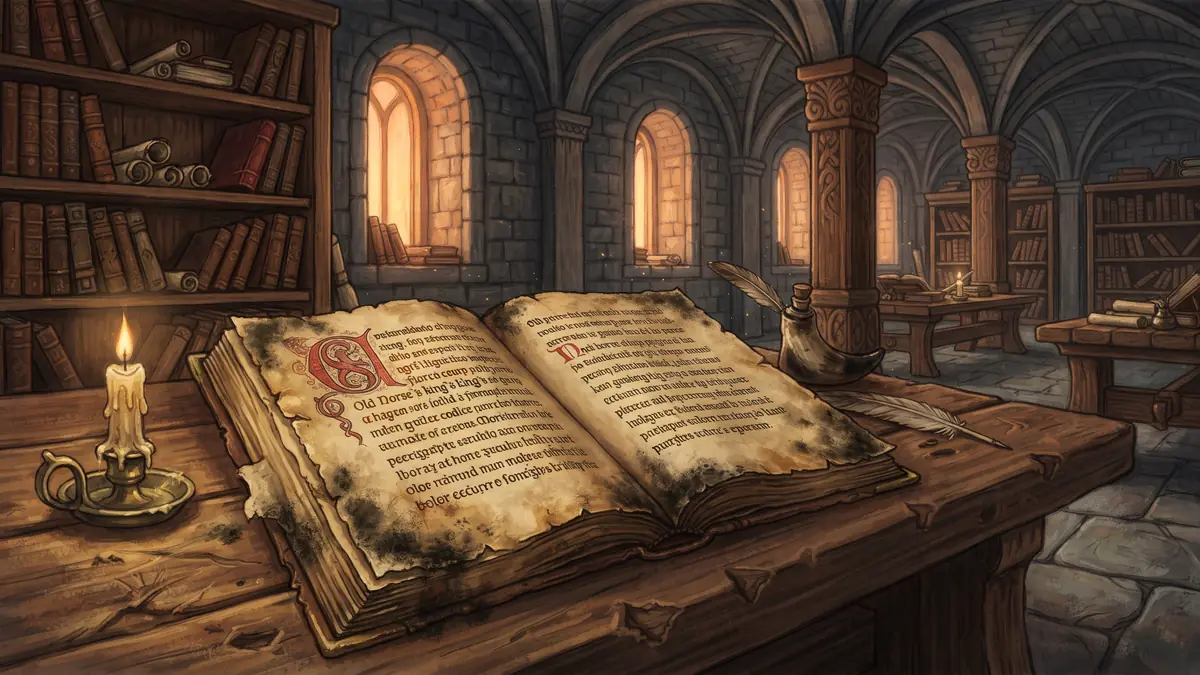
Morkinskinna means “mouldy parchment” and is, according to the source consulted, the original name of the manuscript GKS 1009 fol. It is an Old Norse kings’ saga, written in Iceland around 1220.
The manuscript
The text is preserved in a manuscript of about 1275, now in the Royal Danish Library in Copenhagen. Þormóður Torfason took it to Denmark in 1662.
The name and the object
The article says Morkinskinna was, originally, the name of the manuscript. The name thus describes the object, with its parchment darkened by time, and not the contents, which are the lives and deeds of kings. This helps to see the distance between the book as a physical piece and the text it holds, which is older than the surviving copy.
The period
By the article’s introduction, the saga covers roughly 1025 to 1157. The chapter list has it begin in 1025 or 1026 and end in 1157, after the death of King Sigurðr II. That is about 130 years of royal history. It may have been longer: the narratives of Fagrskinna and Heimskringla, which used Morkinskinna as a source, run to 1177, and the text may have continued that far. The article says only that it ends suddenly. The title of an English edition of the work gives the period as 1030 to 1157, which shows that the starting point varies with the source.
The kings
The article names Magnús, Haraldr, Magnús’s uncle, Sigurðr, with the chapter “The story of King Sigurðr’s adventures”, Eysteinn and Ingi, the last mentioned only in “King Ingi’s letter”. The traditional epithets are not used here, because the article does not carry them. The chapter titles cited, such as “The story of King Sigurðr’s adventures” and “King Ingi’s letter”, point to episodes with a unity of their own within the narrative, but the article does not detail the content of either.
Poetry and tales
About 270 stanzas of skaldic poetry are cited in the text. The saga also includes several short tales, the þættir, about Icelanders.
A source for other sagas
Fagrskinna and Heimskringla used Morkinskinna. This matters to those who study the history of the sagas, because it shows that it was read and drawn on in later works.
What remains uncertain
The article names no author and does not discuss authorship, and does not deal with lost leaves. Nor does it say whether the saga was longer than the copy that survives, only that it ends abruptly. Whoever reads it should remember that it is a narrative composed almost two centuries after the events it begins to tell.
To merge equal parchments until only one remains, the one numbered 128, play The parchments of Morkinskinna.
Sources.
- Wikipedia, "Morkinskinna" (name, date, manuscript GKS 1009 fol., period, skaldic stanzas, þættir, relation to Fagrskinna and Heimskringla)