Nerthus, the goddess of the covered wagon: what Tacitus tells and what no one knows
Nerthus is a Germanic goddess mentioned by Tacitus in the Germania, in a rite with a covered wagon, a sacred grove and a lake. See what the source consulted gathers on the description, the kinship of the name with Njörðr and the scholars' doubts.
Nerthus is a Germanic goddess attested by the Roman historian Tacitus in the Germania, in chapter 40, written in the first century. According to the source consulted, what is known of the rite comes from that description.
Who worshipped her
Tacitus lists seven Suebian peoples who shared the cult: the Reudigni, Aviones, Anglii, Varini, Eudoses, Suarines and Nuitones. He describes them as peoples with nothing special about them.
Where and when
Tacitus speaks of “an island in the Ocean” without naming it, and the article says the place is uncertain. The text is of the first century, so the comparison with the Norse god Njörðr, who appears in much later sources, spans a long interval. Tacitus states that the seven peoples shared the cult, and the article does not say how it varied from place to place.
The rite
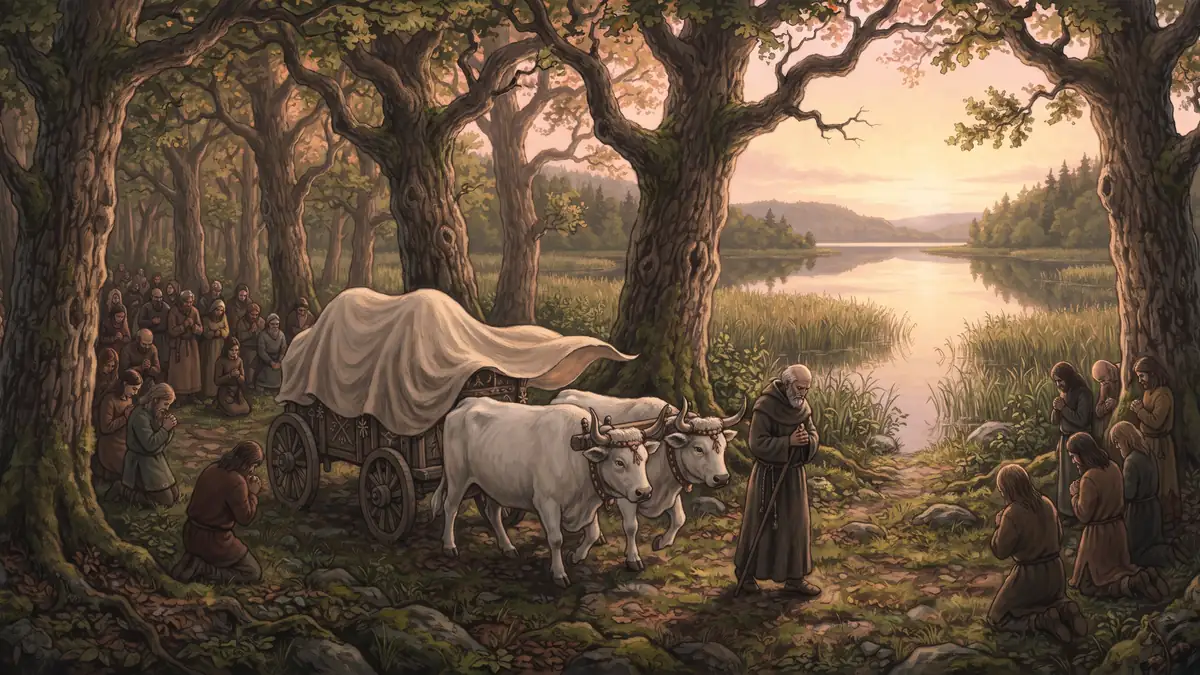
On an island in the Ocean there is a sacred grove and, in it, a wagon covered with cloth, which only the priest may touch. Heifers pull it in a procession marked by festivity, peace and no iron weapons. Afterwards, the wagon, the cloth and the goddess herself are washed in a secluded lake, and the enslaved people who do the washing are drowned in it.
The name
Nerthus corresponds to Proto-Germanic *Nerþuz, the precursor of Old Norse Njörðr, a god tied to wagons and water, father of Freyr and Freyja and a member of the Vanir. Here there is a problem: Tacitus describes Nerthus as a woman, and Njörðr is a man. Paired deities, hermaphroditism, a change of gender over time or a mistake by Tacitus have been proposed. Njörun and Njörðr’s sister-wife have been suggested as possible traces of a female counterpart. The article does not decide among these hypotheses: it only notes that the Proto-Germanic name is the same.
Wagons in bogs
Wagons found in Danish bogs, at Dejbjerg, and the Oseberg ship burial in Norway are often compared to the wagon of the rite, but the link is interpretive, not demonstrated.
What remains uncertain
The meaning of the name is unclear. “The powerful one” has been suggested, and links with “contentment” or “north”. The place is doubtful: Denmark is the usual guess, and Zealand has been proposed. Tacitus’s sources are unknown. The reading “Hertha”, once popular in older studies, is now rejected by most, and the discovery of the Codex Aesinas, in 1902, supports “Nerthus”.
A prudent reading
Since the rite is known from Tacitus’s description, and he does not say where he took it from, it is wise to treat the account as what an outside observer recorded, not as the testimony of someone who took part. The description of peace and the drowning of the enslaved sit in the same paragraph, and the article does not explain that tension.
To steer a wagon through a grove full of obstacles, play Nerthus’s wagon.
Sources.
- Wikipedia, "Nerthus" (Tacitus, Germania ch. 40; Proto-Germanic *Nerþuz and Njörðr; uncertainties of place, gender and manuscript reading)