The nuckelavee of Orkney: the horse demon that will not cross fresh running water
The nuckelavee is a creature of Orkney folklore, in Scotland, half horse and half man and skinless, that cannot bear fresh running water. See what the source consulted gathers on the origin, the first record, the appearance and the Mither o' the Sea.
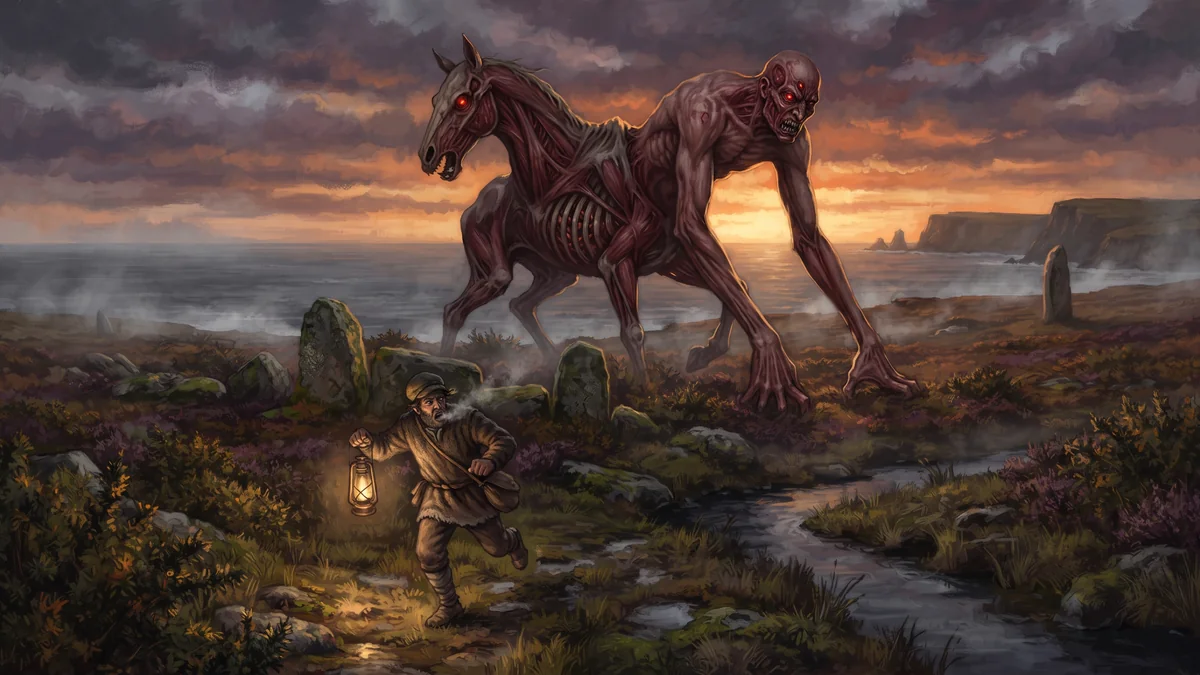
The nuckelavee is a creature of Orkney folklore, islands in the north of Scotland. According to the source consulted, it probably arose from a blend of a Celtic water horse and a creature brought by the Norse, since Orkney folklore was strongly marked by Scandinavian influence.
Where
The form is from Orkney, and a related figure, the mukkelevi, appears in Shetland, which shows that the creature was not restricted to a single archipelago. The article does not describe the mukkelevi or say how much it resembles the nuckelavee.
The first record
It may appear in the sixteenth-century Latin manuscripts of Jo Ben, but it is uncertain whether Jo Ben was speaking of this creature. The main written record is the transcriptions of Walter Traill Dennison, published between 1880 and 1894.
The appearance
According to the article, it is a horse-shaped creature, with a human torso on its back, one fiery red eye, fin-like appendages on its legs and no skin, so that the veins and muscles can be seen. Accounts vary in details, such as the number of heads.
The weakness
The nuckelavee cannot tolerate fresh running water, so a victim can escape by crossing a river or stream. That is where the design of the game in this batch comes from: a race to the water, which the monster cannot enter.
The Mither o’ the Sea
The Mither o’ the Sea is an ancient Orcadian spirit and the only being able to control the nuckelavee. According to the article, she keeps it confined during the summer months. The text does not say what happens in the other months, and it is prudent not to fill that gap.
Choosing a version
Since the accounts vary in details, such as the number of heads, anyone retelling the figure must choose a version and say which. The game in this batch uses only the weakness and the race to the water, which the article records.
One possible reading
The mixture of Celtic and Norse elements, which the article proposes, suggests that the figure arose from contact between peoples. That is a hypothesis, not a recorded fact: the text says “probably”.
What remains uncertain
The origin is probable, not demonstrated. The link of the name to Jo Ben’s manuscript is doubtful. The descriptions differ, and the article does not choose one. And, since the most cited written record is from the late nineteenth century, it is not known how much of the stories collected by Dennison goes back to older times.
To escape to fresh running water with the monster behind you, play The nuckelavee on the moor.
Sources.
- Wikipedia, "Nuckelavee" (origin, record by Walter Traill Dennison, appearance, weakness, Mither o' the Sea)