Fagrskinna, the "Fair Parchment": the history of the kings of Norway written around 1220
Fagrskinna is a history of Norway from the 9th to the 12th century, written around 1220 by an unknown author. See what the source consulted gathers about the period it covers, the skaldic verses, the likely sources, the link with Morkinskinna and Heimskringla and what the text does not allow us to claim.
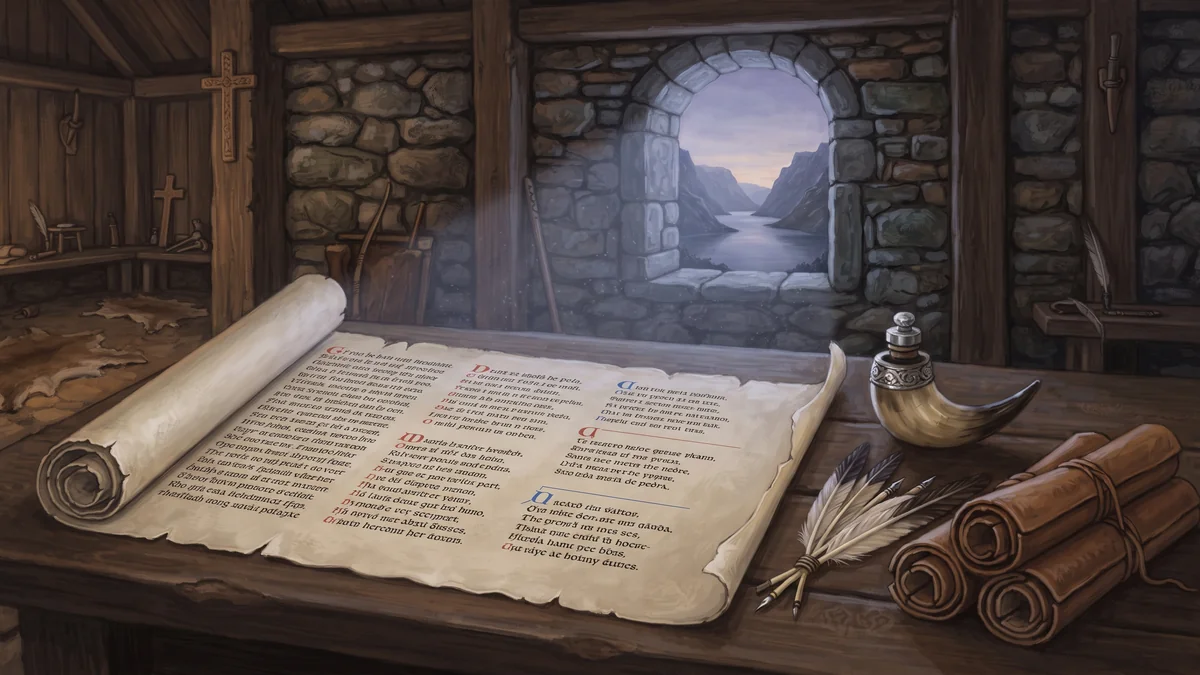
Fagrskinna is a history of the kings of Norway, written in Old Norse. The source consulted dates it to about 1220 and says the author is unknown: it is often thought to have been written in Norway, by an Icelander or by a Norwegian.
What it covers
The text narrates the history of Norway from the 9th to the 12th century, from the career of Halfdan the Black to the battle of Re in 1177. The article says it emphasizes battles and cites many skaldic verses, some of which are preserved nowhere else. That preservation is part of the work’s value: the verses are a form of record from the period that the surrounding prose only arranges.
The name
Fagrskinna means “Fair Leather”, or “Fair Parchment”. The article explains that the name comes from one of the manuscripts that preserved it, and refers to the type of parchment.
The sources and the relatives
Morkinskinna, from about 1220, is one of the written sources proposed as most decisive for Fagrskinna. The article also places it as an immediate source of Snorri Sturluson’s Heimskringla. In addition, Fagrskinna probably drew on a lost version of the Ágrip af Nóregs konunga sögum, from about 1190, one among several proposed sources.
The manuscripts
The original manuscript was destroyed by fire. Copies of it and of another parchment survived, and the text reaches us by that route.
Terms
Skald is the Norse court poet; kings’ saga is a prose narrative about kings; Ágrip is an earlier history, from about 1190, which the article cites as a possible source; the battle of Re is the point at which the account ends.
Four texts in relation
The article places Fagrskinna in the middle of a small family of texts. The Ágrip, from about 1190, appears as a possible source. Morkinskinna, from about 1220, is named as a decisive written source. Snorri Sturluson’s Heimskringla uses Fagrskinna as an immediate source. Anyone reading one of these texts is therefore also reading echoes of the others, and the similarities between them need to be read with that in mind.
Why the verses matter
Since the work cites many skaldic verses, and some exist only in it, losing Fagrskinna would mean losing those verses. The article does not detail how many there are, or which, and this piece does not invent numbers.
What remains uncertain
The author has not been identified, and the origin in Norway or Iceland is not settled. The main sources are “proposed”, not confirmed. And since the original is lost, the text exists only in copies, which means reading the work with the caution one has before any text that arrived at second hand.
To find, among turned-over sheets, the seals that repeat in pairs, play The seals of Fagrskinna.
Sources.
- Wikipedia, "Fagrskinna" (date, authorship, coverage, sources, relation to Morkinskinna, Heimskringla and Ágrip, manuscripts, meaning of the name)