Hauksbók, the book of Haukr Erlendsson: the manuscript that gathers the Landnámabók, the Völuspá and a treatise on arithmetic
The Hauksbók is an Icelandic manuscript from the early 14th century, put together by Haukr Erlendsson. See what the source consulted gathers about the dating, the contents, the three parts into which the book was divided and why the copied texts may differ from the originals.
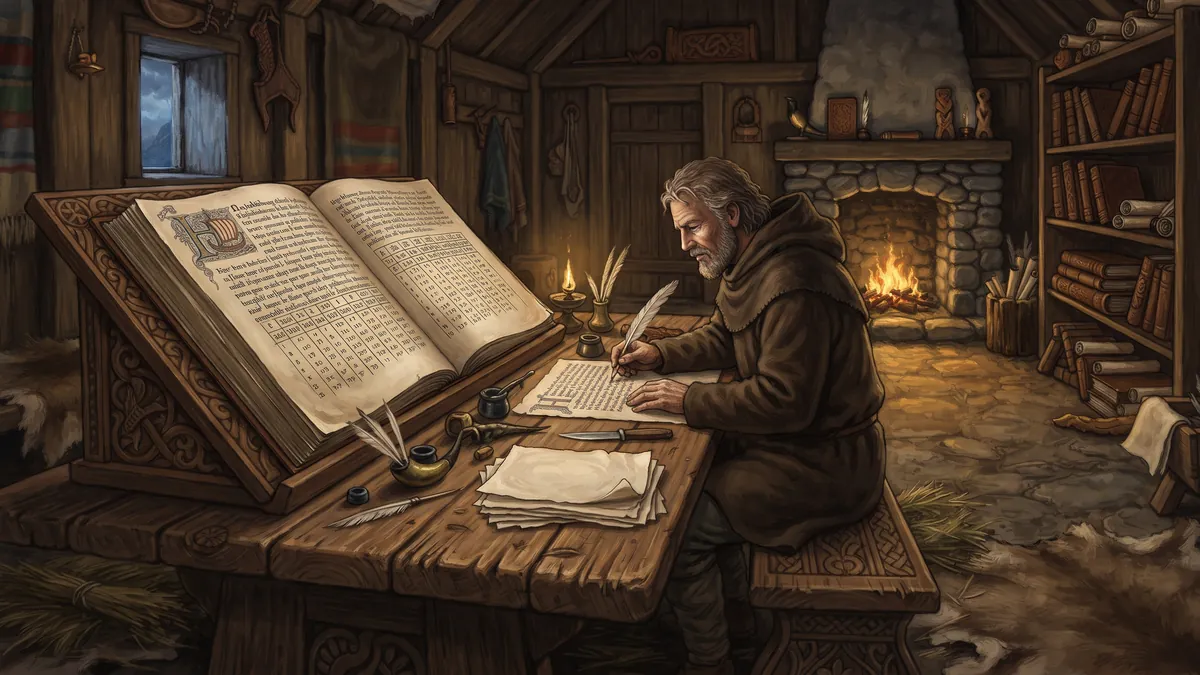
The Hauksbók is an Icelandic manuscript. The source consulted says the compiler was Haukr Erlendsson, an Icelandic lawspeaker. Several scribes worked on the book, but most of it is in his hand.
The date
Professor Stefán Karlsson dated the manuscript to 1302–1310, on palaeographical evidence, that is, from the study of the handwriting.
The contents
The book gathers texts of very varied nature. Among them are a revised version of the Landnámabók, the Kristni saga, the Völuspá, the Trójumanna saga, the Breta sögur, with the Merlínússpá, the Hervarar saga ok Heiðreks, the Fóstbrœðra saga, the Algorismus, a mathematics section, and the Eiríks saga rauða, the saga of Erik the Red. There are also the Skálda saga, the Ragnarssona þáttr, and short pieces: the Hemings þáttr, a Latin list of church festivals, the Cisiojanus, two dialogues between soul and body and encyclopaedic material on geography, theology and philosophy.
The three parts
The book was originally a single volume, but is now divided into three parts, AM 371 4to, AM 544 4to and AM 675 4to, held at the Árni Magnússon Institute in Reykjavík.
Terms
Codex is the manuscript book of bound pages; palaeography is the study of old handwriting used to date a manuscript; lawspeaker is the office the article attributes to Haukr; Algorismus is the mathematics section; þáttr is a short tale.
A collection of genres
Looking at the list, what one sees is a book that mixes history, saga, poetry, mathematics and encyclopaedia. The Landnámabók and the Kristni saga deal with the settlement and conversion of Iceland; the Völuspá is poetry; the Algorismus is arithmetic; the Breta sögur and the Trójumanna saga bring matter from outside Iceland; the dialogues between soul and body are religious texts. The article does not say why Haukr put all this together, and this piece does not try to guess.
One book, three parts
In saying that the book was one volume and is now three parts, the article recalls that what is studied today is not the original object, but fragments of a larger object, kept under different shelf marks in the same institute.
What remains uncertain
Significant portions are lost. Haukr copied mostly from older manuscripts, now lost, and tended to rewrite and shorten the sagas, so his texts may differ from the originals. The article links the book to Haukr Erlendsson, but describes the link as an “association”, and does not state without reservation that he was the author of everything. Finally, the folio ranges in the article’s list of contents are not consistent with one another, and so this piece does not repeat them.
To add numbers up to the sum asked for, as in a passage of the Algorismus, play Haukr’s algorism.
Sources.
- Wikipedia, "Hauksbók" (compiler, date according to Stefán Karlsson, contents, parts AM 371 4to, AM 544 4to and AM 675 4to)