Íslendingabók, the "Book of Icelanders" by the priest Ari Þorgilsson: what it tells
The Íslendingabók is a short history of Iceland written by the priest Ari Þorgilsson between 1122 and 1133. See what the source consulted gathers about the settlement, the Althing, the calendar, Greenland, the conversion around the year 1000 and the 17th-century copies.
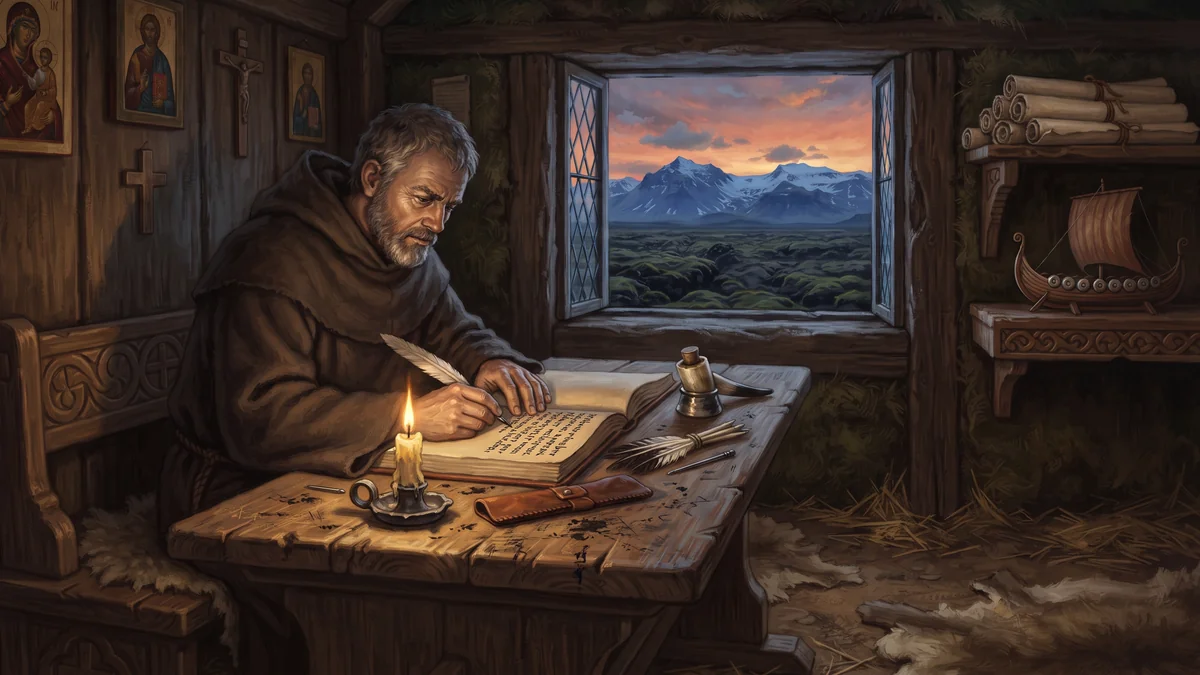
The Íslendingabók, “Book of Icelanders”, is a short history of Iceland. The source consulted attributes it to the priest Ari Þorgilsson and dates it, according to scholars, between 1122 and 1133, from the prologue’s references to Bishops Þorlákur Runólfsson (1118–1133) and Ketill Þorsteinsson (1122–1145).
The two versions
The work originally existed in two versions, but only the younger has survived. The older one covered the kings of Norway and was used by later writers of kings’ sagas.
What it tells
The settlement of Iceland took place in the reign of Harald I of Norway. The first settler was Ingólfur Arnarson, who arrived at the site of Reykjavík, and the land was covered in forest.
Úlfljótr brought the laws from Norway, the Althing was founded at Þingvellir, and Úlfljótr became the first Lawspeaker. Around 955, Þorsteinn surtr proposed adding a week every seven years to correct the calendar. Þórðr gellir proposed dividing the country into judicial quarters, with an amendment giving the north four assemblies.
Greenland was settled from Iceland around 985. As for the conversion, King Olaf I sent the missionary Þangbrandr, who met opposition. At the Althing, around 999 or 1000, Þorgeirr Ljósvetningagoði ruled that everyone should adopt Christianity, with three concessions to the pagans, later abolished.
The manuscripts
Two paper manuscripts of the 17th century, AM 113 a fol. and AM 113 b fol., are the basis of modern editions and are held at the Árni Magnússon Institute in Reykjavík. The priest Jón Erlendsson, who died in 1672, copied both from the same exemplar at the request of Bishop Brynjólfur Sveinsson, and the first copy dates from 1651.
Terms
Althing is the national assembly, founded at Þingvellir; “Lawspeaker” is the translation used in the article for the office that Úlfljótr was the first to hold; “judicial quarters” are the four divisions of the country proposed by Þórðr gellir. The article also recalls that the older version, which dealt with the Norwegian kings, was used by writers of kings’ sagas, and that gives the book a place in the history of texts other than itself.
What the text is for
What survives of the Íslendingabók is a short book that arranges the settlement, the laws, the calendar, Greenland and the conversion on a single timeline. It is the basis of modern editions, and so almost everything said of it today passes through Jón Erlendsson’s copies.
What remains uncertain
The medieval exemplar, probably from around 1200, was lost in the late 17th century, and so was the older version about the Norwegian kings. The dating depends on the prologue’s mentions. The account of Grímr Goatshoe’s exploration is unclear, and the article says he was probably looking for a meeting place. Dates such as that of the calendar reform and that of the conversion are approximate.
To arrange, one by one, the scrolls of a stack of laws, play Ari’s scrolls.
Sources.
- Wikipedia, "Íslendingabók" (authorship, date, versions, content, manuscripts AM 113 a and b fol., Jón Erlendsson)