Jón Árnason and the folktales of Iceland: the collection published in Leipzig in 1862 and 1864
Jón Árnason (1819–1888) was a librarian in Iceland and gathered the Íslenzkar þjóðsögur og æfintýri, published in two volumes in Leipzig. See what the source consulted gathers about his life, the partnership with Magnús Grímsson, Konrad Maurer's encouragement, the influence of the Brothers Grimm and the later editions.
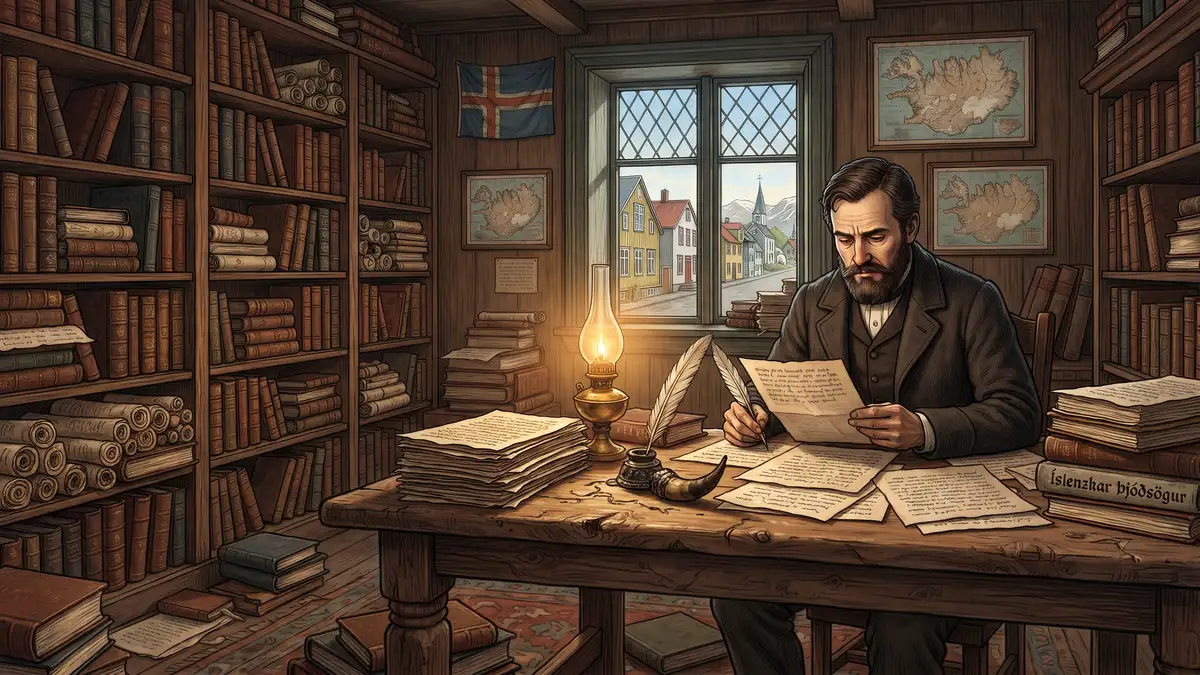
Jón Árnason was born on 17 August 1819 in Hof, Iceland, and died on 4 September 1888 in Reykjavík, aged 69. The source consulted gathers what is known of his life and of the collection that made him known.
The librarian
From 1848 to 1887, Jón was the first librarian of what became the National Library of Iceland. In 1881, his title changed to National Librarian. He was also the first curator of the Icelandic Antiquities Collection, which became the National Museum of Iceland.
The partnership
He and Magnús Grímsson gathered folktales together. Their first collection, Íslenzk Æfintýri, appeared in 1852 and attracted little notice. They resumed the work after Konrad Maurer toured Iceland in 1858 and encouraged them. Magnús died in 1860, and Jón finished the collection alone.
The publication
The collection was published as Íslenzkar Þjóðsögur og Æfintýri, in two volumes, in 1862 and 1864, in Leipzig, with Maurer’s help. It runs to more than 1,300 pages. Jón was inspired by the Brothers Grimm’s Kinder- und Hausmärchen.
The elves
The article mentions the elves, álfar: the survey of Icelandic folklore and elf lore in the collection’s introduction provided the framework in which J. R. R. Tolkien conceived his elves.
The reissues
The collection was reissued in Reykjavík, in six volumes, between 1954 and 1961.
Terms
Þjóðsögur means “stories of the people”; æfintýri means “adventure tales”; álfar are elves; curator is one who looks after a museum collection. The terms are in the title of the collection and in Jón’s office, and they sum up his work: keeping, on one side, what the people told and, on the other, the old objects of the country.
In numbers
Jón’s life spans 69 years; the office of librarian, 39 years, from 1848 to 1887; the collection of 1862 and 1864 has two volumes and more than 1,300 pages; the reissue of 1954 to 1961 has six volumes. These are the numbers the article gives, and they show long-lasting work, done alongside an office.
Who pushed the project
The article gives weight to two names: Konrad Maurer, whose journey of 1858 revived the work, and the Brothers Grimm, whose collection inspired Jón. Between the two, Magnús Grímsson appears as the partner who did not live to see the collection published.
What remains uncertain
The article says Jón or Magnús may have “touched up” the wording of the tales, but that the known changes are slight. It observes that Icelandic stylistic tastes differed little from those of the rest of Europe, which may reduce the effect of any editing. A footnote says the manuscript was discovered in Munich in 1971. The article does not organise the tales into categories such as trolls or ghosts, and neither does this piece.
To link four tokens in a row, like pulling the thread of a tale, against an opponent, play The threads of Jón’s tales.
Sources.
- Wikipedia, "Jón Árnason (author)" (life, librarian, Magnús Grímsson, Konrad Maurer, publication in 1862 and 1864, Grimm, edition of 1954–61)