The Mestermøy, the master maid: Asbjørnsen and Moe's tale and the “magic flight”
The Mestermøy is a Norwegian tale from Asbjørnsen and Moe's collection, tied to the "magic flight" type. See what the source consulted gathers about who told it, the plot, the giant's tasks, the flight, the forgotten bride, the variants and what remains uncertain.
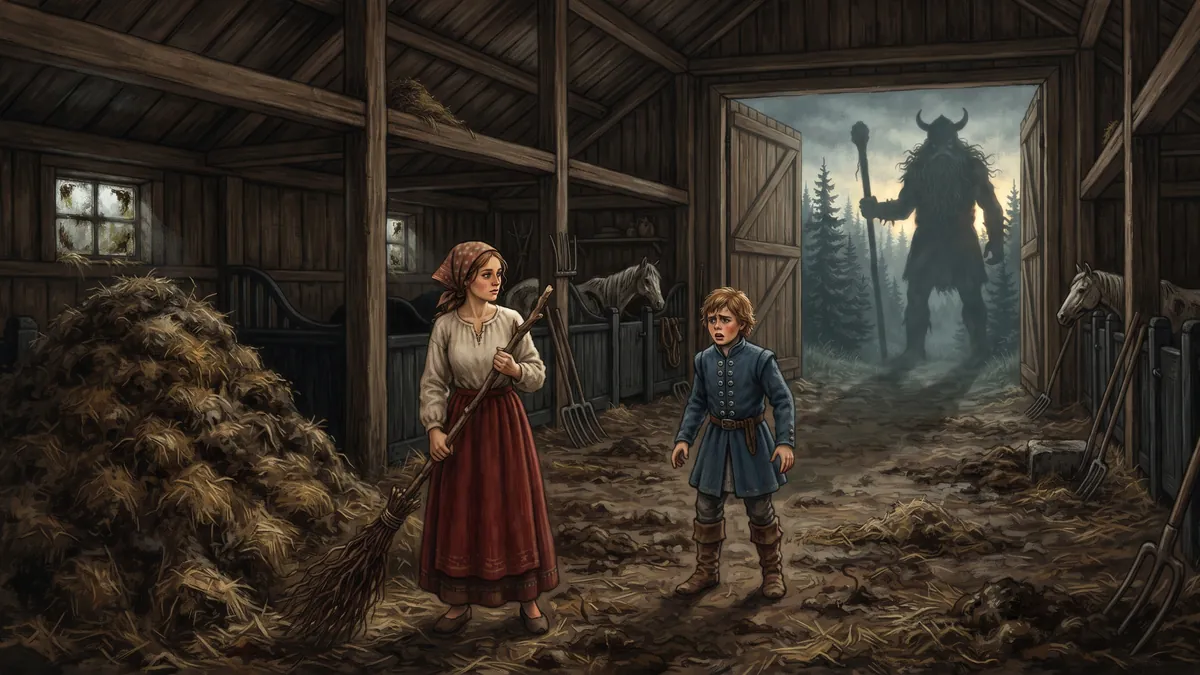
The Mestermøy, in English The Master Maid, is a Norwegian tale from the collection Norske Folkeeventyr, by Peter Christen Asbjørnsen and Jørgen Moe. The source consulted says Moe wrote it down from the storyteller Anne Godlid, in Seljord, in the autumn of 1842. George Dasent translated it into English in 1859, and Andrew Lang included it in the Blue Fairy Book of 1889.
The tale type
The tale is type 313 of the Aarne–Thompson classification, “The Magic Flight”, in which the hero and a helper escape an antagonist by transforming or using magic objects. There is a subtype, that of the “forgotten fiancée”, ATU 313C. Ørnulf Hodne calls this type “Mestermø” in his classification of Norwegian tales.
The plot
A king’s youngest son works for a giant, who forbids him to enter certain rooms. The young man disobeys and finds the Mestermøy, who helps him complete three tasks: cleaning the stables, bringing in a fire-breathing horse and fetching the “fire tax” from Hell.
On the fourth day, the giant orders her to kill and stew the prince. She puts a decoy in his place, and the two flee by sea. Her magic items, among them salt and water, create obstacles that stop the giant.
At the prince’s home, he forgets her after eating an apple given by a wedding guest. She stays in a hut and uses her gold to frighten off three pursuers. Her golden apple and her chickens restore the prince’s memory, and he marries her. The rival bride’s sister is killed as a witch.
Variants
The article names related tales: “The Two Kings’ Children”, “The Water Nixie”, “Nix Nought Nothing” and “Foundling-Bird”. Scholars link the magic flight motif to the Greek myth of Jason and Medea. It also cites a Serbian variant, “The Golden-Fleeced Ram”, and Laboulaye’s “Yvon and Finette”.
Terms
Magic flight is the motif in which fugitives throw objects that turn into obstacles; forgotten fiancée is the subtype in which the hero forgets the helper; ATU is the abbreviation of the international catalogue of tale types, successor to the Aarne–Thompson classification; Mestermø is the Norwegian name of the type. Of the objects the article speaks of, it cites salt and water, without listing the others.
What remains uncertain
The article says the girl who helps the hero “may be” the giant’s daughter or one of his daughters, so her identity is not fixed. The protoform proposed by Joseph Jacobs is a reconstruction, not a recorded text. The link to Shakespeare’s The Tempest is described as a “possible antecessor”, not a confirmed source. And the article gives “Devil’s Daughter” as an alternative name, without explaining how widely it is used.
To put the bales of a stable in order, one empty space at a time, play The Mestermøy’s stable.
Sources.
- Wikipedia, "The Master Maid" (Norske Folkeeventyr, Anne Godlid, type ATU 313, plot, variants, translations by Dasent and Lang)