Níðhöggr, the dragon that gnaws the roots of Yggdrasill: what the texts say
Níðhöggr is, in the Norse sources, the being that gnaws one of the roots of the world ash and feeds on corpses in Náströnd. See what the source consulted gathers about the Gylfaginning, the Grímnismál, the Völuspá, the squirrel Ratatoskr and the debated meaning of the name.
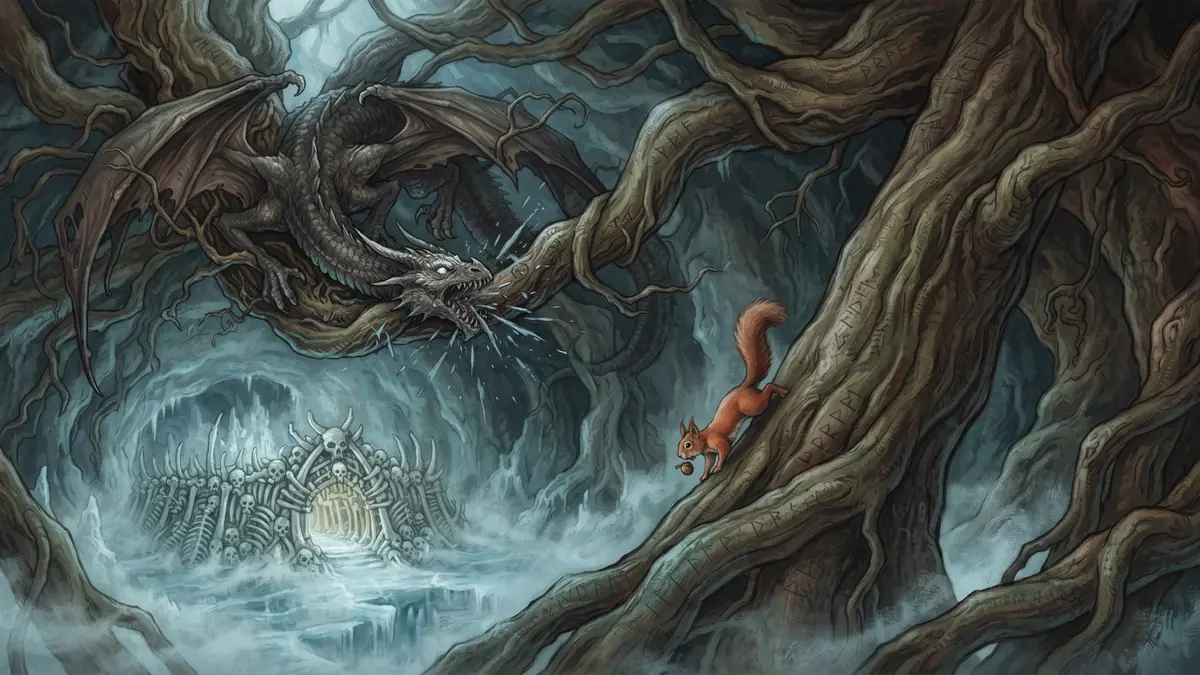
Níðhöggr, also written Nidhogg, is a being of the Norse sources tied to the tree Yggdrasill and to the realm of the dead. The source consulted gathers what three texts say of him.
What the sources say
In the Gylfaginning, Níðhöggr gnaws one of the three roots of Yggdrasill, the one that lies over Niflheimr; the article says he gnaws it from beneath. In the Grímnismál, he tears at the tree from below, and the poem names the squirrel Ratatoskr as messenger between him and the eagle. The article observes that Snorri clearly used this poem as a source.
In the Völuspá, Níðhöggr appears twice. The first time, he sucks corpses in the hall at Náströnd. The second, near the end, he is called a dragon and serpent who arrives from the Niðafjöll.
The squirrel
Ratatoskr runs up and down the ash, “bearing envious words” between the eagle and Níðhöggr, according to the Gylfaginning and the Grímnismál.
Náströnd
According to the Völuspá, Náströnd is a hall of serpents’ spines. The article says it is the realm of the serpents, separated from the rest of Hel by the river Gjallar, made of their poison. Souls denied passage over the Gjallarbrú end up there, and so does Loki. Among the dead on whom Níðhöggr feeds, the article names murderers, adulterers and oath-breakers.
The name
The ending -hǫggr means “hewer”, “biter” or “striker”. The beginning is uncertain. It may be niðr, “down”, which would give “Biter Below”; it may be níð, a term of social stigma, which would give “Malice Biter”; or it may relate to niða-, “dark”, which would give “Striker in the Dark”, with no known cognates.
Terms
Yggdrasill is the world ash; Niflheimr is the region over which the gnawed root lies; Náströnd is the hall of serpents’ spines; Gjallar is the river of poison; Ratatoskr is the messenger squirrel. Each appears in a different text, and the article shows Níðhöggr at the point where they cross: beneath the tree, among the roots, the dead and the poison.
How to read the three sources
The Gylfaginning and the Grímnismál put him at the root of the tree, busy gnawing it. The Völuspá puts him among the dead and, at the end, in the air, as a dragon. These are two different images, and the article does not reduce them to one.
What remains uncertain
The meaning of the end of the Völuspá is debated. The more common reading sees in Níðhöggr’s arrival a sign of Ragnarök; another sees renewal or redemption, with the serpent carrying the dead away. The stanza before the ending is considered spurious by the translator Henry Adams Bellows. The article also notes that Níðhöggr is not mentioned in any other ancient source, and that the length of the vowel at the start of the name is not settled in the texts.
To undo, knot by knot, the damage to a gnawed root, play Níðhöggr’s roots.
Sources.
- Wikipedia, "Nidhogg" (Gylfaginning, Grímnismál, Völuspá; Náströnd; Ratatoskr; etymology)