The Princess on the Glass Hill: the youngest son, the horse and the three golden apples
In “The Princess on the Glass Hill”, the youngest son keeps watch over the meadow, wins a horse and, in three attempts, climbs the glass hill and takes the princess’s three golden apples. See the plot, the ATU 530 type and the hypotheses about the tale’s origin, which remain disputed.
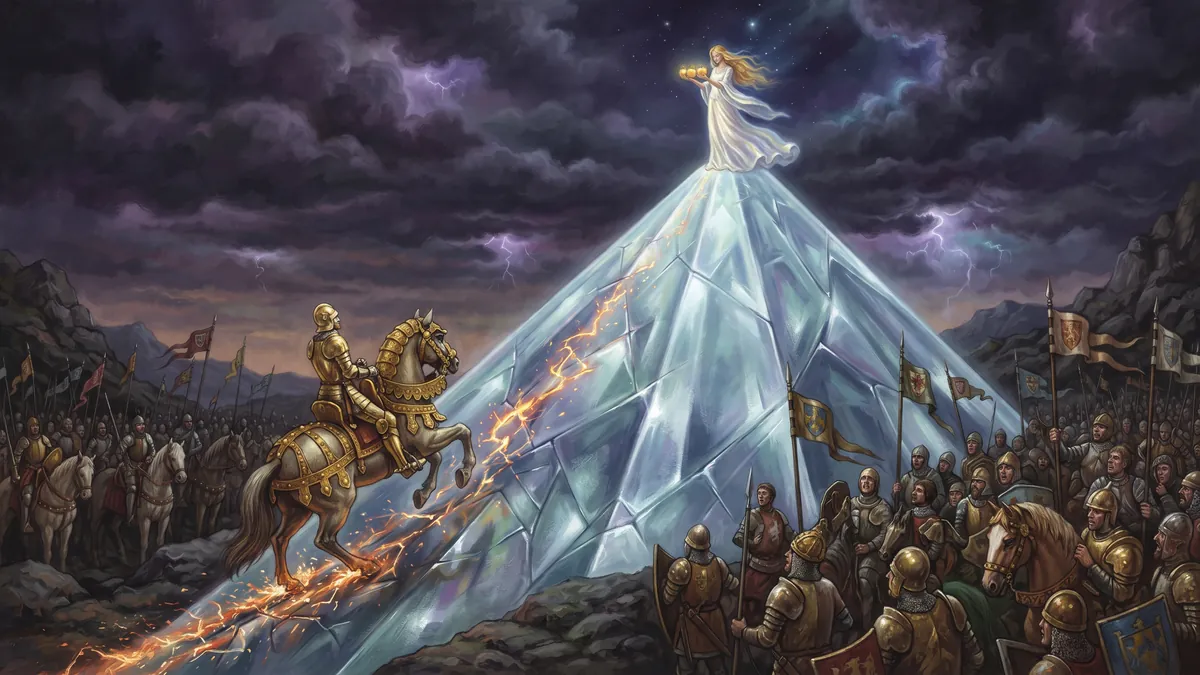
“The Princess on the Glass Hill”, in Norwegian Jomfruen på glassberget, also known as “The Maiden on the Glass Mountain”, is a Norwegian tale that Peter Christen Asbjørnsen and Jørgen Moe gathered in Norske Folkeeventyr. The source consulted for this piece summarises the plot, classifies the tale and lists variants and hypotheses about its origin. The first half of the article was read, and this piece keeps to it.
The plot
A farmer’s hay meadow is eaten every year on Midsummer Eve. He sends his sons to guard it, one at a time. The two eldest are frightened off by earthquakes. The youngest, called Boots or Cinderlad, stays through three earthquakes and catches a horse. He tames the animal with steel from his tinderbox. The gear is brass the first year, silver the second and gold the third. He tells his family nothing.
The glass mountain
A king’s daughter sits on a glass mountain holding three golden apples. Whoever takes them wins the girl and half the kingdom. The brothers leave Boots behind. A knight in brass armour rides a third of the way up and takes an apple. In the next trial, in silver, he gets two-thirds of the way and takes the second. In gold, he reaches the top, takes the third and escapes unidentified.
The outcome
The king summons everyone. The brothers say that Boots sat in the ashes the whole time. Boots produces the apples, marries the princess and receives half the kingdom.
Classification and relatives
The tale is Aarne–Thompson–Uther type 530, named after the glass mountain. Scholars divide the plot into two parts: how the magical horse is acquired and the feat on the mountain. Related types include 531, 533, 550 (The Golden Bird, for the vigil motif), 314, 502 and 532. Bolte, Polívka and Cox called the hero a “male Cinderella”, hence English titles such as “Ashboy” or “Ashlad”.
Variants around the world
Hodne listed 33 Norwegian variants. There are versions in Sweden, Denmark and Finland. In Germany, Ranke reported more than 60 variants, among them the Grimms’ Old Rinkrank (KHM 196). There are also versions in eastern Europe and the Caucasus, the Baltic countries, Ireland, the Iberian Peninsula, Italy, Latin America, Turkey and Iraq. Archive counts vary by study: Estonia has 157 to 180, Lithuania 254 to 330 and Latvia about 420.
Terms
ATU 530 is the numbering of the tale type. Boots and Cinderlad are English names for the youngest-son hero. Norske Folkeeventyr is the collection by Asbjørnsen and Moe. An oikotype is a regional version of a tale type.
What remains uncertain
The origin of the tale is disputed. Von Sydow, El-Shamy, Cosquin and Ranke suggest roots in the Egyptian tale of the Doomed Prince, which has the tower motif; Boberg attributed it to a horse-riding people of the Indo-European period; Honti disagreed; Krohn proposed migration from India; Dzagurov proposed a southern, perhaps Caucasian origin and considered the glass mountain motif late. The reading of the horse’s colours and the comparisons with Brunhilde and with the Hungarian táltos horse are interpretations, not proven links.
To climb the slope and gather the apples, dodging the stones that come down, play The climb of the glass mountain.
Sources.
- Wikipedia, "The Princess on the Glass Hill" (Norske Folkeeventyr; plot; type ATU 530; variants in Norway, Germany, Scandinavia, the Baltic countries, Ireland and elsewhere; origin hypotheses of von Sydow, Boberg, Honti, Krohn and Dzagurov; partial reading of the article)