Angrboða, the giantess of Járnviðr: mother of Fenrir, Jörmungandr and Hel
Angrboða appears little in the sources: the Völuspá hin skamma names her as Loki's mate, the Gylfaginning gives her three monstrous children and the Völuspá speaks of an old woman in the Iron Wood. See what is attested, what is inference and why the name may be late.
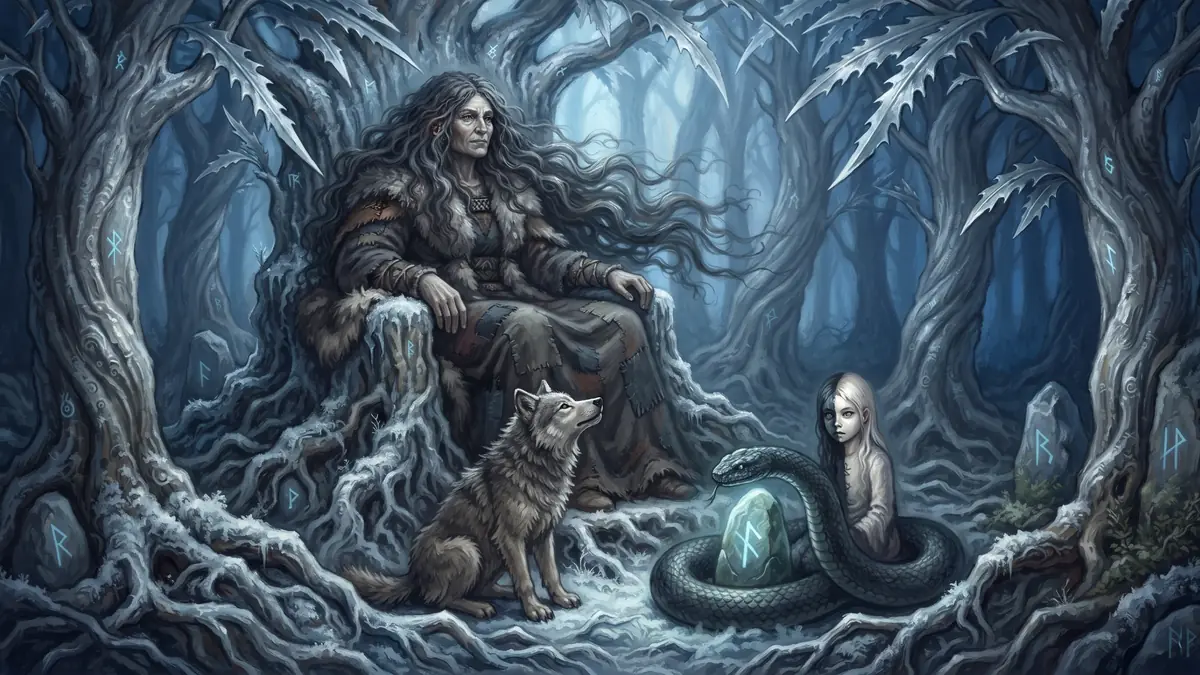
Angrboða is a giantess, a jötunn, of Norse mythology, presented as Loki’s mate and the mother of monsters. The source consulted for this piece shows that the sources say little about her, and that part of what is said is inference. This piece separates what is attested from what scholars deduce.
What the texts say
The Völuspá hin skamma, the “Short Völuspá”, is the poem that names her as Loki’s mate and the mother of the wolf Fenrir. The article states that this is the only mention of her in the Poetic Edda. In the Gylfaginning, of the Prose Edda, she is called a giantess in Jötunheimr, and the three monstrous children she had with Loki are named there.
The three children
According to the Gylfaginning, the children are Fenrir, the wolf, Jörmungandr, the Midgard serpent, and Hel, who rules the dead. The article also recalls that, in the Völuspá hin skamma, Loki also sired Sleipnir on Svaðilfari, but Angrboða is not named as Sleipnir’s mother.
The old woman of the Iron Wood
In stanza 40 of the Völuspá, an “old woman” in Járnviðr raises the kin of Fenrir. Scholars most likely identify her with Angrboða. The Gylfaginning paraphrases this passage: a giantess east of Midgard, in Ironwood, breeds giant sons in wolf shapes, and one of them, called Moongarm in the cited translation, will devour the sun and fill the sky with blood. In stanza 42, Eggþér appears as herder of the giantess who lives in Járnviðr.
The name
The Old Norse name has been translated as “the one who brings grief”, “she who offers sorrow” or “harm-bidder”. The first element means “trouble, affliction”, and also “grief”, and was borrowed into English as anger. The second element derives from Proto-Germanic *beudan, “to offer”.
Terms
A jötunn is a giant or giantess, and Járnviðr is the Iron Wood, where female giants live. Völuspá hin skamma is the “Short Völuspá”, a poem within the Hyndluljóð material. Gylfaginning is the part of the Prose Edda that lists the children. Eggþér is the herder of the giantess of Járnviðr, according to stanza 42. These terms show that the picture is assembled from pieces of different poems, not from a single account.
What remains uncertain
Some scholars consider the name Angrboða a late invention, no earlier than the 12th century. The tradition of three monsters born of Loki and a giantess may be older than the name. The identification of the giantess of Járnviðr with Angrboða is a deduction, described as “most likely”, and not an explicit attestation. Peter H. Salus and Paul B. Taylor suggest that Eggþér may have been Angrboða’s wolf-herder, which is also a hypothesis. The article does not deal with the Skáldskaparmál.
To watch a patch grow across a whole forest until it has a single colour, play The Iron Wood.
Sources.
- Wikipedia, "Angrboda" (Völuspá hin skamma, Gylfaginning, Völuspá stanzas 40 and 42, Járnviðr, children, meaning of the name, hypotheses of Salus and Taylor)