Heiðarvíga saga: the story of the heath-slayings, and the leaves that burned in Copenhagen
The Heiðarvíga saga follows descendants of Egill Skallagrímsson in disputes that end in killings on a heath. It survives badly: twelve leaves of its only manuscript burned in Copenhagen in 1728, and all that remains is a summary written from memory by Jón Grunnvíkingur.
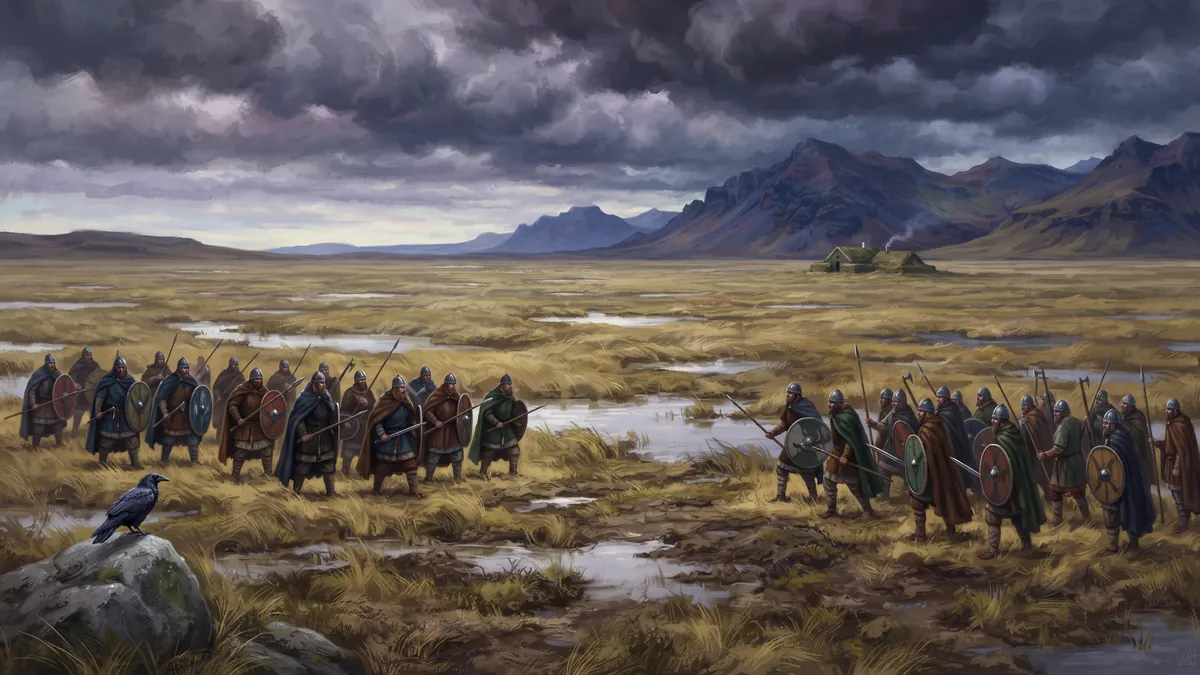
The Heiðarvíga saga, “the story of the heath-slayings”, is one of the sagas of Icelanders. The source consulted for this piece describes it as badly preserved, and that is the first thing the reader needs to know: part of the text was lost and is known only through a summary. This piece keeps to what the article carries, which is little, and says so where necessary.
A badly preserved saga
According to the article, the saga is “badly preserved”. Twelve leaves of its only surviving manuscript were destroyed, together with their only copy, in the fire of Copenhagen in 1728. For that reason it reaches the reader with a hole in the middle.
The summary from memory
The lost part is known only through a summary written from memory by the Icelandic scholar Jón Grunnvíkingur (1705–1779). That summary is the only surviving form of that content. The article says no more about how it was made, and this piece does not deduce what the summary may have left out.
What it tells
The saga follows the descendants of Egill Skallagrímsson. Long-standing disputes and conflicts between them culminate in a battle and subsequent slayings on the heath, which give the saga its name. The article names no other characters and gives no further detail of the plot.
One of the oldest?
Some scholars consider that the saga may be among the oldest sagas of Icelanders. The article gives no firm date and does not explain the reasoning behind this idea, so it stays as the opinion of part of the scholars.
Modern readings
The article lists recent studies. Joanne Shortt Butler (2020) examines how the gaps in the text affect the reader’s engagement with the narrative. Alexander Wilson (2022) discusses the “dissonant voices” in the saga’s prosimetrum, that is, in its mix of prose and verse. Jesse Byock (1993) treats feud in the Icelandic sagas, which bears on the disputes of the story. Viðar Hreinsson (1997) included the saga in a translation of complete sagas, and the Icelandic Saga Database offers the text and an English translation.
Terms
Heiðarvíga means “of the heath-slayings”. Prosimetrum is the mix of prose and verse in a single work. A lacuna is a stretch missing from a text. Jón Grunnvíkingur is the 18th-century scholar whose summary preserves the burned part.
What remains uncertain
The article gives no date of composition, nor the reason why it is considered possibly old. Jón Grunnvíkingur’s summary was made from memory, and what it carries of the lost stretch cannot be checked against the original manuscript, which burned. The article also does not describe Borgarfjörður as a setting, even though it appears in a bibliography title about the Borgarfjörður sagas.
To sweep a heath in search of hidden bands, play The heath of the fights.
Sources.
- Wikipedia, "Heiðarvíga saga" (loss of twelve leaves in the Copenhagen fire of 1728, Jón Grunnvíkingur's summary, plot, dating, bibliography of Finlay, Shortt Butler, Wilson, Byock and Viðar Hreinsson)