Heiðrún, the goat of Valhalla whose mead serves all the einherjar
The goat Heiðrún stands on Valhalla, eats the leaves of the tree Læraðr and mead runs from her every day. See what the Grímnismál and the Gylfaginning say, what the poem Hyndluljóð does with her name and why the etymology is debated.
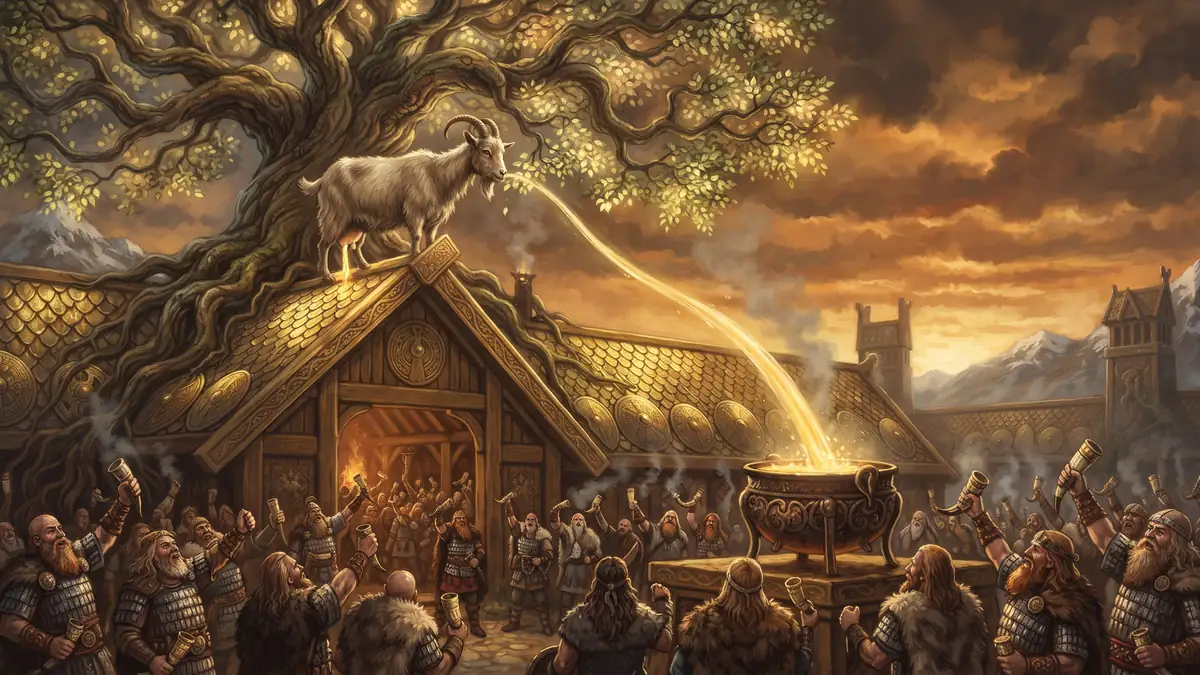
Heiðrún is a goat in Norse mythology who stands on Valhalla. The source consulted for this piece gathers the few lines the sources give her: what she eats, what runs from her, an insult in which her name appears and a hypothesis about the origin of that name. The article itself warns that the etymology is still debated and that it needs more citations, and this piece follows that caution.
What the two Eddas say
In the Poetic Edda, Heiðrún is mentioned twice. In the Grímnismál she is described in a way similar to what Snorri Sturluson wrote later. The Prose Edda describes her in the Gylfaginning, chapters 38 to 43, according to the article. Because Snorri quotes other stanzas of the Grímnismál, the article considers it reasonable that he knew the stanza about Heiðrún and used it as a source.
The leaves and the mead
Heiðrún is a nanny goat who stands on Valhalla. She eats the foliage of the tree Læraðr, which the article calls famous in the sources. Mead runs from her udders every day, and that mead fills a vessel. The amount is enough for all the einherjar to become fully drunk.
The goat in an insult
In the poem Hyndluljóð, the giantess Hyndla uses the term “Heiðrún” as an insult against the goddess Freyja. Thorpe and some other translators render it as “she-goat”. The article records the use but does not explain why that word would offend, and this piece does not go beyond what it states.
The stag and the name
The heavenly stag Eikþyrnir is linked to Heiðrún’s name. Anatoly Liberman proposes that Heiðþyrnir, the name of the lowest heaven in Scandinavian cosmology, formed from heið, “bright sky”, was split into two halves. From those halves the names of the goat Heiðrún and of the stag Eikþyrnir would have arisen. The element rún may have concealed several puns, but it is also a common suffix in female names.
Terms
Heiðrún is the name of the goat, and Læraðr is the tree she eats from. Eikþyrnir is the heavenly stag tied to her name. The einherjar are those who drink the mead in Valhalla. Heið means “bright sky”, and rún is the final element of the name. The article also lists English forms of the name, among them Heidrun, Heidhrun, Heithrun and Heidrún, which are only ways of spelling the same name.
What remains uncertain
The article says that the etymology of Heiðrún “remains debatable”, and the same is true of the modern German name Heidrun. Liberman’s hypothesis is a scholar’s proposal, not a fact. The article is also flagged as needing additional citations, so what it says about the Grímnismál and the Gylfaginning deserves to be checked in the texts themselves. There is no description of manuscripts here, and this piece cannot say more about the mead than the cited sources do.
To serve the mead in exact measures, with unmarked vessels, play Heiðrún’s mead.
Sources.
- Wikipedia, "Heiðrún" (Grímnismál, Gylfaginning, Hyndluljóð, the tree Læraðr, the stag Eikþyrnir, Liberman's hypothesis, debated etymology)