Hiisi: from sacred grove to demon, and the elk he made of rotten wood
In Finnish and Estonian, hiisi first named sacred places, then mythical beings, and finally something close to the Christian devil. See what the article says about cemeteries, magic songs, the Kalevala and Lemminkäinen's elk, and what is only speculation.
Hiisi is a term in the Finnic mythologies. The source consulted for this piece says it first denoted sacred places and later came to name mythical beings of several kinds. That path from place to being, and then to devil, is the thread of this piece, which rests on that single article and marks what it treats as speculation.
A place before a being
The article gives little etymology, but it recalls that in Estonian hiis is a sacred grove, usually of trees on elevated ground. Later the name of Hiisi appears as a proper noun, of a deity or spirit, possibly after the original meaning was lost. The plural is hiidet.
Grove and cemetery
Older works, such as Abercromby’s (1898), describe Hiisi as a spirit of hill forests. Mauno Koski and others proposed that hiisi and hiis were linked mainly to burial sites or the sacred areas around them, and that a secondary meaning applied to dominant or unusual features of the landscape. Tallgren (1933) pointed to 15 or 16 possible Hiisi sites, largely from place names, and Koski (1967) pointed to 14 Iron Age cemeteries, also from names. Wessman (2009) examined the link between those cemeteries and the Hiisi sites.
In the magic songs
Hiisi was tied to hills, mountains and forests, and to game and furs. Bishop Mikael Agricola’s list of pagan gods described him this way, next to Tapio. In spells, “Hiisi” served as a prefix for animals, diseases and afflictions, and sometimes in curses. Folk songs credit him with the origin of snakes, the aspen and iron. In riddles, a pine was “Hiisi’s elk”, and thunder was the neighing of “Hiisi’s horse”.
In the Kalevala
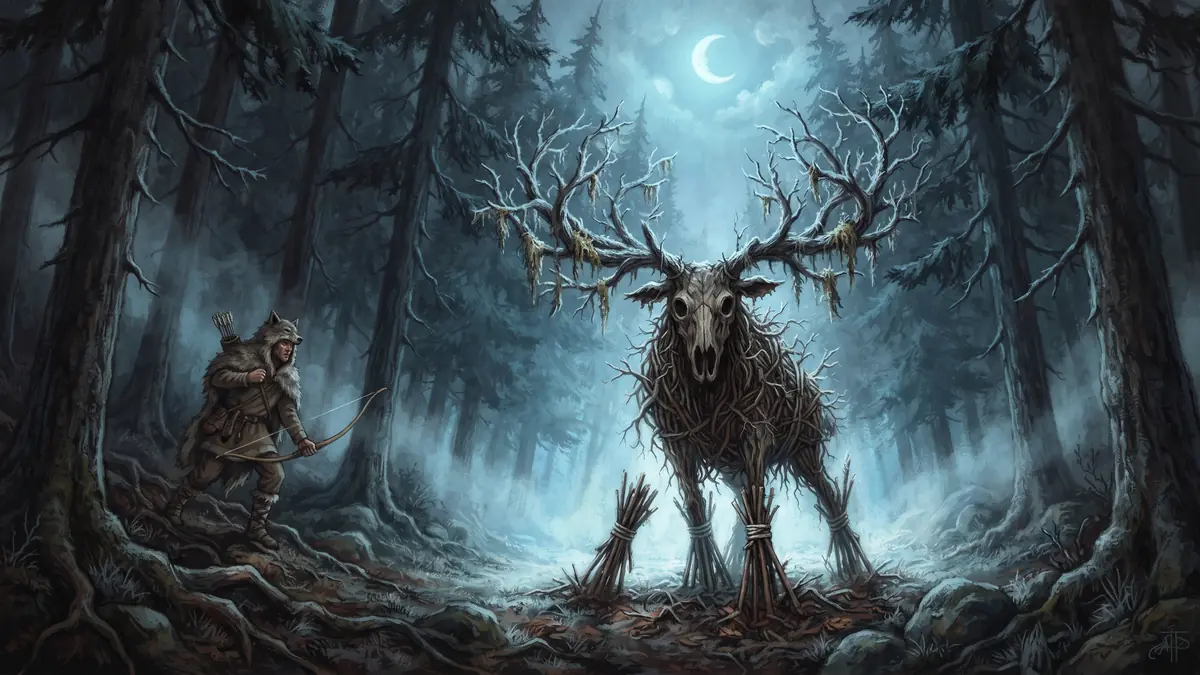
Hiisi appears in many runos. In the bowstring of Joukahainen, made from an elk of Hisi (runo VI), and in the blame he receives for Väinämöinen’s axe wound (runo VII). Lemminkäinen invokes him in spells and owns a sword forged or sharpened by Hiisi (runos XI and XII). Lemminkäinen’s hunt for the Hiiden hirvi, Hiisi’s elk, is the main quest of runo XIII: Hiisi builds it from rotten wood for the head, willow for the horns, and sticks and reeds for the rest. There is also the “fire-breathing steed of Hiisi” (runo XIV), a field of serpents ploughed by him (runo XIX) and the making of snakes (runo XXVI).
The Christian devil
Scholars suggest that Hiisi’s evil side grew stronger after Christianization, in the 12th and 13th centuries. In more recent folklore he is nearly identical to the Christian devil. In modern Finnish, hiisi and derivatives such as hitto are mild profanities.
Terms
Hiisi is the name, and hiidet is the plural. Hiis is the sacred grove in Estonian. A runo is each canto of the Kalevala. Hiiden hirvi is Hiisi’s elk. These terms show the path of the name: from the grove to the being who lives in it.
What remains uncertain
The article marks the link with cemeteries as more recent speculation. It says that the original meanings may have been lost after Christianization and that some folklore claims need a citation. According to it, the distinctions between early and late meanings rest on interpretation of limited evidence. There is also a letter by Cajanus (1674) that calls Hiisi a son of Kaleva, with no further detail.
To plant a numbered grove without repeating a single tree, play Hiisi’s grove.
Sources.
- Wikipedia, "Hiisi" (etymology, Estonian sacred grove, the cemetery hypothesis, magic songs, Agricola, Kalevala runos VI to XXVI, the Christian devil; relies on Abercromby, Lönnrot, Tallgren, Koski and Wessman)