Kari Trestakk: the dun bull, the stepmother and the golden shoe in a tale by Asbjørnsen and Moe
In Kari Trestakk, a dun bull feeds a girl persecuted by her stepmother and fights trolls in copper, silver and golden woods. See the plot, the tale's classification among Cinderella types and what is known of Norwegian variants and the alleged Sámi version.
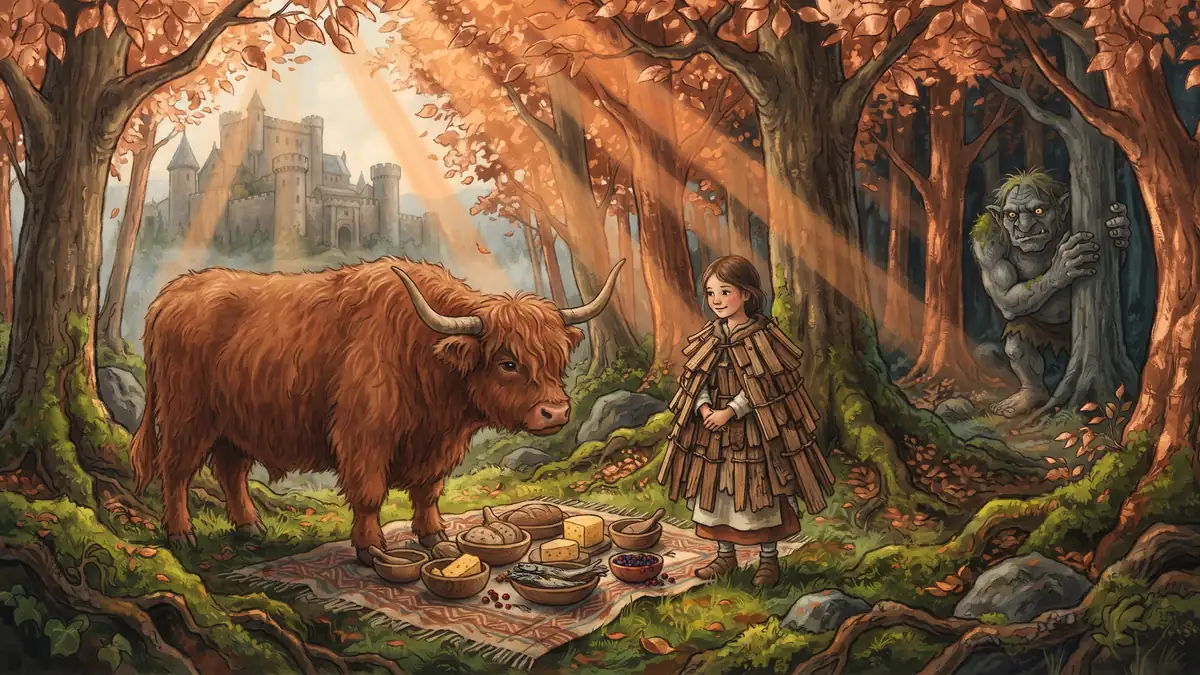
Kari Trestakk, in English Katie Woodencloak or Kari Woodengown, is a Norwegian fairy tale collected by Peter Christen Asbjørnsen and Jørgen Moe in Norske Folkeeventyr. The source consulted for this piece summarises the plot, classifies the tale and points to variants. Andrew Lang included it in the Red Fairy Book, where it appears as “Kari Woodengown”.
The plot
A king with a daughter marries a widowed queen who also has a daughter. The king goes to war, and the stepmother mistreats and starves the stepdaughter. A dun bull helps her: a cloth in his left ear, when spread out, provides all the food she needs. The stepmother discovers this, feigns illness and bribes a doctor to say that only the bull’s flesh would cure her. The princess warns the bull, and the two flee together.
The three woods
In a copper forest, the princess breaks off a leaf despite the bull’s warning, and he tells her to keep it safe. In each of three woods, copper, silver and golden, a troll fights the bull. He wins but is badly injured, and the princess heals him with ointment from the troll’s horn. Along the way she collects a silver leaf and a golden apple.
The wooden cloak
At a castle, the bull gives her a wooden cloak and tells her to seek work as “Katie Woodencloak”. First, she must kill and flay him, hide the hide in a rock with the leaves and the apple, and knock on the stone if she needs help. She agrees reluctantly. She works in the scullery, and when she carries bathwater to the prince, he throws it on her, thinking her filthy.
The church and the shoe
She visits the rock, dresses in finery and goes to church three times: in a copper dress, saying she is from “Bath”, and the prince gets one glove; in silver, saying she is from “Towelland”, and she drops a riding whip; in gold, saying she is from “Combland”, and the prince gets a golden shoe. The king has every woman try on the shoe. The stepsister fits it after cutting her own foot, but a bird reveals the deception and identifies Katie. The prince insists on finding her, and the two marry.
Cinderella and relatives
The tale is ATU type 510A, the “persecuted heroine”. Other tales listed under the same type are “Cinderella”, “The Sharp Grey Sheep”, “The Golden Slipper”, “The Story of Tam and Cam”, “Rushen Coatie”, “The Wonderful Birch” and “Fair, Brown and Trembling”. The article notes that most 510A tales do not have the heroine driven out, a motif more typical of type 510B, as in “Catskin” and “Cap O’ Rushes”. It also recalls that, in Norwegian custom, couples meet at church, not at a royal ball.
Terms
Norske Folkeeventyr is the collection by Asbjørnsen and Moe. ATU 510A is the international tale classification the article uses. Kari Trestakk is the Norwegian title, and Katie Woodencloak and Kari Woodengown are English titles.
What remains uncertain
Variants recorded in Valdres and Telemark are closer to the classic Cinderella: the dead mother helps the girl, who is called Kirsti or Åse, and Åse wears a dirty leather dress. A tale “Kari Woodencoat” appears as from a Sámi source in a 1928 book by Frances Jenkins Olcott, but the article does not explain how that origin was established or how closely the version resembles the Norwegian one. That link therefore stays unconfirmed here.
To push crates like the dun bull, until all reach the marks, play The bull and the crates.
Sources.
- Wikipedia, "Katie Woodencloak" (Kari Trestakk; collection by Asbjørnsen and Moe, Norske Folkeeventyr; Andrew Lang's Red Fairy Book; type ATU 510A; Valdres and Telemark variants; mention of Olcott, 1928)