Kormáks saga: the poet Kormákr, Steingerðr and a wedding that comes too late
Kormáks saga tells the life of an Icelandic poet of the 10th century, betrothed to Steingerðr, who because of a curse arrives late for the wedding. See the plot, the verses, the only complete manuscript and what remains uncertain about author and date.
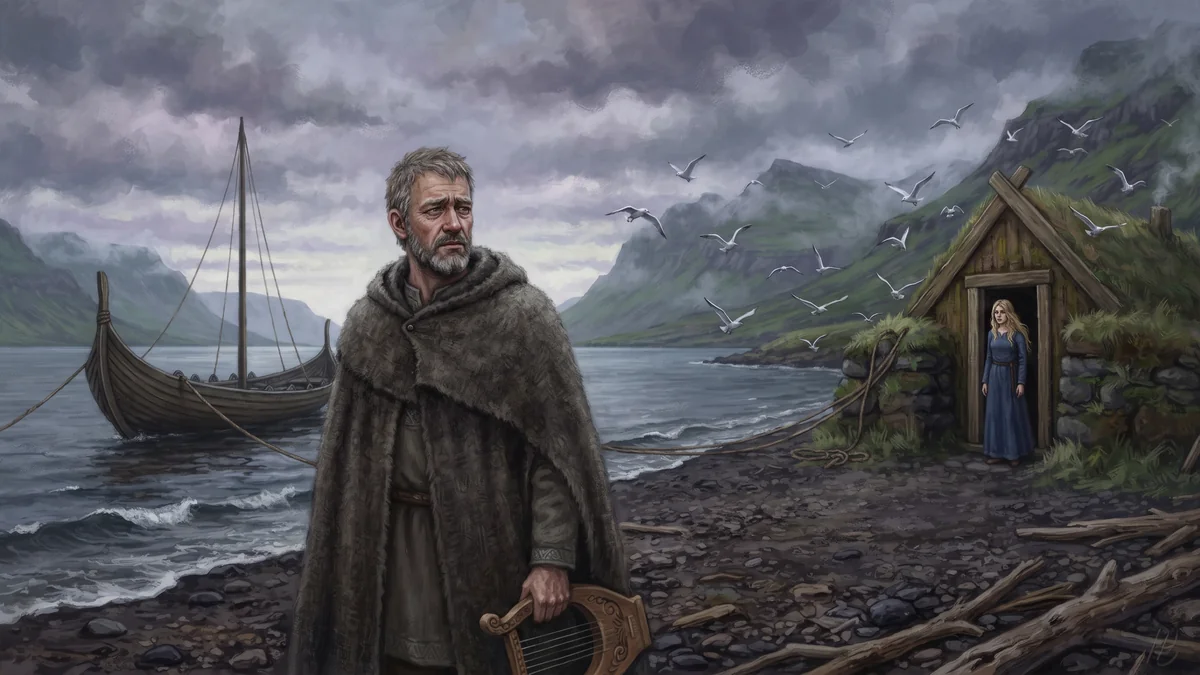
Kormáks saga is a saga of Icelanders about a 10th-century poet. The source consulted for this piece summarises the plot, the place of the verses and what is known of the text, and this piece follows that summary. It does not tell episodes that the article does not carry.
A poet and a bride
The saga is about Kormák Ögmundarson, an Icelandic poet of the 10th century. The woman he loves is Steingerðr Þórkelsdóttir, to whom he becomes betrothed. The article gives the plot a simple line, and the text is organised around it.
The curse and the wedding
Because of a curse, Kormákr arrives too late for his own wedding, and Steingerðr marries another man. That is the turn of the story: the betrothal exists, but the wedding does not happen as the poet expected. The article does not say who cast the curse, and this piece does not invent it.
Exile and death
After that, Kormákr follows King Harald Greycloak to Ireland. Later, in Scotland, he dies in a battle with a wizard. The article sums up the rest of the poet’s life this way, in two short sentences.
The verses
The saga preserves a significant number of poems attributed to Kormák, the lausavísur, many of them about his love for Steingerðr. In one set of stanzas he recalls how he met her, and these verses represent the style and content of his love poems. The article observes that the declarations of love in the verses often contrast with the poet’s antagonizing behaviour. The article has an audio reading of one stanza, which we do not reproduce here.
The author
The author is unknown. According to the article, he relies on oral tradition and adds little of his own. He does not fully integrate the different accounts of Kormákr he knew, and often only sets the scene for the poet’s stanzas.
The manuscript and the date
The saga was probably written in the first part of the 13th century, and it is believed to be among the earliest composed, although it survives well. The only complete version is in the Icelandic manuscript Möðruvallabók, AM 132 fol.
Further reading
The article cites the edition Íslenzk fornrit VIII, by Einar Ól. Sveinsson (1939), the translations by Lee M. Hollander (1949), Viðar Hreinsson (1997) and Collingwood and Jón Stefánsson (1902), Russell Poole’s study (1997) of the first ten lausavísur and an essay by Alexander Wilson (2021) on unwanted guests in sagas of poets.
Terms
A saga of Icelanders is the genre of prose narratives about Icelandic families. A lausavísa, plural lausavísur, is a loose stanza attributed to a poet. Möðruvallabók is the manuscript that holds the only complete version. AM 132 fol. is its shelfmark in the Árni Magnússon collection.
What remains uncertain
The article says the author relies on oral tradition, but it does not identify which traditions, and the dating is a probability. The text does not tell who cast the curse or what the Scottish wizard wanted. The stanzas are attributed to Kormák, and the article does not discuss how far they are his.
To decide who takes more seeds in a contest of pits, like someone contesting a bride, play Kormákr’s pits.
Sources.
- Wikipedia, "Kormáks saga" (plot, lausavísur, authorship, dating, the Möðruvallabók manuscript; relies on Íslenzk fornrit VIII, Hollander, Viðar Hreinsson, Collingwood and Stefánsson, Poole and Wilson)