Tatterhood (Lurvehette): the ugly princess who rides a goat and defeats the trolls
In Tatterhood, an ugly, loud princess who rides a goat and carries a wooden spoon goes to the trolls' island and recovers her sister's head. See the plot, the ATU 711 type, where the tale is found and what the sources leave unsettled.
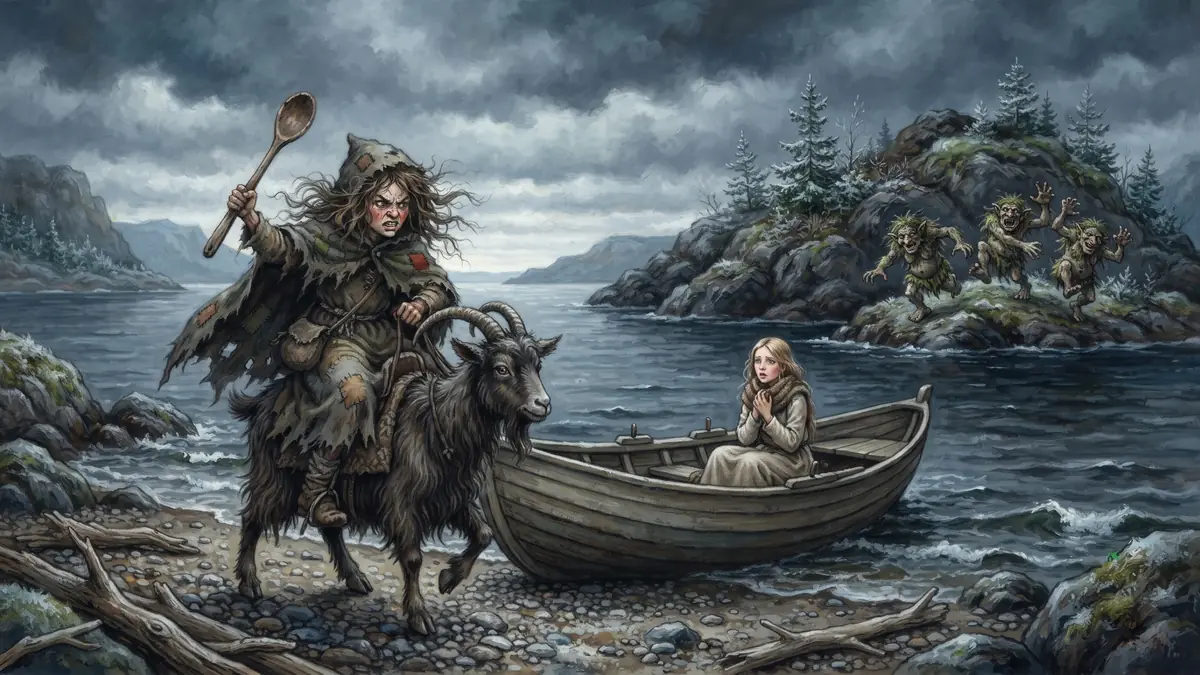
Tatterhood, in Norwegian Lurvehette, is a Norwegian fairy tale collected by Peter Christen Asbjørnsen and Jørgen Moe in Norske Folkeeventyr. The source consulted for this piece cites George Webbe Dasent’s translation, Popular Tales from the Norse (Edinburgh, 1888). It summarises the plot, classifies the tale and discusses where it is found. Ruth Manning-Sanders retold a version in A Book of Witches (1966), and the tale is related to Kate Crackernuts.
The plot
A childless king and queen adopt a girl. When the queen sees her adopted daughter playing with a beggar girl, she scolds her. The beggar girl says her mother knows how to make the queen pregnant. The beggar woman first denies this, and the queen gives her wine until she is drunk. Drunk, the woman tells the queen to wash in two pails of water, pour the water under the bed and find two flowers the next morning. She must eat the fair flower and never the foul one. The queen eats the beautiful flower, then craves and eats the other one too.
Tatterhood and her sister
The queen gives birth to Tatterhood, who is ugly, loud, carries a wooden spoon and rides a goat. She is named for her tattered hood. Tatterhood promises that the queen’s next child will be fair, and a second daughter is born, sweet and lovely. The sisters are very fond of each other.
The trolls
On Christmas Eve, when the girls are half-grown, a group of trolls, in some versions witches, that visits the house every seven years arrives. Tatterhood insists on confronting them and tells her mother to keep the door shut. The younger sister opens a door, is beheaded and receives a calf’s head. The trolls are driven off. Tatterhood sails alone with her sister to the trolls’ island, defeats the trolls and recovers her sister’s head.
The wedding
In a distant kingdom, a widowed king falls for the younger sister, who refuses to marry until Tatterhood does. The prince agrees reluctantly. On the wedding day, Tatterhood wears rags while the others dress richly. On the ride to church, the prince asks about the goat, the spoon and the hood. Each becomes something grander: a horse, a fan or a wand, and a golden crown. She says her beauty is greater than her sister’s, and it becomes so. The prince understands her nature and is glad to marry her.
Where the tale appears
It is ATU type 711, “The Beautiful and the Ugly Twin(sisters)”. According to Stith Thompson, the type is common in Norway and Iceland and very rare elsewhere. Hodne records six Norwegian variants. There are reports from Denmark, Sweden (Liungman, 1961), Ireland and America, among them sources from Kentucky and Newfoundland.
Terms
Lurvehette is the Norwegian title. ATU 711 is the international classification of the type. Norske Folkeeventyr is the collection by Asbjørnsen and Moe. In some versions the trolls are witches, and the spoon becomes a fan or a wand.
What remains uncertain
The sources on the distribution of the tale conflict. Hasan M. El-Shamy held that the type was confined to Europe, but there are reports of variants in Turkey. The article gives details that vary from version to version, such as trolls or witches and spoon, fan or wand, and it does not give exact collection dates. The article also has citation problems, among them a duplicated reference to Hodne.
To put a stack of rags in order, flipping it from one rag upward, play Tatterhood’s rags.
Sources.
- Wikipedia, "Tatterhood" (Lurvehette; collection by Asbjørnsen and Moe, Norske Folkeeventyr; Dasent's translation; type ATU 711; Norwegian, Icelandic, Swedish, Danish, Irish and American variants; Stith Thompson, Hodne, Liungman, El-Shamy and Sehmsdorf)