Vatnsdæla saga: the chronicle of a family in the valley of Vatnsdalur, in northern Iceland
The Vatnsdæla saga follows generations of a family from Norway until the coming of Christianity, beginning with Ingimundr Þorsteinsson, who fights for Harald Fairhair and moves to Iceland at a sorceress's instigation. See what is known about its manuscripts and date.
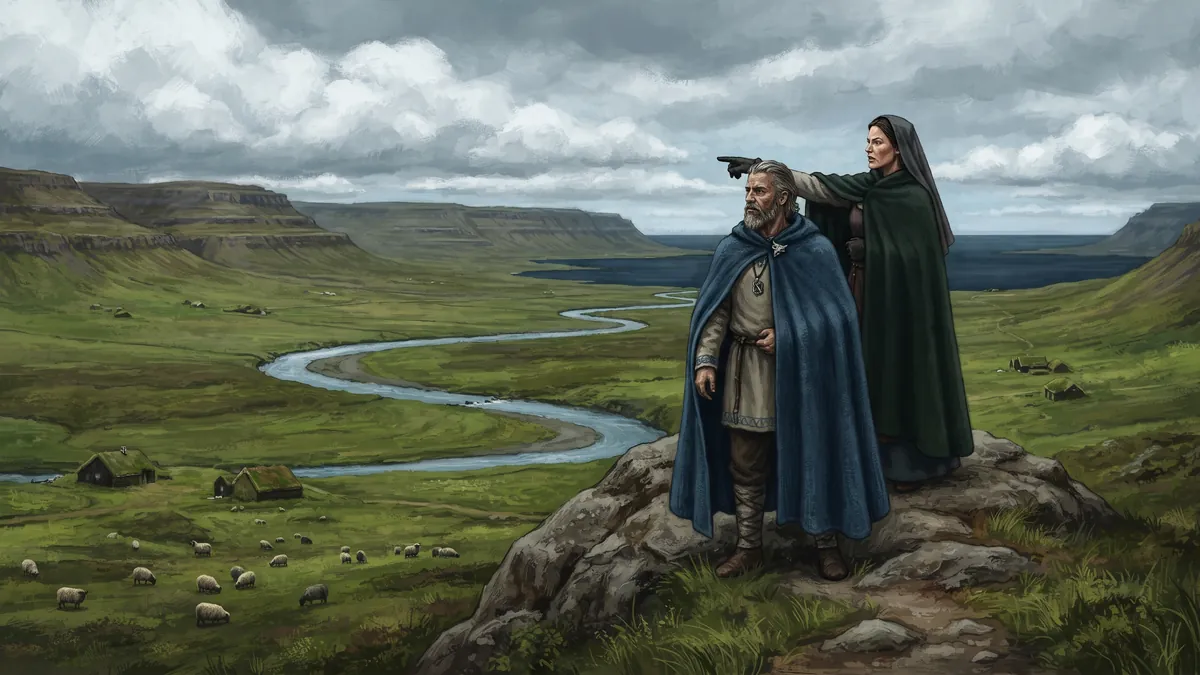
The Vatnsdæla saga is one of the sagas of Icelanders, and the source consulted for this piece describes it, in essence, as a family chronicle about the residents of Vatnsdalur. The valley runs south from Húnaflói, a large bay in northern Iceland. The article is short, and this piece keeps to what it carries, without adding episodes that it does not mention.
A family chronicle
The saga follows several generations of a family that came from Norway and settled in northern Iceland. The narrative runs until the arrival of Christianity in the late 10th century. For that reason it is, above all, the story of a place and of those who lived in it, more than the account of a single life.
Ingimundr and the king
The principal protagonist is Ingimundr Þorsteinsson. He fought for Harald Fairhair at the battle of Hafrsfjord, won the king’s friendship and received an amulet. The article cites the amulet as part of his relationship with the king, and nothing more is said about it here.
The sorceress and the move
At the instigation of a sorceress, Ingimundr moved to Iceland and settled at Vatnsdalur, in Húnaþing. The article gives no details of the conversation or of what the sorceress said, and this piece does not invent them.
The manuscripts
A fragment is preserved in a late 14th- or early 15th-century manuscript, AM 445 b 4to. Complete versions exist only in later paper manuscripts: AM 559 4to, written between 1686 and 1688, and AM 942 4to, written between 1700 and 1782.
The date
The complete texts likely derive from a 14th-century source. The saga may have been originally written in the late 13th century. The article cites Pulsiano (1993), Medieval Scandinavia: an encyclopedia, for this discussion, and it does not choose between the two dates.
Further reading
The article lists Jane Smiley’s 2001 translation, in Penguin Classics, within The Sagas of the Icelanders. It also lists a study by Richard L. Harris (2010) on the saga’s proverbs and the Sword of Jökull, which relates them to the flawed heroism of Grettir Ásmundarson. The full text is in the Icelandic Saga Database.
Terms
A saga of Icelanders is the genre of prose narratives about Icelandic families. Vatnsdalur is the valley, and Húnaflói is the bay from which it stretches. Húnaþing is the district. AM marks manuscripts of the Árni Magnússon collection. These terms are enough to place the reader, and what lies beyond them depends on opening the saga.
What remains uncertain
It is not known which of the dates, late 13th century or 14th century, is right for the original composition, and the article does not settle the question. The complete versions are on paper and late, and the early fragment is small. The article does not discuss other characters, episodes and places of the saga, and this piece cannot say what it does not.
To fill a board of light and dark stones, like someone settling a valley, play The stones of the valley.
Sources.
- Wikipedia, "Vatnsdæla saga" (summary, Ingimundr Þorsteinsson, Hafrsfjord, sorceress, manuscripts AM 445 b 4to, AM 559 4to and AM 942 4to, dating, bibliography)