Assipattle and the Stoor Worm: the Orkney tale in which the monster gives birth to the islands
In the Orkney tale, Assipattle, the seventh son, sets the liver of the Stoor Worm alight with a burning peat; the worm's teeth become the northern islands. See the plot, who recorded it and what scholars debate.
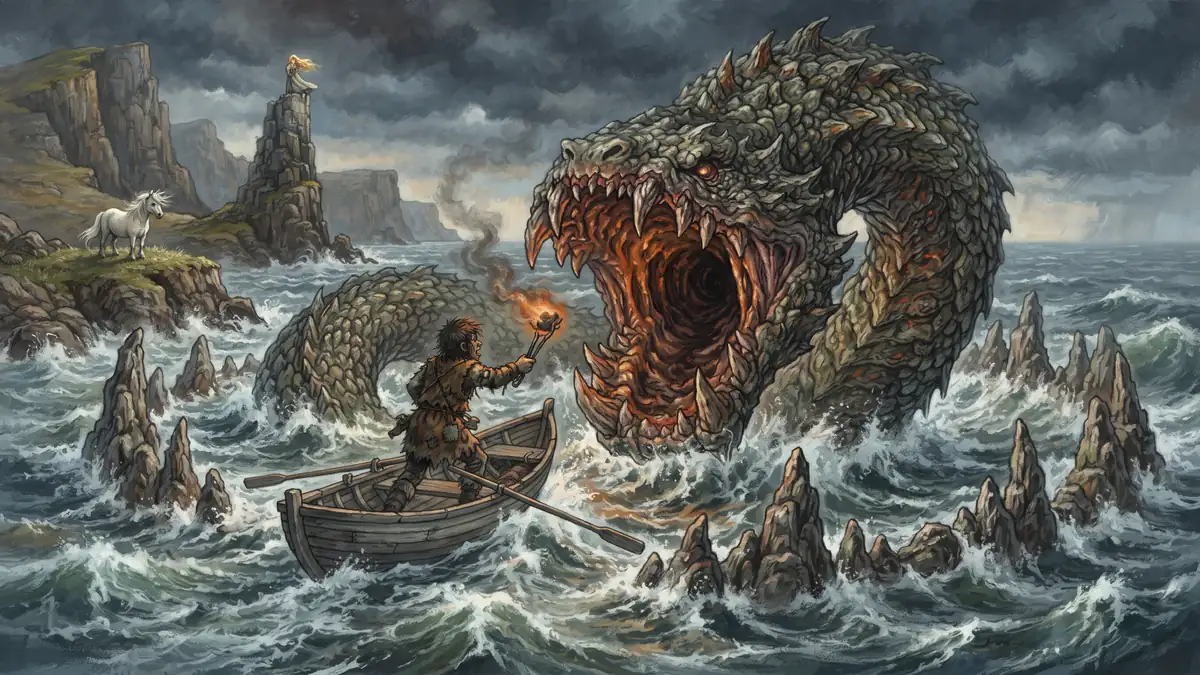
Assipattle and the Stoor Worm is a tale from Orkney, in northern Scotland, about a young man who defeats a sea monster. The source consulted for this piece describes the plot, who recorded it and the debate among scholars about its origins. This piece separates what the tale narrates from what is interpretation.
Who recorded the tale
The version we know was preserved by Walter Traill Dennison and published in The Scottish Antiquary in 1891. A collection by Douglas, of about 1893 or 1896, also carries the tale. Marwick made a retelling.
The plot
Assipattle is the seventh son, not necessarily the youngest. In the story appear Princess Gem-de-lovely, a sorcerer, the sword Sickersnapper and the horse Teetgong. Assipattle sets the monster’s liver alight with a burning peat. The worm writhes and dies.
The origin of the islands
As it dies, the monster gives rise to places on the map. The teeth become the islands of Orkney, Shetland and the Faroes. The tongue becomes the Baltic Sea, and the body becomes Iceland. That is why the tale is read as an explanation of the birth of lands.
How the tale links the monster to the map
The tale works as a map in the form of a story: each part of the monster corresponds to a place in the North Atlantic or the Baltic. The teeth are northern islands, the tongue is a sea and the whole body is a large island. This piece does not claim that this is ancient geographical knowledge: it is only the logic of the tale.
The hero
Assipattle is the seventh son, and the source takes care to say that he is not necessarily the youngest. The remark matters because hero tales usually favour the youngest, and here it is the number seven, not the age, that the source records.
The debate about origins
The source records two opinions. Dasent published a version with a hero called Boots. Hartland considers it “purely Norse”. Simpson considers it “almost pure märchen”, that is, an ordinary fairy tale of a European type. The source does not decide between the two readings.
Terms
Stoor Worm is the name of the great sea worm. Orkney is an archipelago in northern Scotland. Peat is compact plant soil used as fuel. Märchen is the German word for fairy tale. Sickersnapper is the name of the sword.
What remains uncertain
The source does not mention the Greek hero Perseus or the serpent Jörmungandr: links of that kind are free, and this piece does not assert them. Whether the tale is of Norse origin or of a common European type is debated. The form in which we know it was recorded in the 19th century, and it is not known precisely how much of it is much older.
To slice embers in the air without touching the bubbles, play Assipattle’s embers.
Sources.
- Wikipedia, "Assipattle and the Stoor Worm" (Orkney tale, Walter Traill Dennison, The Scottish Antiquary 1891, Douglas's collection, Marwick, Dasent, Hartland, Simpson, plot, origin of the islands)