Gudbrand on the Hill-side: the farmer who traded the cow down to nothing and still won the bet
In Gudbrand on the Hill-side, a Norwegian tale by Asbjørnsen and Moe, a farmer trades his cow for a horse, a pig, a goat and a sheep, and his wife praises every trade. See the plot, the retellings by Andersen and Jensen and what remains uncertain.
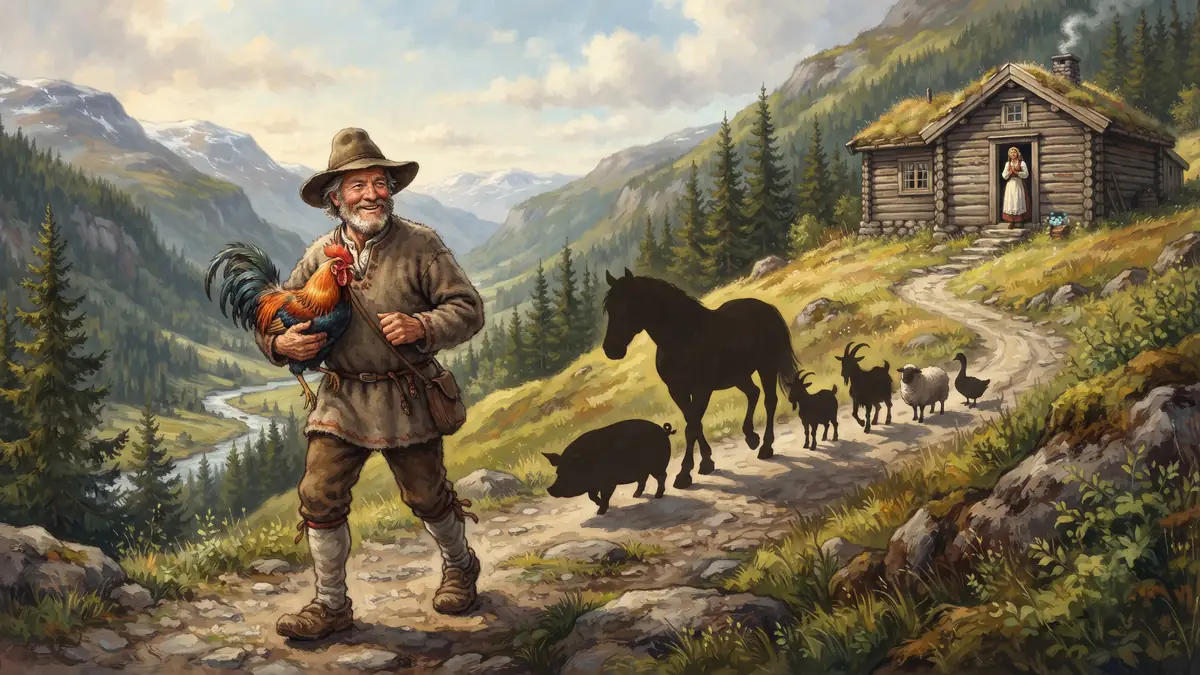
Gudbrand i Lia, in English Gudbrand on the Hill-side, is a Norwegian folktale collected by Asbjørnsen and Moe. The source consulted for this piece describes the plot, the translations and the retellings by other authors. This piece separates what the tale narrates from what is interpretation.
The plot
A farmer, Gudbrand, goes to market to sell his cow. On the way, he trades the cow for a horse, the horse for a pig, the pig for a goat, the goat for a sheep, the sheep for a goose, the goose for a rooster, and the rooster for food. In the end he has nothing. He bets one hundred thalers that his wife will not be angry, and the wife, who praises every trade when he tells her, makes him win the bet.
The sequence of trades
The list has eight objects, from the cow to the food, making seven trades. The charm of the tale lies in the repetition: at each trade the farmer tells the story to his wife, and the wife answers with praise. The repetition is what makes the bet turn on her behaviour, and not on the value of what was left.
The editions
The tale was collected by Asbjørnsen and Moe and translated into English by Dasent, in 1859. The source classifies it as type 1415 in the Aarne–Thompson index and discusses its themes, among them the trades and the wife’s reaction.
The retellings
In 1861, Hans Christian Andersen wrote a tale with a close plot, What the Old Man Does Is Always Right. In 1939, Johannes V. Jensen reversed the story. That the tale was taken up and reversed by different authors, almost eighty years apart, shows that it stayed alive in literature.
Terms
A thaler is an old silver coin used in Europe, including Scandinavia. Aarne–Thompson is an international index that classifies types of folktales. A folktale is a narrative of oral tradition, later collected in writing. Asbjørnsen and Moe are the two Norwegians who gathered the country’s folktales.
What remains uncertain
The source has weak references on some points: the citations of Bodansky and of Cole, of 1982 and 1983, are given without much support. The source page does not give other classification numbers, such as ATU 1693, nor the English name “Lucky Hans”, and so this piece does not assert them either. The moral sense of the tale, whether it is a satire or a praise of trust between the couple, is the reading of whoever interprets it. One possible reading is that what Gudbrand loses in objects he gains in trust, but it is only a reading.
To win a bet of three in a row against an opponent, play Gudbrand’s bet.
Sources.
- Wikipedia, "Gudbrand on the Hill-side" (Asbjørnsen and Moe, Dasent in 1859, plot, the bet of one hundred thalers, Andersen in 1861, Johannes V. Jensen in 1939, themes, AT 1415 classification)