Hallfreðar saga: the poet who served three chiefs and his difficult conversion
Hallfreðar saga tells the life of the Icelandic skald Hallfreðr, court poet to Hákon Sigurðarson, Óláfr Tryggvason and Eiríkr Hákonarson. See what the saga says, how the manuscripts differ and what the source rejects.
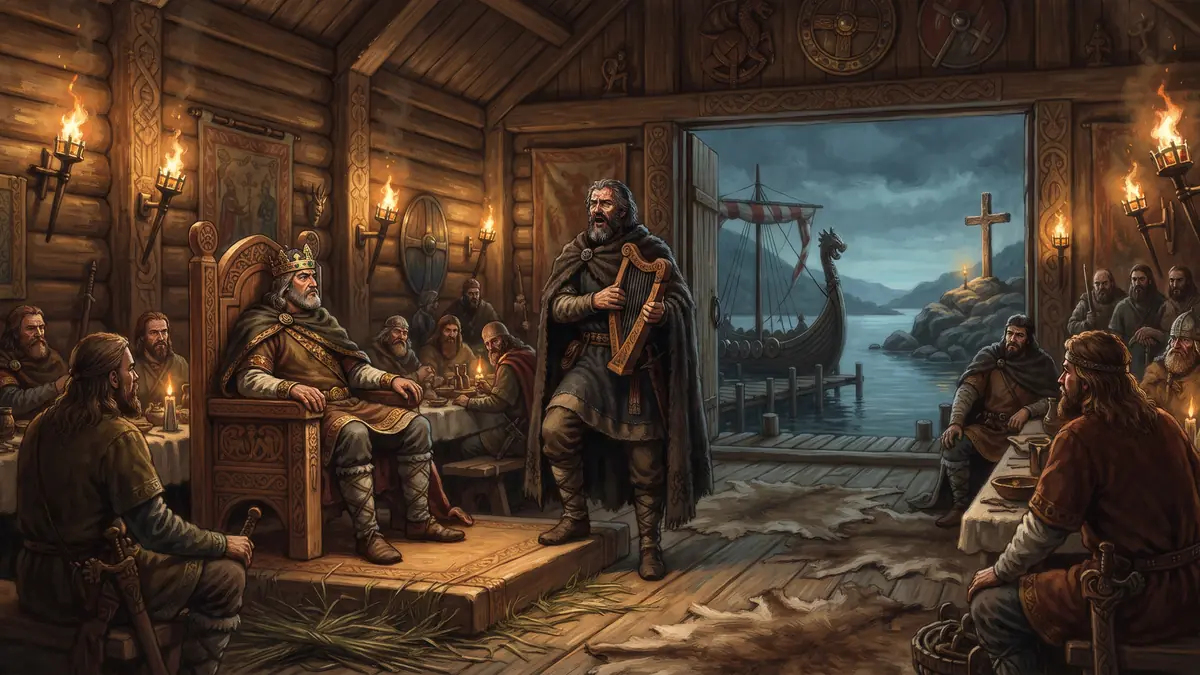
Hallfreðar saga vandræðaskálds is an Icelandic saga about the poet Hallfreðr, who lived from about 965 to about 1007. The source consulted for this piece summarises the life the saga gives him, the manuscripts that preserve it and the questions raised by scholars. This piece separates what the saga tells from what the source treats as established.
The poet and the three chiefs
According to the saga, Hallfreðr was, in succession, court poet to three rulers: Hákon Sigurðarson, Óláfr Tryggvason and Eiríkr Hákonarson. A skald was a court poet who composed verses in honour of his lords. The saga gives Hallfreðr the epithet vandræðaskáld, which the source associates with his difficult conversion, between paganism and Christianity.
The difficult conversion
The central point of the narrative is the relation between the poet and the new faith. Hallfreðr serves Óláfr Tryggvason, a king tied to the Christianisation of Norway, but the saga shows a conversion marked by conflict. The poet’s very epithet points to this. The source gives no further detail here about the episodes of the conversion, and so this piece neither invents nor reconstructs them.
The verses and the manuscripts
The saga includes lausavísur, loose verses that the poet is said to have composed at moments in his life. It survives in several 14th-century manuscripts, among them the Möðruvallabók and the Flateyjarbók. The versions in the manuscripts differ from one another. The source points to similarities with other poets’ sagas, Kormáks saga and Gunnlaugs saga. In all three, the poet is the centre of the narrative, and his verses are part of the story. This closeness is an observation of the source about the genre, not proof that one served as a model for another.
A rejected attribution
The source records that the attribution to Hallfreðr of the Óláfsdrápa Tryggvasonar, preserved in the Bergsbók, is rejected. In other words, a poem that might be read as his is not, according to that view, of his authorship.
Terms
A skald (skáld) is a Norse court poet. A lausavísa is a loose verse of a single stanza. Möðruvallabók and Flateyjarbók are great medieval Icelandic manuscripts. A drápa is a longer poem of praise.
What remains uncertain
Hallfreðr’s dates are approximate. Because the manuscript versions differ, there is no single text of the saga. The source does not state that all the verses in the saga are the poet’s, and the saga itself is a literary narrative, written long after the events: it does not prove that each scene happened this way. This piece also gives no detailed plot of each phase of Hallfreðr’s life, because the source consulted does not; whoever wants the episodes should read the saga itself in translation.
To link islands with bridges until they form a single group, play Hallfreðr’s bridges.
Sources.
- Wikipedia, "Hallfreðar saga vandræðaskálds" (Hallfreðr, c. 965 to c. 1007, Hákon Sigurðarson, Óláfr Tryggvason, Eiríkr Hákonarson, conversion, lausavísur, manuscripts, Óláfsdrápa Tryggvasonar)