Kalevipoeg: Kreutzwald's Estonian epic, the giant hero and the thrown stones
The Kalevipoeg is the Estonian epic that Friedrich Reinhold Kreutzwald compiled after 1850, with a giant hero, a cursed sword and thrown stones. See how it was made, the three versions and what the source leaves open.
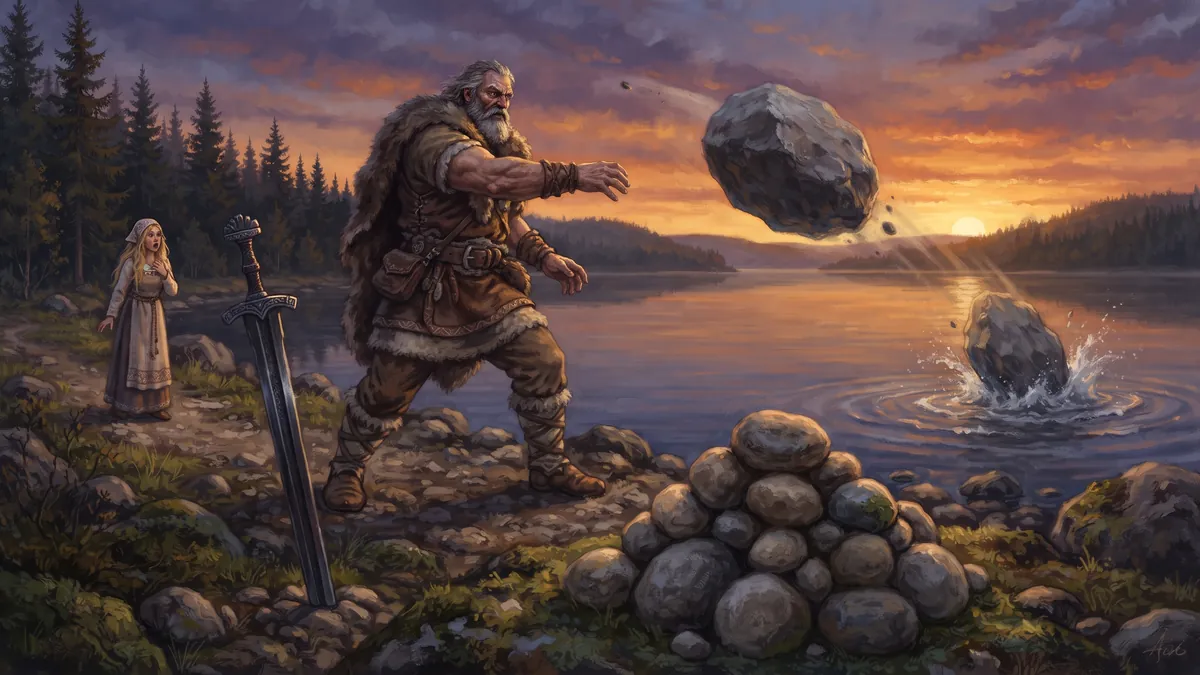
The Kalevipoeg is the national epic of Estonia, compiled by Friedrich Reinhold Kreutzwald after 1850. It tells the deeds of a giant hero, son of Kalev. The source consulted for this piece describes how the work came to be, its versions and its use in the country’s history. This piece separates what the source states from what it leaves as opinion or doubt.
How it came to be
In 1839, Faehlmann presented a paper and sketched the plot. Kreutzwald wrote the work after 1850, and put it together from folk verses and his own composition. The source states that about one eighth of the verses would be authentic, collected folklore, but this proportion is a claim of the page, not a precise measure.
The versions
The work had three main versions. That of 1853, of 13,817 verses, was censored. That of 1857 to 1861 has 19,087 verses. That of 1862, published in Kuopio, has 19,023 verses. The work is divided into twenty cantos. The two later versions have more than 5,000 verses more than that of 1853.
The plot
The hero’s mother is Linda. In the story appear a cursed sword, the throwing of stones, a descent into hell and the meeting with Olevipoeg. The hero’s legs are cut off, and the god Taara revives him.
Use in history and translations
Estonia’s Declaration of Independence quotes Canto XX, which shows the national weight of the work: a poem gathered and composed in the 19th century came to speak in the country’s name in a state document. There are English translations by Kirby, of 1895, by Kurman, of 1982, by Kartus, of 2011, and by Hasselblatt, of 2016.
Earlier mentions
The source records mentions before Kreutzwald, among them Agricola, in 1551, and Leyen Spiegel, in 1641. It also cites the Anglo-Saxon poem Widsith, in which a people called “Caelic” appears, a link that is the opinion of some scholars.
Terms
An epic is a long narrative poem about heroic deeds. A canto is each of the divisions of the work. Folklore is the body of narratives and verses of the people. Taara is a god of the Estonian tradition. Kalevipoeg means “son of Kalev”.
What remains uncertain
The proportion of authentic verses, about one eighth, is a claim of the source and is not easy to verify. The link with Widsith is opinion. The three versions of the work differ in length and text, and so there is no single Kalevipoeg. The epic is a 19th-century work, composed with old material: it is not a medieval text, and whoever reads it today should know that the compiler’s hand is in every canto.
To choose the stones that fit in the hero’s sack, play Kalevipoeg’s stones.
Sources.
- Wikipedia, "Kalevipoeg" (Faehlmann in 1839, Kreutzwald, the 1853, 1857–61 and 1862 versions, twenty cantos, folk verses, Declaration of Independence, translations, earlier mentions, Widsith)