Knýtlinga saga: the kings of Denmark from Harald Bluetooth to the 12th century, written in Iceland
Knýtlinga saga, from the 1250s, tells the story of the kings of Denmark from Harald Bluetooth to the end of the 12th century, with the attacks on the Wends and the conversions. See what it holds, who may have written it and what is uncertain.
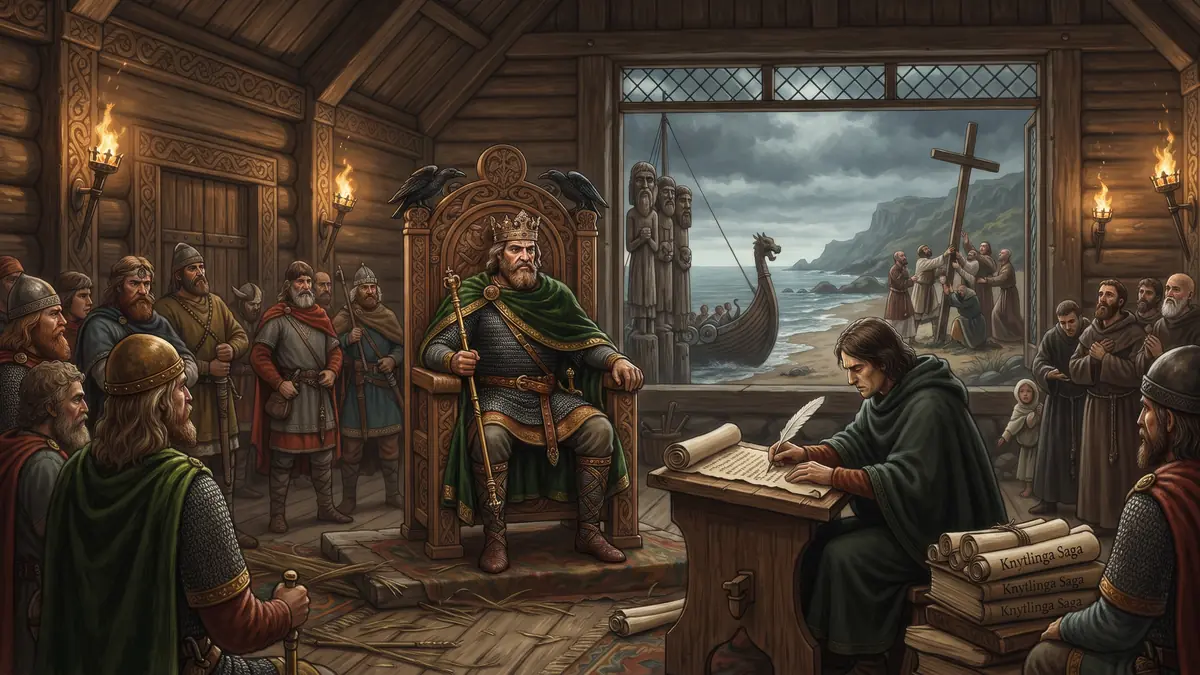
Knýtlinga saga is a saga of the kings of Denmark, written in Iceland in the 1250s. The source consulted for this piece describes what it covers, who may have written it, how it relates to Heimskringla and what it holds on the Wends, Slavic peoples of the Baltic coast. This piece separates what the source states from what it considers probable.
What the saga covers
The saga deals with the kings of Denmark from Harald Gormsson, the “Bluetooth”, in the early 10th century, to the end of the 12th century. Its themes are good and bad kings. The source says it takes Heimskringla as a model, the collection of sagas of Norwegian kings. The source also mentions the court of Valdemar II, king of Denmark, in the years 1240 and 1241, but this piece does not detail that link. The way the saga tells good kings from bad ones is therefore a choice of the author, and not a neutral judgement of history.
Who wrote it
The authorship is probably Óláfr Þórðarson hvítaskáld, who died in 1259 and was a nephew of Snorri Sturluson, but this attribution is conditional: the source says “probably”, and the saga does not carry the author’s name.
The Wends and the Slavic gods
An important part of the saga narrates Danish campaigns against the Wends. The source cites Svantevit at Arkona, idols at Gartz and names such as Pizamar, Tjarnaglofi and Boka, linked to Slavic gods and temples. It also records numbers of baptisms: 1,300 people at Arkona, 900 at Gartz and about 5,000 at another moment, as well as eleven graveyards mentioned. The source notes that the equivalences between the names in the saga and the Slavic gods are presumed.
The translation
An English translation, by Hermann Pálsson and Paul Edwards, was published in 1986.
Terms
A kings’ saga is a narrative of historical kings, different from the sagas of Icelanders. Heimskringla is the history of the kings of Norway, attributed to Snorri. Wends is the name Norse writers gave to Slavic peoples of the southern Baltic. Hvítaskáld means “white poet”.
What remains uncertain
The authorship is conditional, and the source does not treat it as certain. The figure called Cnut in the saga probably corresponds to Harthacnut, not to the better-known king of that name. The equivalences between the idols of the saga and the Slavic gods are presumed. The numbers of baptisms are those the saga presents, and this piece does not confirm them from other sources. Like all sagas, Knýtlinga saga was written long after the events it tells, and it is literature, not an official record.
To paint a map of a region divided into realms, with no neighbours of the same colour, play The map of the realms.
Sources.
- Wikipedia, "Knýtlinga saga" (date, authorship, kings of Denmark, Valdemar II, Heimskringla, Wends and Slavic gods, Svantevit at Arkona, Gartz, conversions, translation by Hermann Pálsson and Paul Edwards, 1986)