The Kensington Runestone: the runic inscription of 1362 found in Minnesota in 1898
The Kensington Runestone, reported in 1898 by Olof Ohman in Minnesota, bears a runic inscription dated 1362. See what it says, how it was examined and why most scholars regard it as a forgery.
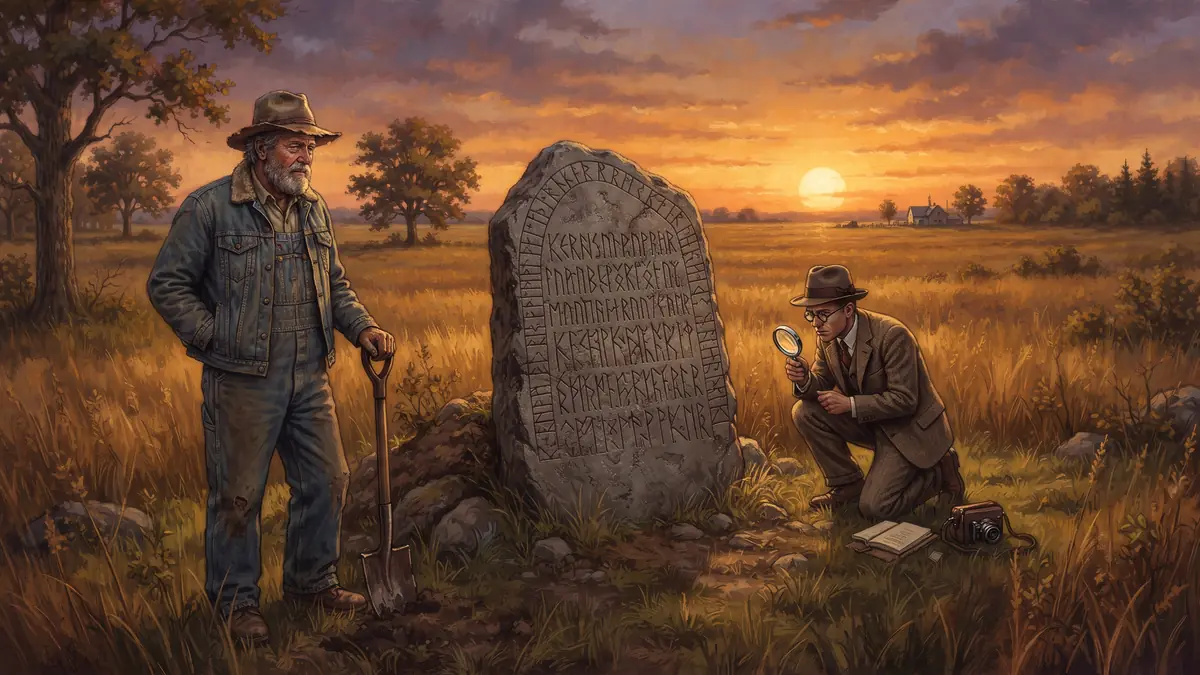
The Kensington Runestone is a slab with an inscription in runes that carries the date 1362. It was reported in 1898 by Olof Ohman, a farmer in Solem Township, in Douglas County, Minnesota, in the United States. The sources consulted for this piece describe the stone, the carved text and the long discussion about its authenticity. This piece says clearly what is established and what is still disputed.
The stone
It is a slab of greywacke weighing about 200 pounds, some 90 kilograms. According to the 1898 account, it was found on Ohman’s land. The inscription, in runes, says that eight Goths and twenty-two Norwegians were on a journey of exploration. It speaks of ten men found dead, red with blood, calls on the Virgin Mary with the letters AVM and mentions ten men left by the sea, a journey of fourteen days away. It ends with the date, “year 1362”.
The examinations
In 1899, the scholars Curme and Breda said the inscription was false. In 1907, Holand began to defend the authenticity of the stone. In 1910, a committee of the Minnesota Historical Society, with Winchell, concluded it was genuine. In 1911, Ohman conveyed his interest in the stone. In 1928, it was sold for 2,000 dollars. In 1948, the stone was at the Smithsonian, in Washington. Moltke, in 1950, Wahlgren, in 1958, and Blegen, in 1968, concluded that it was a hoax. In 2003, Wolter contested that conclusion.
The consensus
The case shows how one examines an object whose origin was not excavated by specialists: the account of the discovery, the writing and the stone are assessed separately, and the source records that, from 1899 to 2003, different scholars reached opposite conclusions. Today, the consensus among scholars is that the stone is a 19th-century forgery. It is displayed in a museum in Alexandria, Minnesota.
Who made it
Who made the stone is uncertain. The source considers Ohman the most likely, and cites Fogelblad as a possibility. Gran, in 1976, is one of the references on this point.
Terms
Runes are the letters of the ancient Germanic peoples of the north. Greywacke is a dark, hard sedimentary rock. Goths and Norwegians are the groups named in the inscription. AVM is the abbreviation of Ave Maria, the invocation to Mary. The Minnesota Historical Society is the state institution that formed the 1910 committee.
What remains uncertain
The authorship of the forgery is not proved: Ohman is the most often named, but there is no confession. Wolter’s conclusions, of 2003, contest the consensus but have not changed it. The stone does not prove that Norsemen reached Minnesota in 1362.
To black out repeated numbers until the stone is deciphered, play The erased runes.
Sources.
- Wikipedia, "Kensington Runestone" (the 1898 discovery, Olof Ohman, inscription, the 1899 and 1910 examinations, Holand, Smithsonian in 1948, Moltke, Wahlgren, Blegen, Wolter, consensus, Alexandria museum)
- Minnesota Historical Society, MNopedia, "Kensington Runestone" (history of the stone and the debate)