Draumkvedet: Olav Åsteson's dream and the medieval ballad of Norway
Draumkvedet, the "Dream Poem", tells that Olav Åsteson slept from Christmas to the thirteenth day and saw hell and part of heaven. See how the ballad was collected, what is known of it and what stays uncertain.
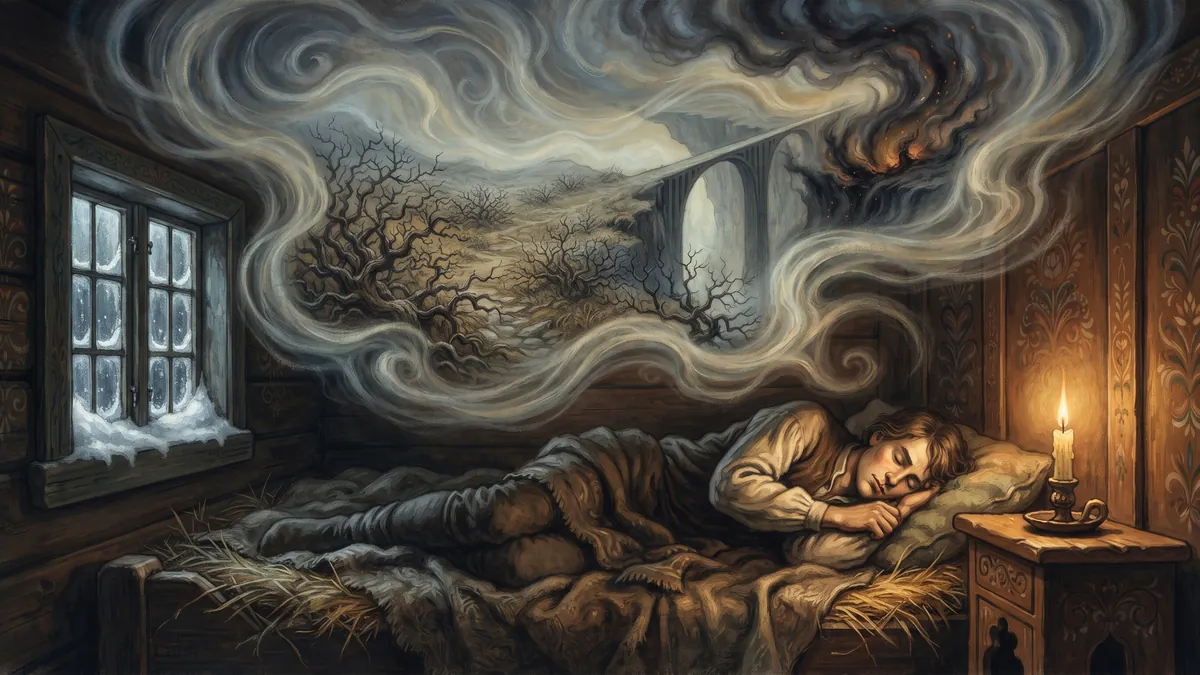
Draumkvedet, the “Dream Poem”, is a Norwegian ballad of oral tradition, from the late Middle Ages, preserved in many versions from Telemark. The protagonist is Olav Åsteson, who sleeps for a long time and, on waking, tells what he saw in the other world. This piece uses two sources, an encyclopaedia in English and the Store norske leksikon, and separates what they state from what they leave open.
What the ballad is
The first source identifies it as a late medieval ballad, catalogued in the indexes of Norwegian ballads as NMB 54 and TSB B 31. The records that have reached us were made in the second half of the 19th century, in Lårdal and Kviteseid, in Telemark. The second source places the first collections in the 1840s, with Jørgen Moe and Landstad, and says the poem has a refrain, the omkved.
The plot
According to the first source, Olav Åsteson sleeps from Christmas Eve to the thirteenth day. During the sleep, he sees a moor of thorns, a very tall bridge, a black fire, hell and part of heaven. The ballad also carries advice on charity. The second source adds that Christ and Saint Michael appear, and a figure called Grutte Gråskjeggje.
How it was preserved
The second source says there are more than a hundred recordings, mostly fragments. Moltke Moe reconstructed a version, and one of the best-known versions is that of Maren Ramskeid. The source notes that the poem gained a new artistic life: Agnes Buen Garnås received the Spellemannsprisen in 1984 for a recording, and there have been performances at the Fantoft stave church since the mid-1990s. The first source mentions compositions made from the ballad.
How it has been read
The second source reports that the poem probably drew on Irish and Scottish visionary accounts. It also cites the opinion of Olav Bø, for whom Draumkvedet is “Norway’s answer to Dante”. It is a comparison of reading, not a claim that the works are directly related.
Terms
A ballad is a sung poem that tells a story. The omkved is the refrain that repeats in the Norwegian ballad. A vision is an account of an experience of the beyond. Oral tradition is what passes from person to person by speech and song.
What remains uncertain
There is no medieval manuscript, and the age of the ballad is estimated by those who study it, not documented. The version known today is a gathering of fragments, and Moltke Moe’s reconstruction shows that there are editorial choices among the voices. The Irish and Scottish influence is described as probable, and the comparison with Dante is an opinion. The sources do not say why the poem was preserved precisely in Telemark.
To cross the dream bridge by repeating in the right order the planks that light up, play The dream bridge.
Sources.
- Wikipedia, "Draumkvedet" (identification, late medieval version, collection in Lårdal and Kviteseid, plot, compositions)
- Store norske leksikon (snl.no), "Draumkvedet" (refrain, characters, collections of the 1840s, recordings, influences, reception)