Droplaugarsona saga: the brothers Grímr and Helgi, vengeance near Lagarfljót
Droplaugarsona saga tells the story of two brothers, sons of the widow Droplaug, in eastern Iceland around the year 1000. See the plot, the date and the relation to Fljótsdœla saga, and what remains uncertain.
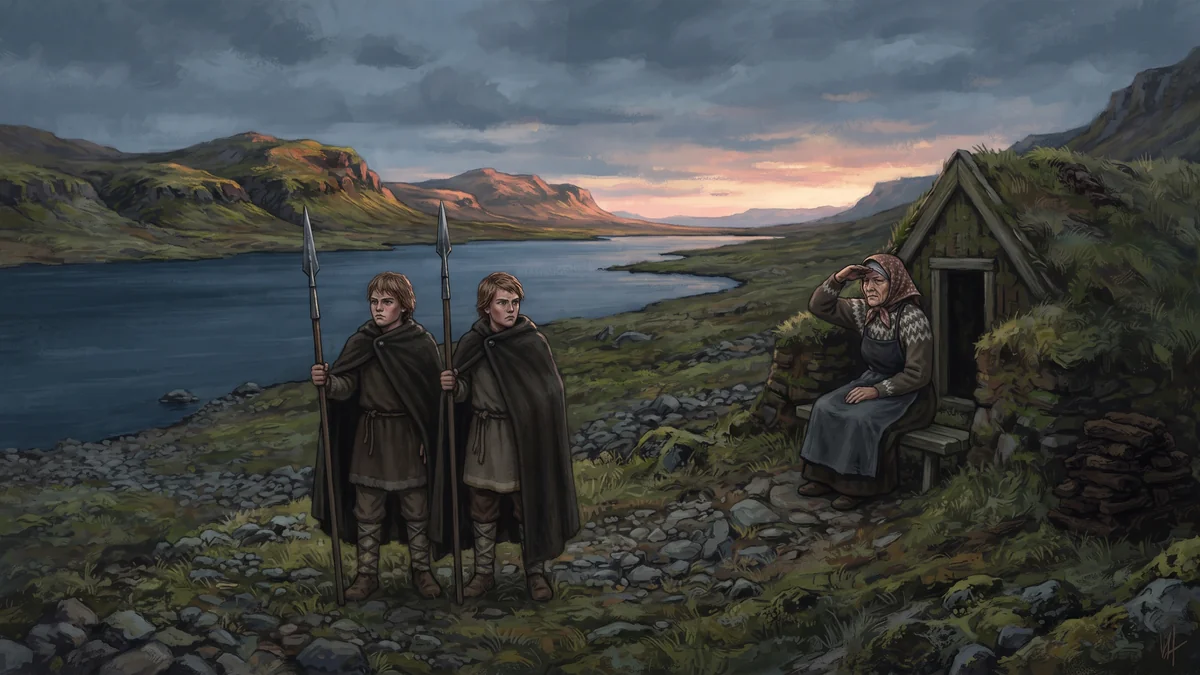
Droplaugarsona saga is one of the sagas of Icelanders. It is set near Lagarfljót in eastern Iceland, around the year 1000, and tells of two brothers, Grímr and Helgi, sons of the widow Droplaug. This piece uses two sources, an encyclopaedia in English and a Norwegian entry, and separates what they state from what they leave open.
Two brothers, their mother’s name
According to the Norwegian entry, the two brothers lose their father early and are called by their mother’s name, Droplaug. The title of the saga, Droplaugarsona, means “of Droplaug’s sons”. Helgi, in the Norwegian description, is a man who values honour and likes to quarrel.
The plot
The English source summarises the story in a few lines. Helgi, Droplaug’s son, is killed by Helgi Ásbjarnarson, and Grímr avenges his brother by killing Helgi Ásbjarnarson. The Norwegian entry adds two details: Helgi dies in a battle at Eyvindardal, and Grímr slips one night to the home of the main adversary, the local chieftain called Helge Åsbjørnsson, and kills him.
Two linked deaths
In short, the story turns on two chained deaths: that of Helgi, the brother who valued honour, and that of the chieftain who killed him, killed in turn by the other brother. Neither source describes what came after the vengeance.
Date
The Norwegian entry says the main action takes place around the year 1000 and that the saga was written in the 13th century. The English source says it was “probably written in the 13th century”.
The same story, in another saga
The same brothers appear in Fljótsdœla saga. The English source says the two sagas tell stories that overlap, but with details that often differ. In another piece in this series we deal with Fljótsdœla saga.
Who appears
The characters the sources mention are Droplaug, the mother; Grímr and Helgi, the brothers; and Helgi Ásbjarnarson, the adversary chieftain. The English source gives no names for other characters.
Terms
Saga of Icelanders is a prose narrative about Iceland in its first centuries. Goði, or goden in Norwegian, is a local chieftain. Lagarfljót is a long river-lake in eastern Iceland. A matronymic is a name taken from the mother’s name rather than the father’s.
What remains uncertain
The date is given as “probably” the 13th century, and the sources say nothing about the author or the manuscripts. It is also unclear at which exact points the two sagas, Droplaugarsona and Fljótsdœla, differ: the English source only states that they differ. The two sources, moreover, give differently spelled names for the adversary, Helgi Ásbjarnarson and Helge Åsbjørnsson, which seem to be the same person in different spellings, but that is our reading, not a statement of the sources.
To guide two brothers at the same time, each in his own field, play The mirrored brothers.
Sources.
- Wikipedia, "Droplaugarsona saga" (plot, dating, relation to Fljótsdæla saga)
- Store norske leksikon, "Droplaugsønnenes saga" (plot, Eyvindardal, dating in the 13th century)