Fjölsvinnsmál: the castle watchman, Svipdagr's hidden name and Menglöð
Fjölsvinnsmál is the poem in which the young Svipdagr reaches a castle on a mountain top and hides his name from the watchman. See the plot, the link to Gróagaldr and to a medieval ballad, and what remains uncertain.
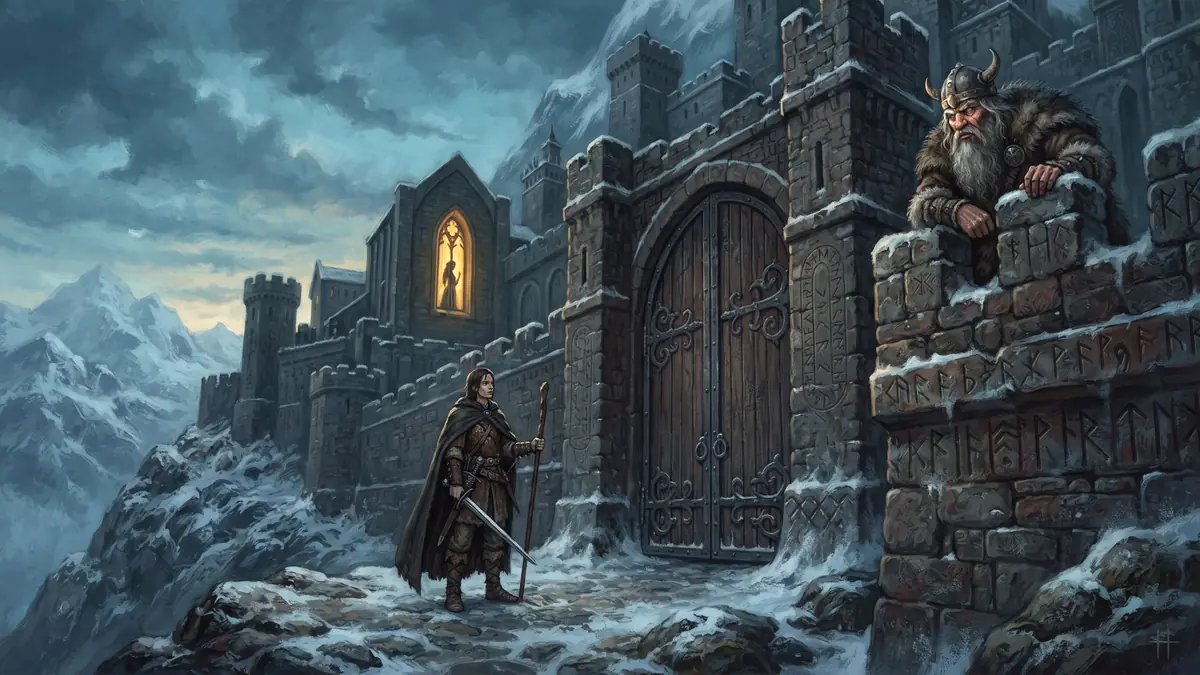
Fjölsvinnsmál is an Old Norse poem about a young man who reaches a castle on a mountain top and is questioned by the watchman at the gate. It is the second of two poems usually published together under the title Svipdagsmál, “The Lay of Svipdagr”. The first is Gróagaldr. The source consulted for this piece summarises the two poems, their history in the manuscripts and their link to a medieval Scandinavian ballad. Here we separate what it states from what stays open.
Two poems, one title
The title Svipdagsmál was given in 1860 by Sophus Bugge, in a paper published in the proceedings of the Society of Sciences in Christiania, and later scholars accepted it, according to the source. The two poems appear together in several 17th-century paper manuscripts. In at least three of them the order is reversed, and the poems are separated by a third Eddic poem, Hyndluljóð. The source cites John McKinnell (2005) on this order, but does not explain why it appears reversed.
A link that took time to be seen
For a long time, the connection between the two poems was not recognised. In 1854, Svend Grundtvig linked the story of Gróagaldr to the first part of a medieval Scandinavian ballad, known in different languages as Ungen Sveidal, Herr Svedendal or Hertig Silfverdal. In 1856, Sophus Bugge noticed that the last part of the same ballad corresponded to Fjölsvinnsmál. From then on, the two poems came to be read as two halves of a single story.
Gróagaldr: the dead mother
In Gróagaldr, Svipdagr asks his dead mother, Gróa, who is a witch, for help in completing a task set by his cruel stepmother. The source does not say what the task is.
Fjölsvinnsmál: the watchman and the castle
In the second poem, Svipdagr arrives at a castle on a mountain top. The watchman, Fjölsviðr, tells him to leave before even asking his name. Svipdagr hides who he is and reveals it only later. A question-and-answer exchange follows. Through it, Svipdagr learns that Menglöð lives in the castle and that no one may enter except Svipdagr himself. When he finally gives his true name, the gates open and Menglöð greets him.
Who is who
The characters named by the source are Svipdagr, the young man; Gróa, his dead mother and a witch; the cruel stepmother, who is not named; Fjölsviðr, the castle watchman; and Menglöð, the woman who lives inside.
Terms
Svipdagsmál is the modern title that joins the two poems. Gróagaldr is the first of them, and the name joins Gróa’s name to the word galdr, meaning “incantation”. A ballad is a medieval narrative song, for a long time passed on orally. An Eddic poem is a poem of the kind found in the Poetic Edda, the collection of Old Norse poems.
What remains uncertain
The source does not give the number of stanzas, the content of the stepmother’s task, or why the manuscripts reversed the order of the poems. Nor does it explain why the link to the ballad took so long to be noticed, beyond recording that it did. Likewise, it does not give the full text of the ballad or of its other parts, so the comparison between ballad and poems is, here, limited to what is said above.
To carry a stack of rings from one post to another, like a castle gate that opens only when the right thing is done, play The rings of the gate.
Sources.
- Wikipedia, "Fjölsvinnsmál" (Svipdagsmál, Gróagaldr, 17th-century manuscripts, Hyndluljóð, ballad Ungen Sveidal, Svend Grundtvig, Sophus Bugge)