Hœnsa-Þóris saga: the merchant, the refused hay and a 13th-century law
Hœnsa-Þóris saga tells how an enriched merchant refuses hay to his neighbours and ends up killed in a vengeance. See the plot, the themes of hospitality and the theory that links the saga to a law of 1281.
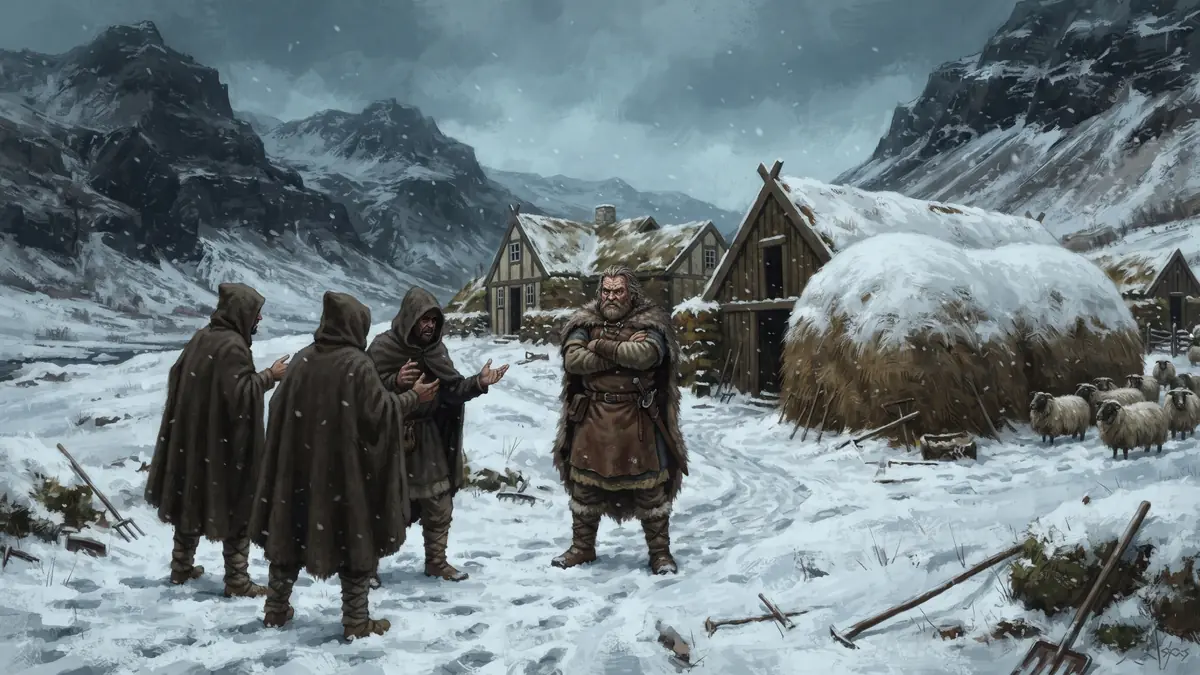
Hœnsa-Þóris saga is one of the sagas of Icelanders. The name of the protagonist, Hœnsa-Þórir, means “Hen-Þórir”, from hœnsn, “hen”, and already shows the contempt his neighbours have for him. The source consulted summarises the plot, the themes and a theory about when the saga may have been written. This piece separates what the source states from what it presents as hypothesis.
The plot
Hœnsa-Þórir is a poor and unpopular man who becomes rich as a merchant and buys land. His neighbours come from older and more established backgrounds, and the saga compares him unfavourably to them. He causes strife among them. One winter, he refuses to sell hay to his neighbours. They take the hay anyway, and Hœnsa-Þórir burns them alive in a farmhouse. A vendetta follows: Hœnsa-Þórir is killed and beheaded. The neighbours end the dispute by arranging a marriage between their families.
The themes
According to the source, the saga speaks of hospitality to guests and travellers, of the generosity expected among neighbours and of the need to win a chieftain’s support to obtain justice.
A link with the law
The source says that Ari Þorgilsson mentions the events in the Íslendingabók, linking them to a change in law: a legal complaint was no longer brought to the nearest Thing but to the Quarter Thing. The source also cites a theory that the saga was written in response to a law of King Magnus VI of Norway, which required a farmer to sell hay to neighbours in great need, with a fine for anyone who refused; if he resisted by force, the neighbours could attack without committing a crime. The law was a novelty in Icelandic jurisprudence, and a formal objection to it was raised at the Althing in 1281. According to the theory, the saga would be propaganda in favour of the new law.
Manuscript and studies
The source cites the manuscript AM 162 G fol, catalogued by the National and University Library of Iceland and accessible through the portal handrit.is, without describing its contents or date. Among the studies, it points to Jan de Vries (1964), in Altnordische Literaturgeschichte, and Björn Sigfússon (1962), on the place of the saga in the development of Icelandic law in the 13th century.
Terms
Althing is the national assembly of medieval Iceland. The Quarter Thing is the assembly of each of the four divisions of the country. Íslendingabók is a history of Iceland written by Ari Þorgilsson. Propaganda, here, is the hypothesis that the text was written to defend a political measure.
What remains uncertain
The source gives no firm date of composition. The link with the 1281 objection and with Magnus VI’s law is presented as a suggestion (“it has been suggested”), not as established fact, and the reading of the “saga as propaganda” is a theory based on the work of Björn Sigfússon and Jan de Vries, not a conclusion accepted by all. The source also does not say when the change to the Quarter Thing took effect, and does not name the neighbours who were the victims of the fire.
To put hay bales into tidy stacks, each of a single kind, play The hay bales.
Sources.
- Wikipedia, "Hænsa-Þóris saga" (plot, Ari Þorgilsson in Íslendingabók, Magnus VI, objection at the Althing in 1281, manuscript AM 162 G fol)