Hlöðskviða: the war of two brothers between Goths and Huns inside Hervarar saga
Hlöðskviða is the poem in which Angantýr and Hlöðr dispute the inheritance of the Gothic king Heiðrekr and bring Goths and Huns to war. See the plot, how the poem survived and the historical identifications scholars propose.
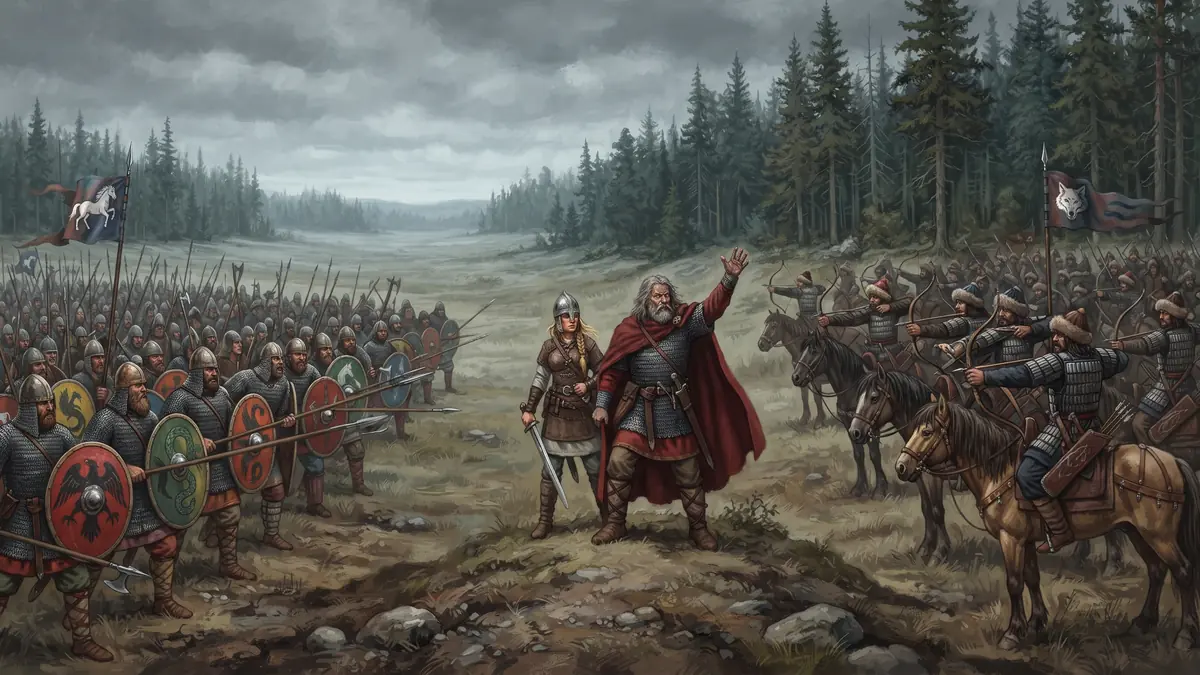
Hlöðskviða is an Old Norse heroic poem, known in English as “The Battle of the Goths and Huns” and in German, at times, as Hunnenschlachtlied. It is preserved within the Hervarar saga ok Heiðreks. The source consulted for this piece summarises the plot, the transmission of the text and the various attempts to link the poem to historical events. This piece separates what the source states from what stays open.
The plot
Heiðrekr is king of the Goths and has two sons: Angantýr, the only legitimate heir, who inherits the kingdom, and Hlöðr. Hlöðr’s mother is a daughter of Humli, king of the Huns, and he is born and raised among the Huns. Hlöðr claims half the inheritance. Angantýr refuses to divide it evenly, and war begins. Their sister, Hervör, is named among the casualties, and then Hlöðr himself.
After Heiðrekr’s death, Hlöðr goes to Árheimar to claim half the Gothic realm. His demand refers to a forest on the boundary between the Goths and the Huns and to a “holy grave”, which seems to be an important Gothic sanctuary. The background of this sanctuary is unknown. Angantýr offers Hlöðr a third of the realm. Gizur, Heiðrekr’s former foster-father, says this is more than enough for the son of a slave. Hlöðr returns to the Huns, and Humli, enraged by the insult, gathers an army. The poem ends with Angantýr finding his brother dead and acknowledging that he was the killer.
How the poem reached us
The poem is preserved in 29 stanzas, or parts of stanzas, interspersed through the saga, and most are narrative, not speech. The saga is now mostly prose, but the original was probably verse, and there are signs of this in the prose. Source H is the Hauksbók (AM 544), from the early 14th century, and source R is a 15th-century parchment (MS 2845). The final parts, including Hlöðskviða, are absent from H and truncated in R. The rest survives in better-preserved 17th-century paper copies. Christopher Tolkien (1960) proposed that the poem existed as a complete, independent narrative outside the saga.
Which battle?
The source says that most scholars date the tale to the 4th and 5th centuries. The poem is an epic that telescopes and fictionalises history. Among the identifications proposed are the Battle of the Catalaunian Plains, in 451, a battle between Ostrogotha and Fastida, king of the Gepids, and a conflict between Gepids and Huns after the death of Attila. The source says the identification of the people in the poem with historical figures is “equally confused”.
Terms
Goths and Huns are peoples of the Migration Period. Hauksbók is a Norse manuscript from the early 14th century. A stanza is a unit of verse. To fictionalise is to turn facts into a fictional narrative.
What remains uncertain
The identities of persons, places and events have no clear answer among scholars. The source does not mention the sword Tyrfing or describe Hervör’s fate beyond naming her among the casualties. One verse refers to a place name linked to “Danpar”, which the source does not explain. The text also shows signs of different dates of composition, so the poem cannot be treated as the work of a single period.
To put a line of warriors in order, from the shortest to the tallest, by swapping neighbours, play The line of warriors.
Sources.
- Wikipedia, "Hlöðskviða" (plot, Hervarar saga, manuscripts H and R, Christopher Tolkien, historical identifications, parallel traditions)