Rindr: the mother of Váli, Odin's spell and Saxo Grammaticus's princess Rinda
Rindr is the mother of Váli, the son of Odin who avenges Baldr. See what the Prose Edda, a poem by Kormákr and Saxo Grammaticus say, with Saxo turning her into a princess of the Ruthenians, and what is uncertain about her name.
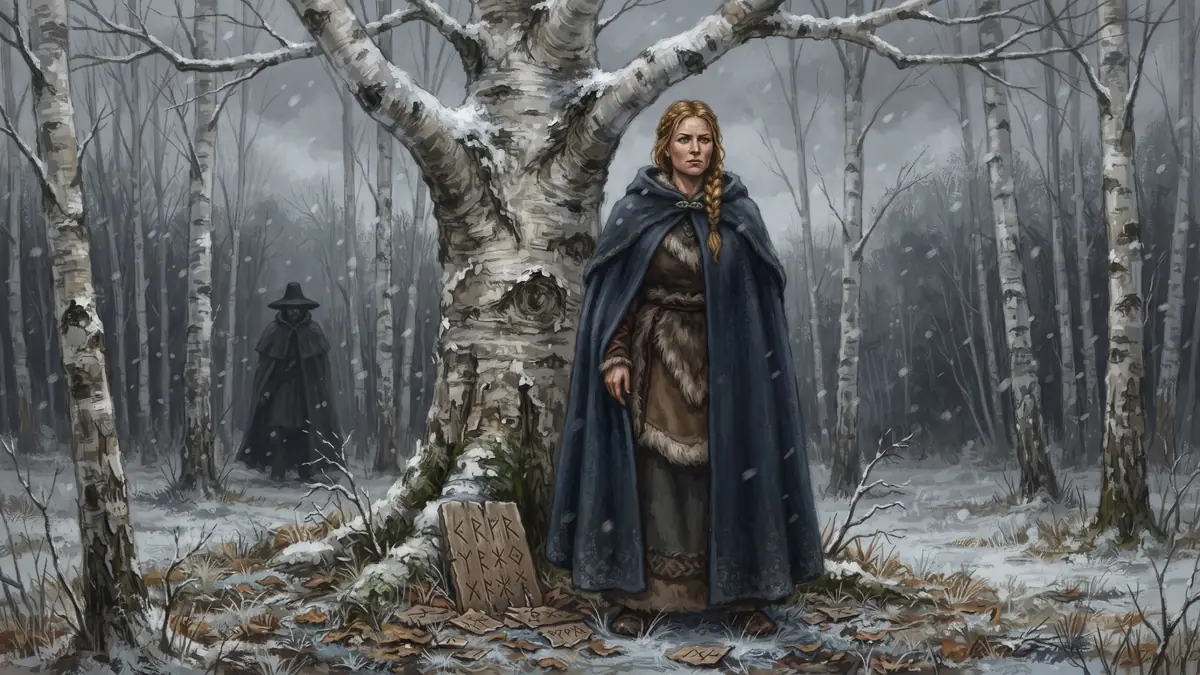
Rindr, sometimes written Rind in English, is a female figure of Norse mythology, the mother of Váli, the son of Odin born to avenge the death of Baldr. The source consulted for this piece gathers what the Prose Edda, skaldic poems and the work of Saxo Grammaticus say about her. The Norse texts say little, and the longest version, Saxo’s, is of another kind: it turns the goddess into a human character. This piece keeps that difference in view.
What the Norse sources say
In the Prose Edda, in the Gylfaginning, which draws on earlier material, Rindr is the mother of Váli and one of the ásynjur, the goddesses. Her name also appears in several skaldic verses and in the Eddic poem Baldrs draumar. One important verse is stanza 3 of the Sigurðardrápa, by Kormákr Ögmundarson, a poem praising Sigurðr Hlaðajarl, who ruled around Trondheim in the middle of the 10th century. In it, Yggr, a name that may refer to Odin, enchants Rindr, using the verb síða. The verse gives no further details. In Grógaldr, stanza 6, the name Rani appears as the one who chanted a charm to Rindr.
The name
The name is sometimes Anglicised as Rind. The alliteration in Baldrs draumar suggests that the original form may have been *Vrindr. The source records a possible link with the Swedish place names Vrinnevi or Vrinnevid, near Norrköping, but presents the etymology as uncertain.
Saxo Grammaticus’s version
In Book 3 of the Gesta Danorum, written by the Danish historian Saxo in the 12th century, the story is told in a euhemerised way, that is, with the gods treated as people. Rindr becomes Rinda, a human princess and daughter of the king of the Ruthenians, a Slavic people. After the death of Balderus, who is Baldr, Othinus consults seers about how to avenge him. He travels to the Ruthenians disguised as a warrior called Roster, but Rinda rejects him twice. Then Othinus carves runes on a piece of bark and touches her with it, and Rinda goes mad. Afterwards he disguises himself as a healing woman, named Wecha, and comes to attend her. Saxo describes a sexual assault on Rinda, and the son who is born, Bous, is the one who later avenges Balderus.
Váli and Bous
In the Norse sources the avenger is Váli. In Saxo, the avenger is Bous. The two figures fill the same place in the story, and the source presents them as parallel, not as the same person.
Terms
Ásynjur is the plural of ásynja, “goddess” of the Æsir group. Skaldic concerns the poetry of the skalds, the court poets. Euhemerism is the reading that treats gods as human beings of a distant past. Gesta Danorum is the history of the Danes written by Saxo.
What remains uncertain
The etymology of the name is uncertain, and the link with Vrinnevi is only a possibility. Kormákr’s verse says only that Yggr enchanted Rindr, without giving further detail. The identity of Rani in Grógaldr is not explained in the source. The Norse sources do not describe the meeting between Odin and Rindr in the detail Saxo gives, and the story of Rinda in Saxo is a late and reworked version, not a parallel account of the same kind.
To open a way by turning stretches of path until they reach the exit, as Odin had to open his way to Rinda, play The way to Rindr.
Sources.
- Wikipedia, "Rindr" (Gylfaginning, Kormákr Ögmundarson's Sigurðardrápa, Baldrs draumar, Grógaldr, Saxo's Gesta Danorum, etymology)