Svarfdœla saga: the valley of Svarfaðardalur, Karl, Ljótólf and a saga in two parts
Svarfdœla saga tells of disputes in the settlement of Svarfaðardalur, in northern Iceland. See what two sources say about the plot, the date and the transmission, and what remains uncertain.
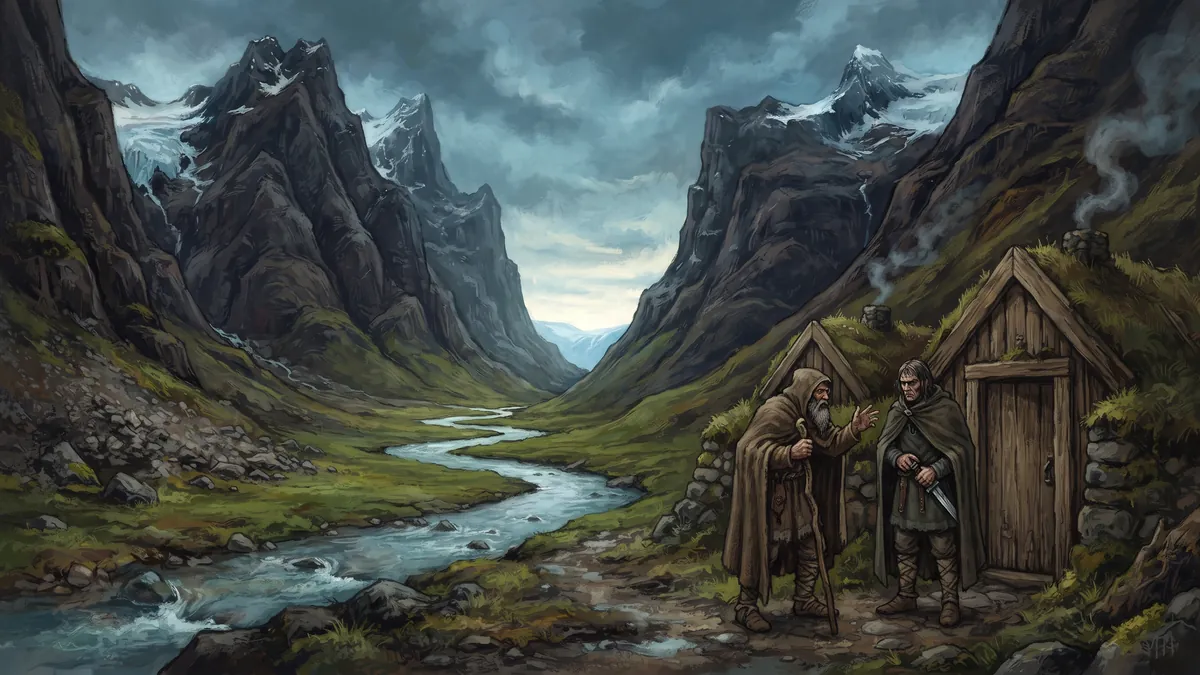
Svarfdœla saga is one of the sagas of Icelanders. The name comes from Svarfaðardalur, a valley in northern Iceland, on the west side of the fjord Eyjafjörður, where the disputes it recounts take place. For this piece we use two sources, an encyclopaedia in English and a Norwegian entry, and the two do not always speak of the same characters, which we will point out. We separate what they state from what stays open.
What the saga is about
According to the English source, the saga deals with disputes in the early days of the settlement of Svarfaðardalur. The family at the origin of the story comes from Norway and spans three generations. Thorstein Svarfað arrives in Iceland from Namdalen, with his youngest son, Karl. Most of the saga revolves around Karl and his relationship with Ljótólf, the local chieftain, who in Icelandic society holds the title of goði.
The two parts
The Norwegian entry describes the saga in two parts. The first has adventures like those of the fornaldarsögur, the sagas of ancient times. In it, a character called Torstein Torgnysson rises from humble origins to become a famous warrior and marries the daughter of a jarl of Götaland. The second part deals with families of Svarfaðardalur and a dispute among them. Between one part and the other the narrative jumps, and the entry attributes this to a lacuna in the exemplar used for the 17th-century copy.
Date and transmission
The English source says the saga was first recorded in the first half of the 14th century. The Norwegian entry says that it is mentioned in Landnámabók, from the 13th century, and that the version we know seems to have been written in the late 14th century. Of it only a single medieval parchment leaf survives, from the 15th century. The complete text exists in a 17th-century copy, from which many later copies derive.
A recent study
The English source cites a chapter by Rebecca Merkelbach, from 2020, titled “The Coarsest and Worst of the Íslendinga Sagas”, published in the book Margins, Monsters, Deviants. The source does not summarise what the chapter concludes.
Terms
Saga of Icelanders is a type of prose narrative about Iceland in its first centuries. Goði is a local Icelandic chieftain. Fornaldarsögur are the sagas of ancient times. A lacuna is a gap in a text, a part that has been lost.
What remains uncertain
The two sources differ on the date: the first speaks of the first half of the 14th century, and the second of the end of the 14th century. They also give different names for the opening character, Thorstein Svarfað and Torstein Torgnysson, and the sources do not clarify whether they are the same person. Because there is a lacuna in the 17th-century copy, the link between the two parts of the saga is left unclear, and neither source details the characters of the dispute or the events of the lost part.
To put the plots of a valley into the right order, sliding one at a time, play The pieces of the valley.
Sources.
- Wikipedia, "Svarfdæla saga" (plot, Thorstein Svarfað, Karl, Ljótólf, dating, Rebecca Merkelbach's 2020 chapter)
- Store norske leksikon, "Soga om svarvdølane" (two parts, Landnámabók, manuscripts, lacuna in the 17th-century copy)