Bjarnar saga Hítdœlakappa: two poets, one woman and a fatal feud
Bjarnar saga Hítdœlakappa tells of the rivalry between the poet Björn and Þórðr, who marries Oddný, the woman promised to Björn. See what two sources say, where they differ and what the text does not preserve.
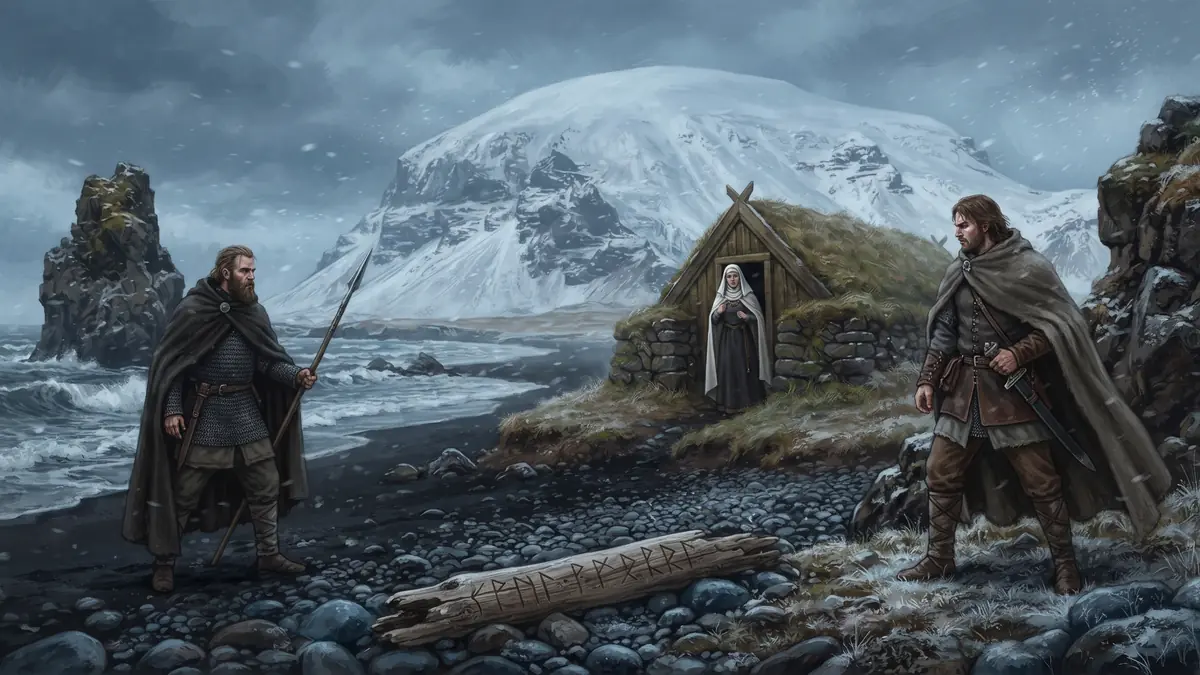
Bjarnar saga Hítdœlakappa, the “Saga of Björn, the champion of Hítardalur”, is a saga of Icelanders about the rivalry of two poets for the love of the same woman. This piece uses two sources, an encyclopaedia in English and an academic article by Daniel Sävborg, and separates what they state from what they leave open.
The characters
According to the first source, Björn was born in 989 and fostered at Borg á Mýrum, where he grew up with Skúli Þórsteinsson. Þórðr Kolbeinsson, also a poet, becomes Björn’s friend in Norway. Oddný Þorkelsdóttir is the woman Björn asks to marry.
The plot
The first source summarises it thus: Þórðr promises to carry Björn’s proposal to Oddný, falsifies the message, spreads word that Björn has died and marries her. The second tells it differently: Björn travels abroad after becoming betrothed to Oddný, and Þórðr, believing him dead, marries her. In both, when Björn returns, the love between him and Oddný shows on a winter visit, Þórðr grows jealous and an exchange of insulting verses escalates into a fatal feud. The first source places the main conflict near Snæfellsnes between the years 1000 and 1025, and the story ends with Björn dead and Þórðr sentenced at the Thing, the assembly.
How the text reached us
The first source cites two 14th-century parchment manuscripts, among them AM 162 f fol., and two 17th-century paper ones. The second says the separate saga survives in AM 551 d 4to, a 17th-century copy of a 14th-century vellum, and that the fragment AM 162 f fol. lacks the opening chapters. These survive in copies of a lost work, the Bæjarbók, inside an expanded Óláfs saga helga.
How it is read
The traditional reading makes Björn the hero and Þórðr the villain. Sävborg proposes another: Þórðr would be a more complex figure than the traditional villain. He argues that the verses, quoted in great number, express emotions that the prose often omits. Other scholars he cites see mainly a conflict, almost “the pure pattern” of a feud saga, and little love interest.
Terms
A skald is a court or aristocratic poet of the Norse world. The Thing is the assembly where disputes and laws were decided. Parchment is a skin prepared for writing.
What remains uncertain
The text is incomplete, since no manuscript carries the whole saga. The date of composition is not given in the first source and is disputed in the second: the early 13th century, for Bjarni Einarsson, around 1300 or later, for Bjarni Guðnason, and not much before 1230 if romances influenced it, according to Sävborg. The two sources also differ on the falsification of the message, which only the first mentions.
To decipher a secret sequence of coloured seals, as in a swapped message, play The forged message.
Sources.
- Wikipedia, "Bjarnar saga Hítdœlakappa" (plot, characters, manuscripts)
- Daniel Sävborg, article on eroticism, love and emotion in Bjarnar saga Hítdœlakappa (core.ac.uk), with dating, manuscripts and readings of the saga