Sinfjötli: Sigmund's son, the wolfskins and the vengeance of the Völsungs
Sinfjötli, in the Völsunga saga, is born of Sigmund and his sister Signý, puts on a wolfskin and helps avenge the family, but dies poisoned. See what two sources say and what they leave uncertain.
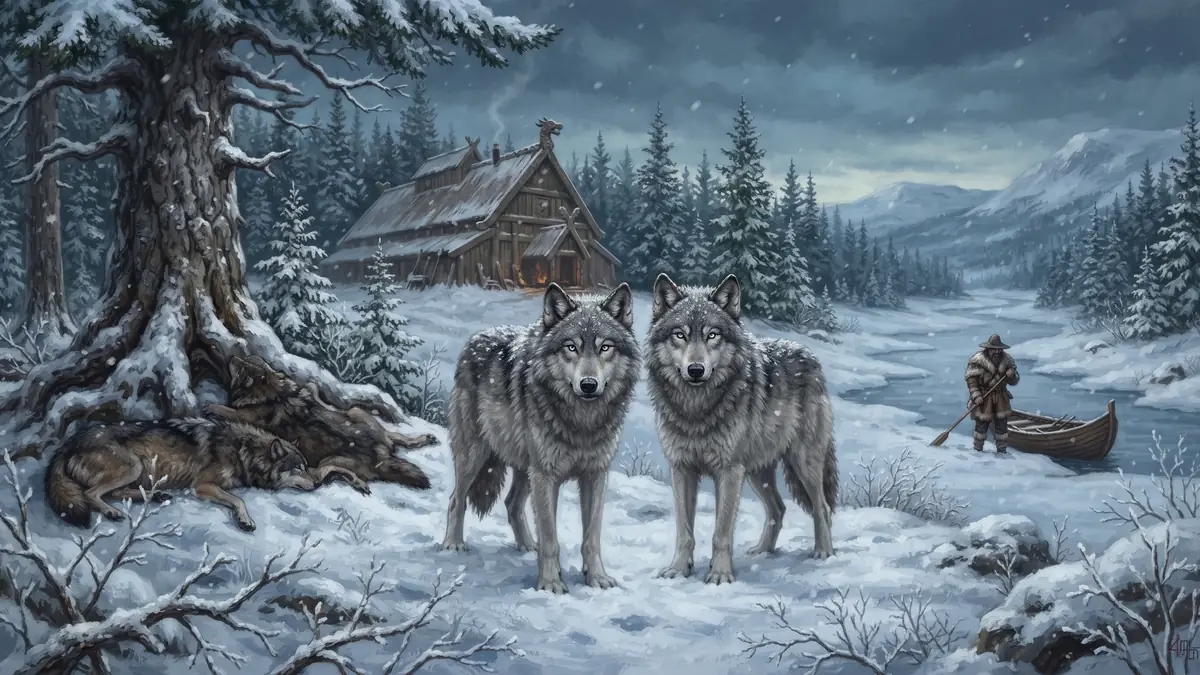
Sinfjötli is a character of the Völsunga saga, the saga of the Völsungs, the family of Sigmund. He is the son of Sigmund and of his own sister, Signý, and appears putting on wolfskins, avenging his father and dying poisoned. This piece uses two sources, two entries of an encyclopaedia in English, and separates what they state from what they leave open.
The birth
According to the first source, Signý, Sigmund’s sister, disguises herself as a völva, a seeress, and Sigmund does not recognise her. From this Sinfjötli is born, son of the two.
The wolfskins
According to the first source, father and son kill men who sleep inside cursed wolfskins, put on the skins and are left with the curse of lycanthropy. The first source records that the two take vengeance on Siggeir.
The death
Sinfjötli is poisoned by Borghild, and Odin, as a ferryman, takes his body.
The other mentions
The first source recalls that the poem Helgakviða Hundingsbana I contains an accusation, made by Guðmundr, that Sinfjötli is a werewolf. It also links the name to the Fitela of Beowulf. The second source gives the frame of the work: the Völsunga saga is a prose saga of the late 13th century, made from older legends, with a single manuscript, Ny kgl. Saml. 1824 b 4to, from about 1400, joined to the Ragnars saga. The source cites in it the she-wolf episode, in which Sigmund bites out the animal’s tongue, and the Ramsund carving, from about 1000.
The story in order
To sum up what the sources say, the sequence is this: Sinfjötli is born of Sigmund and his sister, Signý, who disguises herself as a völva. Father and son put on cursed wolfskins and are left with the curse of lycanthropy. They take vengeance on Siggeir. In the end, Borghild poisons Sinfjötli, and Odin, as a ferryman, takes his body.
Terms
A völva is a Norse seeress. A werewolf is a person who turns into a wolf. Völsungs is the name of Sigmund’s family. A manuscript is a text written by hand.
What remains uncertain
The second source observes that the she-wolf of the episode may be the mother of Siggeir, which the saga itself does not state. The sources treat Sinfjötli sometimes as the son and sometimes as the nephew of Sigmund. The etymology of the name and the reason Odin appears at the death also remain unanswered in the sources. Since the text is from the 13th century and the manuscript from about 1400, and the underlying legends are older, it is not possible to say what is oldest in the version we have.
To turn two linked rings until the beads match the target image, like two skins put on, play The two wolfskins.
Sources.
- Wikipedia, "Sinfjötli" (birth, wolfskins, death, other mentions)
- Wikipedia, "Völsunga saga" (date, manuscript, the she-wolf episode, the Ramsund carving)