Auðun of the West Fjords: the polar bear, the Danish king and the gold ring
A poor Icelander buys a polar bear in Greenland and takes it as a gift to a king. The tale of Auðun passes through Norway, Denmark and Rome. See what two sources say, which versions exist and what remains uncertain.
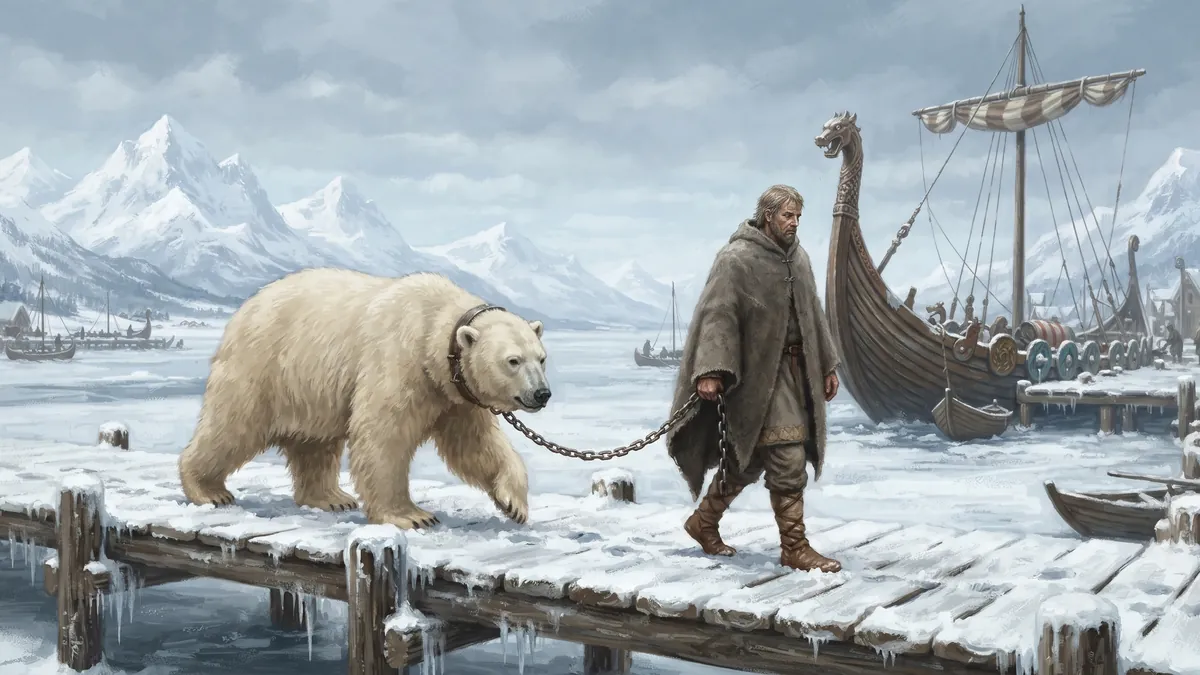
The tale of Auðun of the West Fjords is a short tale, or þáttr, of medieval Icelandic literature. This piece uses two sources, an entry of an encyclopaedia in English and a text from the site WE Vikings with a summary of the plot. What comes from scholars is marked.
The plot
Auðun is a poor Icelander, from the West Fjords. In Greenland, he buys a polar bear and decides to take it as a gift to King Sveinn of Denmark, the Sweyn of the entry. In Norway, King Haraldr lets him pass. Later, a steward called Áki asks for half of the bear, and Sveinn banishes him.
Rome and the return
After delivering the bear, Auðun goes on a pilgrimage to Rome. He comes back bald and ill, and King Sveinn gives him a ship, silver and an arm ring. Auðun passes by Haraldr and gives him the ring, to pay for the passage that he had allowed him. Haraldr, in turn, gives Auðun a sword and a cloak. Auðun ends up rich, back in Iceland.
The versions
The entry cites three versions of the tale: the Morkinskinna, from about 1275, the Flateyjarbók, from about 1390, and the Hulda, from about 1350 to 1374. Sveinn II reigned from 1047 to 1074 or 1076, which places the plot in the second half of the 11th century. That does not mean the episode is a fact.
What scholars say
Ciklamini calls the tale “a historified folktale”, that is, a story of popular tradition that took the names of real kings. Miller analyses Auðun’s name and luck and the exchange of gifts. Gwyn Jones praised the tale.
Giving and repaying
The plot is a chain of gifts. Auðun gives the bear to Sveinn, and Sveinn gives him a ship, silver and an arm ring. Auðun gives the ring to Haraldr, and Haraldr gives him a sword and a cloak. Each gift received comes back as another gift, and this is what the scholar Miller dwells on when he speaks of the exchange of gifts.
In brief
A poor man crosses three kingdoms with an expensive gift and returns a gift to each one who helped him. The story deals with generosity and with giving what is owed. It is tied to named kings, but the entry treats it as a tale, not as a historical account.
Terms
A þáttr is a short tale. An arm ring is a jewel worn on the arm that was also given as a gift of value. A pilgrimage is a journey to a holy place. Historified means that it was given a background of history.
What remains uncertain
The sources do not say whether Auðun existed. The dates of the versions are approximate. The entry gathers the opinions of scholars, and each one is a reading, not a fact. The WE Vikings summary was used only for the plot, and the dates and the opinions come from the entry.
To find the path of lowest cost to the king, play The bear’s road.
Sources.
- Wikipedia, "The Tale of Auðun of the West Fjords" (summary, manuscripts, dates, scholars cited)
- WE Vikings, text on the Auðunar þáttr vestfirzka (plot summary)