Ratatoskr: the squirrel who runs along Yggdrasil carrying messages between the eagle and Níðhöggr
In Norse mythology, a squirrel called Ratatoskr goes up and down the tree Yggdrasil carrying messages between an eagle, at the top, and Níðhöggr, below. See what the texts say, what the name means and what scholars propose.
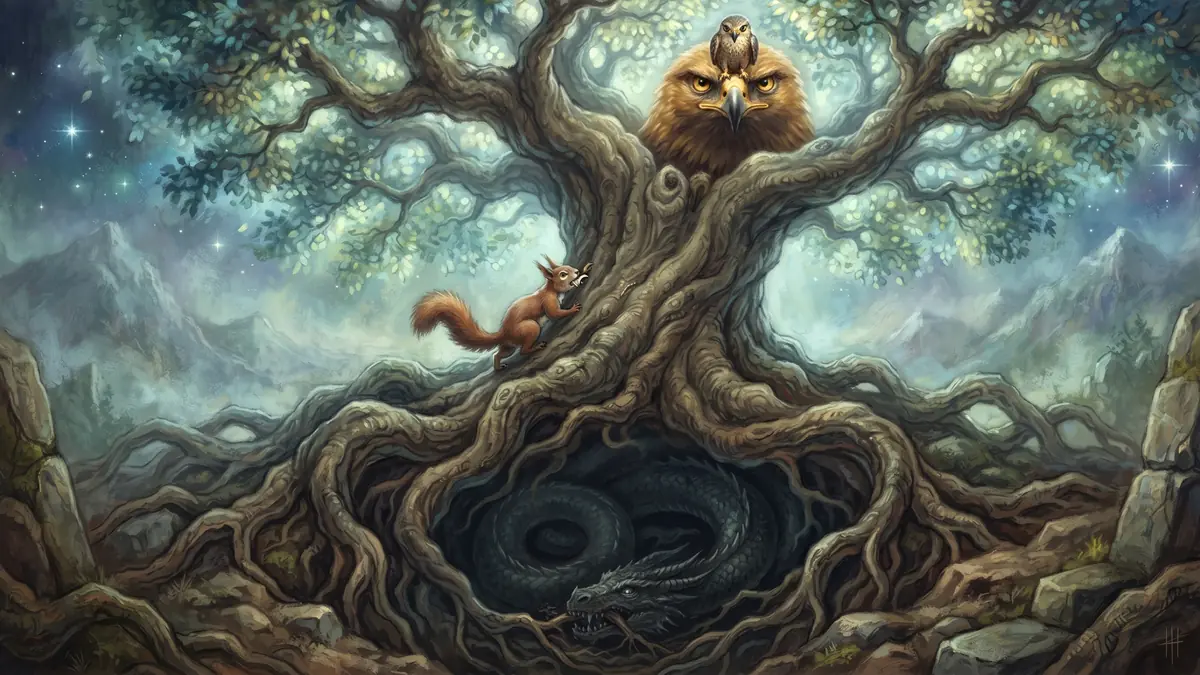
Ratatoskr is a squirrel of Norse mythology who lives in the tree Yggdrasil. This piece uses two sources, an entry of an encyclopaedia in English and a text of the site Skjalden on the tree. What is a scholars’ theory is said to be a theory.
What the texts say
In the Grímnismál, Odin, disguised as Grímnir, says that Ratatoskr runs up and down Yggdrasil and carries messages between the eagle, at the top, and Níðhöggr, below. In the Gylfaginning, in chapter 16, Snorri describes the eagle that is at the top of the ash and knows many things, and the hawk Veðrfölnir, sitting between its eyes. Snorri adds that Ratatoskr spreads “slanderous gossip” and so provokes the eagle and Níðhöggr. The passage of the Grímnismál does not speak of gossip.
The tree and its creatures
The eagle sits at the top of the ash, and Níðhöggr lives under one of the three roots. The Skjalden text says that the squirrel carries insults back and forth and, with that, keeps the two enemies hostile. Since a hawk fits between the eagle’s eyes, it would have to be much larger than an ordinary eagle, and its nature is not well known. The text also recalls that only Snorri mentions the eagle and the hawk together at the top, and for that reason the existence and role of the hawk are uncertain. Four stags, Dáinn, Dvalinn, Duneyrr and Duraþrór, live among the branches and eat the leaves.
The name
The name is read, in general, as “drill-tooth” or “bore-tooth”, and the second element, toskr, would be “tusk”. Vigfússon, in 1874, proposed that rati- means “the traveller”, which would give “tusk the traveller” or “the climbing tusk”. Bugge proposed a loanword from Old English, “rat-tooth”. Sturtevant, in 1956, rejected that reading. He cited the Hávamál, stanza 106, in which Rata names Odin’s boring instrument, and concluded that Rati means “the borer, the gnawer”. Simek, Byock, Orchard and Lindow accept that explanation.
How scholars read the squirrel
Simek thinks that the squirrel “probably only represents an embellishing detail” in the Grímnismál. Davidson sees in the gnawing a cycle of destruction and renewal. Lindow notes that, in the sagas, those who carry malicious words between feuding parties rarely have high status, and this perhaps explains giving the role to a small animal. Thorington Jr. and Ferrell suggest that the role may come from the alarm calls of European red squirrels. It is a theory.
In brief
A squirrel makes the way between the crown and the roots of an enormous tree and links two enemies. For a poem, he carries messages, and for Snorri, he carries gossip. The name speaks of teeth and of boring, and the readings of his role range from simple ornament to a sign of renewal.
Terms
Grímnismál is a poem in which Odin, disguised, speaks of myths. Gylfaginning is the part of the prose Edda that describes the world of the gods. Etymology is the origin of a word. A loanword is a word taken from another language.
What remains uncertain
The meaning of the name is generally accepted, but it is not certain, and Vigfússon and Bugge proposed other readings. The role of the squirrel may be only an embellishing detail. The existence of the hawk depends on Snorri. The readings of Davidson, of Lindow and of Thorington Jr. and Ferrell are theories. The sources used here do not give the stanza number of the Grímnismál or the manuscripts.
To find the pairs of creatures of the tree by turning the cards, play The creatures of the tree.
Sources.
- Wikipedia, "Ratatoskr" (Grímnismál, Gylfaginning ch. 16, etymology, interpretations of Simek, Davidson, Lindow and others)
- Skjalden, "Yggdrasil" (the squirrel, the eagle, Veðrfölnir, Níðhöggr, the four stags)