Selkie: the seal who sheds her skin and becomes a person in the northern isles of Scotland
In Orkney and Shetland, folklore speaks of seals that shed their skin and become people, and of a bride who loses her skin. See what two sources say about selkies, the variants that exist and the theories of origin.
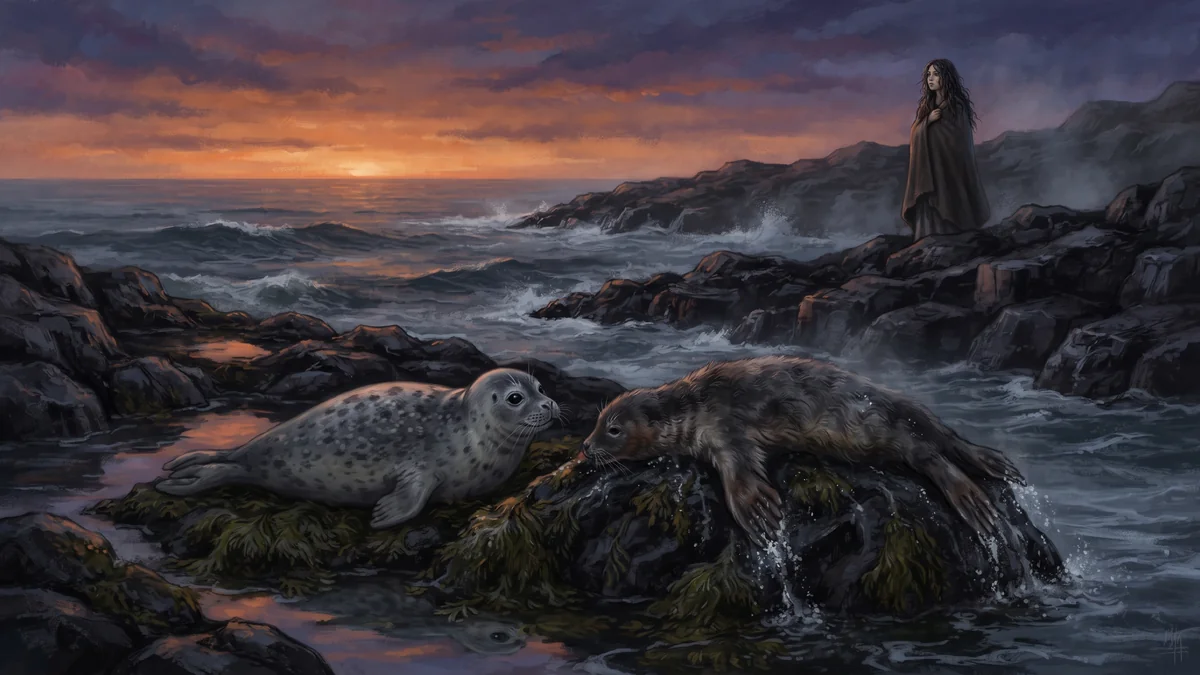
Selkies are beings of the folklore of the northern isles of Scotland, described as seals that change shape. This piece uses two sources, an entry of an encyclopaedia in English and a text of the site My Voyage Scotland. The theories of origin are marked as speculation.
The name and the place
Selkies appear above all in the northern isles, Orkney and Shetland. The name comes from the Scots selch, which means “grey seal”. The entry describes the selkie as a seal that sheds its skin and becomes a person.
The tale of the stolen skin
The best-known tale is that of the bride of the stolen skin. In it, a selkie has her skin stolen and becomes the bride of a human. According to the sources, it is the best-known tale about selkies, and it appears in several versions.
The variants
The entry lists versions from several places. In Orkney, there are those of Wastness, on North Ronaldsay, and of Deerness. There is one in Unst, in Shetland. In Iceland, there is “Selshamurinn”, recorded by Jón Árnason. In the Faroe Islands, there is “Kópakonan”. And there is a song, “The Great Silkie of Sule Skerry”.
What the variants show
The same story appears with different names and places: in Orkney, in Shetland, in Iceland and in the Faroes. This shows that the theme of the seal who becomes a person is known on several islands of the North Atlantic, but it does not say where it came from, and the sources do not affirm that the versions have a single origin.
Selkies and Finfolk
Dennison, Marwick and Bruford disagree about whether selkies were confused with the Finfolk, another group of the folklore of Orkney. This confusion is debated, and the sources do not settle it.
The theories of origin
The entry mentions ideas about where the stories might have come from: Sami kayaks, the Inuit, Spaniards and souls of the drowned. These theories are speculative, and none prevails firmly over the others.
In brief
The selkie is a seal that sheds its skin, and the central tale is that of the stolen skin. The variants run from Orkney to Iceland and the Faroes, and the tradition even has a song. The origin of the stories remains open, and the sources say so clearly.
Terms
Selkie is the seal that becomes a person in folklore. Selch is the Scots word for grey seal. Folklore is the body of stories and beliefs of a people. A variant is a different version of the same story.
What remains uncertain
Where the stories came from is not known. The theories of the Sami kayaks, of the Inuit, of the Spaniards and of the souls of the drowned are speculation. Scholars disagree about the confusion with the Finfolk. The summaries used here also give no date for the beginning of the tradition.
To tap the seals before they vanish on the rocks, play The seals on the rocks.
Sources.
- Wikipedia, "Selkie" (name, variants, Orkney, Unst, Iceland, Faroe Islands, Sule Skerry, theories)
- My Voyage Scotland (myvoyagescotland.com), text on selkies (general description and the tale of the stolen skin)