Norse place-names in England: what -by, -thorpe and -thwaite say about the Danelaw
Many hundreds of place-names of England, above all in the old Danelaw, have a Scandinavian origin. See what two sources say about the endings -by and -thorpe and why a name does not prove who the people were who gave it.
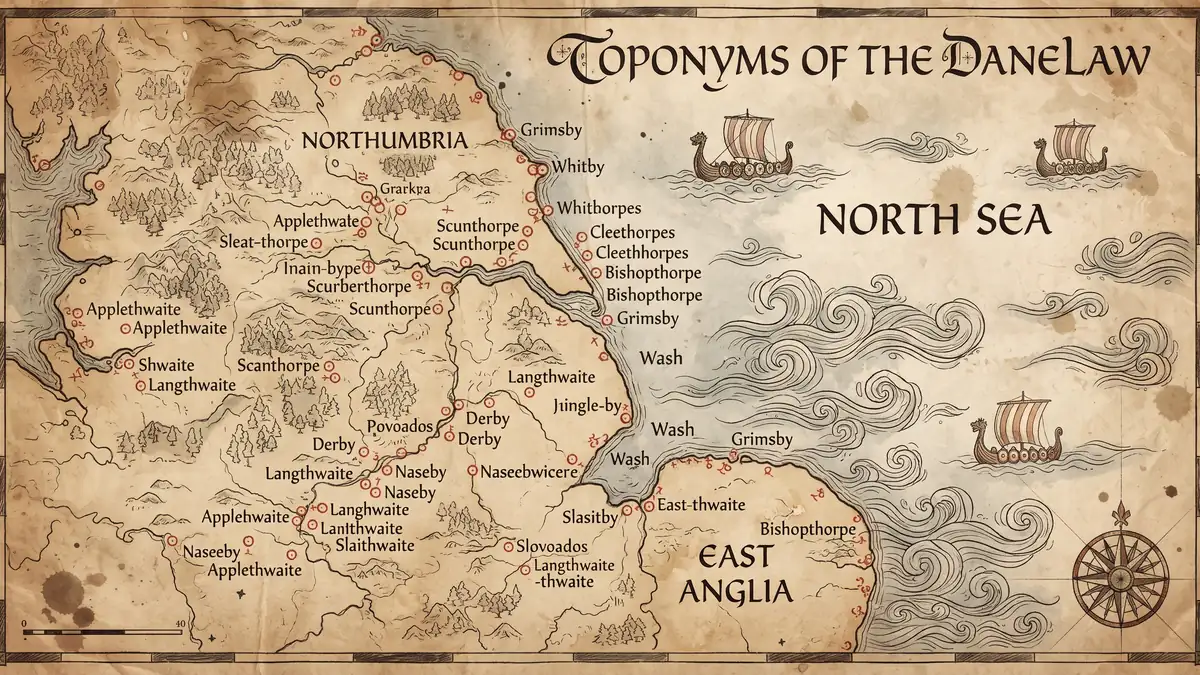
In parts of the east and north of England, many place-names end in -by or in -thorpe. This piece uses two sources, a text of the site viking.no and a page of the site family-tree.co.uk. They describe the most common endings and explain why caution is needed when drawing conclusions from a name.
The Danelaw
The Danelaw is the region of England where, in the Viking Age, the Scandinavian presence was strong. According to the sources, there are there many hundreds of place-names of Scandinavian origin, and this is what allows one to speak of a Norse mark on the map.
The most common endings
The ending -by means “farmstead” and is the most common, with a concentration in Lincolnshire. The ending -thorpe indicates a secondary settlement, which arises as an overflow of a larger one. Other endings cited are -toft, -kirk and -ness. The ending -holme is tied to land reclaimed from a marsh, and -thwaite is a clearing, and the sources say it would be “supposedly” more Norwegian. The endings -wick and -wich, and also -borough, are ambiguous, and may have other origins.
Hybrid names
There are names formed from two languages. The source cites Grimston and Grimsby when speaking of hybrid names. The idea is that a name may mix elements of different origins, and so the ending alone does not always tell the origin of the whole name.
Cautions
The sources warn that a Scandinavian name does not prove that whoever gave it was Scandinavian. Many names may have been created later. The spellings of the Domesday Book, the English record of the 11th century, vary, and this makes it hard to know the old form of a name.
How the sources complete each other
The two sources agree on the essentials: -by is the most common ending and -thorpe indicates a secondary settlement. The message of caution comes from the sources themselves, which do not treat the name as proof. For that reason the map of endings is a starting point for questions, and not an answer about who lived in each place.
In brief
The endings -by and -thorpe are the best known and are concentrated in the Danelaw. They indicate farmsteads and secondary settlements, and other endings complete the picture. What the map shows is a presence of Norse words, not a count of people.
Terms
A place-name is the name of a place. A settlement is a small cluster of houses. Hybrid is what mixes two origins. The Domesday Book is an English record of the 11th century.
What remains uncertain
Who the people were who gave the names is not said by the names. When each name was born, and whether it was in the time of the Vikings or after, is not always known. Some endings, like -wick and -borough, are ambiguous. The idea that -thwaite would be more Norwegian is only a supposition of the sources.
To mark the farmsteads by the sums of the rows and columns, play The farmsteads of the Danelaw.
Sources.
- viking.no, text on Scandinavian place-names in England (elements, Danelaw, concentration in Lincolnshire)
- family-tree.co.uk, page on place-names of Viking origin (elements, hybrid names, cautions)