Eiríksmál: the poem that welcomes Eric Bloodaxe into Valhalla
Eiríksmál is a skaldic poem of about 954, made at the request of Queen Gunnhild to honour Eric Bloodaxe. See what the entry says about the poem, the dialogue in Valhalla and what has been lost.
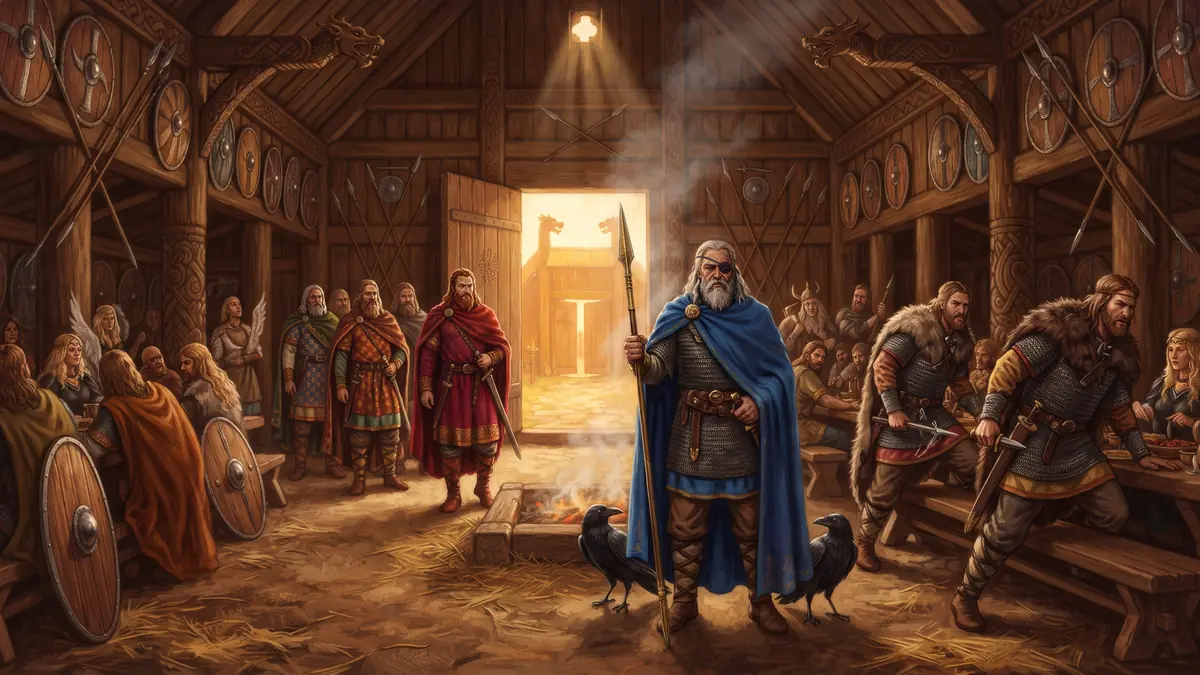
Eiríksmál is a skaldic poem, that is, a poem that deals with a historical person. This piece uses one source, an entry of an encyclopaedia in English, and points out where that source is itself incomplete.
The poem and the queen’s request
According to the entry, Eiríksmál was composed around 954 at the request of the Norwegian queen Gunnhild. It honours her consort, Eric Bloodaxe, who had died. Only the beginning of the poem survived. The author is anonymous, that is, unknown.
Who Eric was
The entry bases the story of Eric on Roger of Wendover. According to that chronicler, Eric, described as a Viking ruler, was betrayed and killed on Stainmore in 954. He was on the run after being expelled from York. Eric was king of Northumbria in two periods, around 947 to 948 and 952 to 954.
The form of the poem
Although it deals with a historical figure, the poem does not use the ornate metre dróttkvætt. It uses fornyrðislag, and the entry says that this brings it close to the poems of the Poetic Edda. The later poem Hákonarmál seems to have been modelled on Eiríksmál.
The dialogue in Valhalla
The poem is made as a dialogue between Eric, the gods Odin and Bragi and the legendary hero Sigmund. In the passage that survived, the speakers are not identified, and the entry’s translation shows only quotation marks. One of them tells of a dream in which he prepared Valhalla for the arrival of slain warriors and a glorious ruler. Bragi is urged to speak sensibly, since the speaker knows what is happening.
Sigmund and Sinfjötli, mentioned in the passage, are told to rise, go out to meet the ruler and invite him in, if it is Eric. Asked why he expects Eric more than the others, the speaker says that Eric has reddened blades with blood in many lands. Asked why he denied Eric victory when he seemed brave, he answers that it is uncertain when the grey-coated wolf will attack the seat of the gods. Eric is greeted and invited into the hall. Asked who follows him, Eric says there are five kings, and that he himself is the sixth.
Notes of the entry
The entry explains that Balder, son of Odin, was killed without intent by his blind brother Höðr, tricked by Loki, and that the gods failed to bring him back from Hel. It also says that Odin wanted Eric in Valhalla because he needed Eric’s military skills to defend the hall against the forces of chaos.
In brief
Eiríksmál is an anonymous poem, of about 954, made at the request of Gunnhild to honour Eric Bloodaxe. Only the beginning survived. It shows, in dialogue, Odin, Bragi, Sigmund and Eric in Valhalla.
Terms
Skaldic is the kind of poetry about people and events of history. Fornyrðislag is a metre simpler than dróttkvætt. Valhalla is the hall of Odin where slain warriors go. Anonymous means without a known author.
What remains uncertain
The author of the poem is not known, and only its beginning has reached us. Eric’s death comes from the account of Roger of Wendover, which the entry presents as its source. The entry also does not discuss other controversies among scholars.
To put the kings of Eric’s train in the right order, play The kings of the train.
Sources.
- Wikipedia, "Eiríksmál" (date, Gunnhild, dialogue between Odin, Bragi and Sigmund, metre fornyrðislag, relation to Hákonarmál, Roger of Wendover)