Hvalsey: the stone church of Greenland and the wedding of 1408
At Hvalsey, in Greenland, a stone church holds the latest record we have of the Norse of the island: a wedding in 1408. See what two sources say about the church, the record and what is not known.
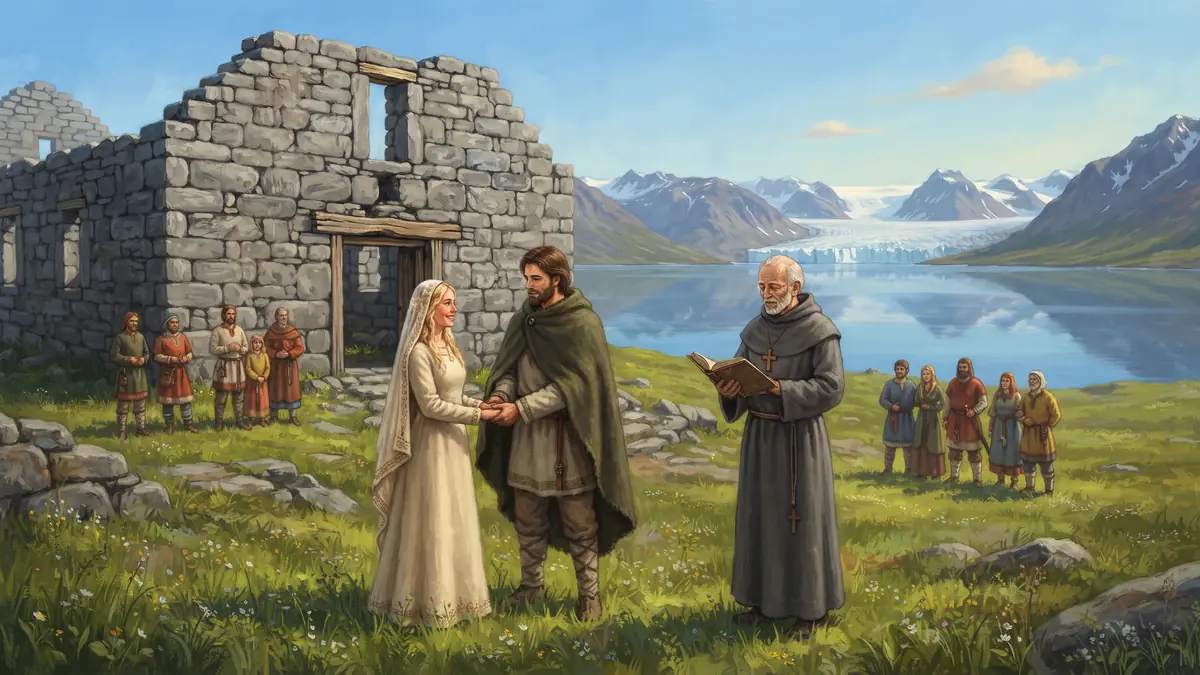
The church of Hvalsey is near Qaqortoq, in southern Greenland. This piece uses two sources, an entry of an encyclopaedia in English and an article of the newspaper Nunatsiaq News. The dates of the two do not coincide, and this is marked.
The church
Hvalsey Church was a Catholic church at an abandoned Norse homestead, on the Hvalseyjarfjord. The church is about 70 m from the water, and the land is now part of a sheep farm. It belongs to the diocese of Garðar. Its walls are of granite fieldstones, carefully laid, some weighing 4 to 5 tonnes. The mortar was made of crushed shells, and so the church would have been white when built. It is 16 m long and 8 m wide, with walls about 1.5 m thick. It held 30 to 35 people. The entry says the roof is thought to have been of wood covered with turf.
The dates of construction
The entry gives two dates: the infobox gives the 12th century, and the text says the church is thought to have been built in the early 14th century, although the finds indicate that it was not the first on the site. It was built in the Anglo-Norman style of the early 13th century. The entry says that the dwelling of the homestead was built on top of a building from the time of Erik the Red, which may have been the home of Thorkell Farserk, and that, according to the sagas, this relative of Erik claimed the land around Hvalsey.
The wedding of 1408
The church hosted the wedding of Thorstein Olafsson and Sigrid Björnsdóttir. The entry gives the date as 14 or 16 September 1408, and Nunatsiaq News gives 16 September, reconstructed from a later document that says the wedding was in autumn, on the Sunday after “Cross Mass”. According to the newspaper, the priests Eindridi Andresson and Pall Halvardsson read the banns on three consecutive Sundays, and no one raised an objection. It is presumed that the same priests performed the ceremony.
The record comes from letters of a priest at Garðar and of several Icelanders. A certificate of 16 April 1409, signed by the bishop’s official at Gardar, now Igaliko, confirms the marriage, but does not state its date. The couple later settled in Iceland, Olafsson’s land. The entry calls the case the last written record of the Greenland Norse. The newspaper says there is, in the record, no sign of the colony’s decline, and cites the historian Finn Gad: “nothing jarred the wedding ceremony on that September Sunday in 1408”.
What remains today
The entry says the church is the best preserved Norse ruin in Greenland, and that it has resisted better than others because it was well built. It has partly collapsed, mainly because it was built over a graveyard, without removing the graves, which made the foundation sink. All doors and windows have straight lintels, except one arched window in the east gable.
The Inuit legend
An Inuit legend tells of a war between the Norse chief Ungortoq and the Inuit leader K’aissape, in which the Inuit would have attacked Hvalsey and burned the Norse in their houses. Archaeological studies show no sign of a fire, which contradicts the legend. The name Qaqortoq means “the white place”, and the entry suggests it may come from the white look of the church.
In brief
The church of Hvalsey is the best preserved Norse ruin in Greenland and the site of the last recorded wedding of the Norse of the island, in September 1408. The banns were read on three Sundays, and a certificate of 1409 confirms the union.
Terms
Banns are the notices read in church before a wedding, for anyone who has an objection. Lintel is the horizontal piece above a door or window. Mortar is the mixture that binds or covers the stones. Anglo-Norman is a style of church of the early 13th century.
What remains uncertain
The exact date of construction is not clear, and an earlier church may have existed. It is not known whether the mortar was between the stones or only as plaster outside, and the turf roof is only a supposition. The link with Thorkell Farserk is uncertain. The date of the wedding comes from a later document, and the officiant is presumed. The Inuit legend contradicts the finds. The newspaper article does not say which source gives the exact day.
To pile stones of many tonnes, one on the other, without letting the wall fall, play The wall of stones.
Sources.
- Wikipedia, "Hvalsey Church" (place, construction, materials, measurements, wedding of 1408, Inuit legend, doubts)
- Nunatsiaq News, "A wedding at Hvalsey Church" (wedding of 1408, banns, certificate of 1409)