Ramsund: the carving of Sigurd on a rock in Sweden, around 1030
On a rock near Ramsund, in Sweden, a serpent band with scenes of the legend of Sigurd was carved around 1030. See what the entry says about the scenes, the family and the other Sigurd stones.
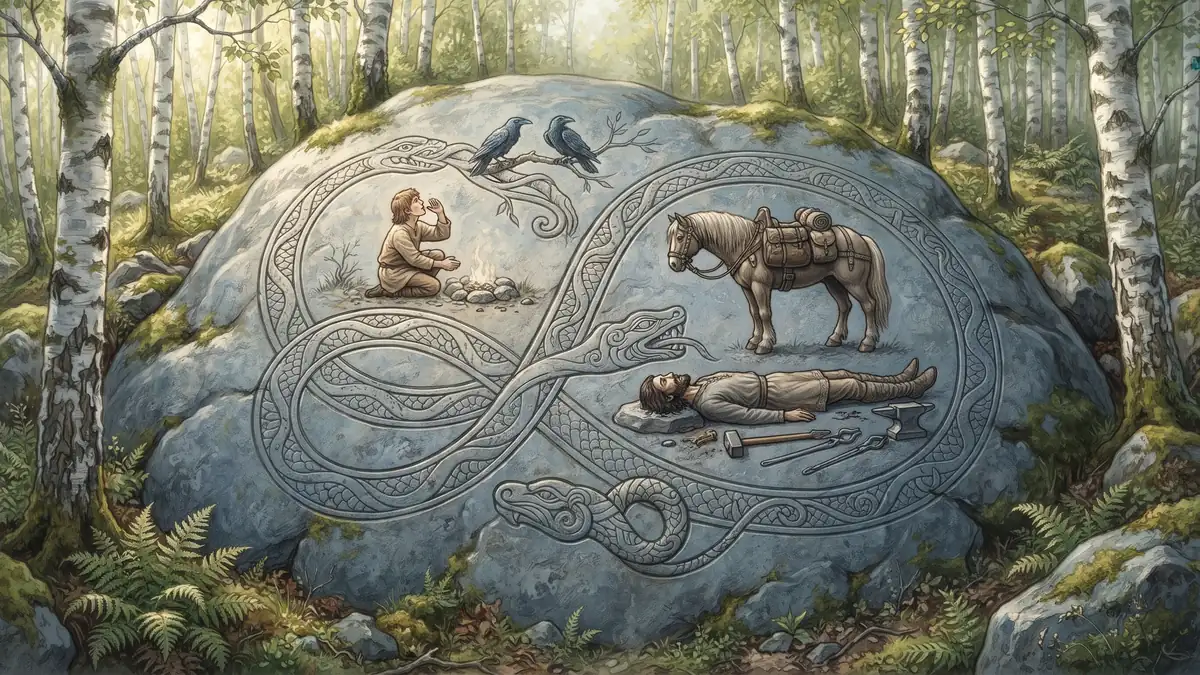
On a flat rock near Ramsund, in Eskilstuna municipality, in Södermanland, in Sweden, there is a carving with scenes of the legend of Sigurd. This piece uses one source, an entry of an encyclopaedia in English on the Sigurd stones. The carving is archaeology, and the legend it shows is fiction of tradition.
The Sigurd stones
According to the entry, the Sigurd stones are eight or nine Swedish runic inscriptions, among five or six runestones, two natural rocks and a baptismal font, plus one picture stone, all with the legend of Sigurd. They were made in the Viking Age and are the earliest Norse representations of the Völsung cycle, the matter of the Nibelungenlied, of the Eddas and of the Völsunga saga. The entry also recalls stones in Great Britain, at Ripon, Kirby Hill, York and Halton, and slates from the Isle of Man, of about 950 to 1000, with scenes read as Sigurd’s.
The Ramsund carving
The Ramsund carving is an engraving on a flat rock, not a runestone. The entry says it is believed to be from about 1030 and calls it an important piece of Norse art. It shows Sigurd sitting, naked, by the fire, preparing Fafnir’s heart for his foster-father Regin, Fafnir’s brother. He burns his finger, puts it in his mouth and then understands the song of the birds. The birds warn that Regin will break the promise of peace and try to kill him, and Sigurd cuts off Regin’s head. Regin lies dead beside his head, with the smith’s tools he used to reforge Sigurd’s sword, Gram, scattered around. The horse Grani carries the dragon’s treasure. Also shown are the earlier killing of Fafnir and Ótr, another brother of Regin, from the beginning of the saga.
The family behind it
The inscription was made for the same aristocratic family as the nearby runestones of Bro and Kjula. The entry gives two readings of the kinships. In one, Sigríðr is the widow of Sigrøðr, and Holmgeirr was her father-in-law, and Alríkr, her son, raised a stone for his father, Spjút, and so was not Sigrøðr’s son. In the other, Holmgeirr was Sigríðr’s second husband, and Sigrøðr, but not Alríkr, was their son. The entry suggests that the similarity between Sigurd and Sigrøðr may have inspired the image. Bridge-building is a frequent theme on 11th-century stones, with references that are partly Christian.
The Gök stone
On a rock at Gök, about 5 km west of Strängnäs, the entry describes a stone 2.5 m wide and 1.65 m high, of the same period. The runic text runs on two serpents that surround much of the scenes, the same as at Ramsund, but with a Christian cross added and the scenes combined in a way that undoes the logic of the narrative. For some scholars, the carver misunderstood the myth or altered it on purpose, and the stone would show the pagan heroic myth dissolving during Christianization.
The Drävle stone and others
On the Drävle stone, the runic text runs in a serpent band. Sigurd thrusts his sword into Fafnir, the dwarf Andvari appears and the valkyrie Sigrdrífa offers him a drinking horn. There is also a stylized cross, and the entry reads the combination of cross and legend of Sigurd as a sign that Christianity accepted the Völsung legends in the transition from Norse paganism. The Norum font, of about 1100, shows Gunnar in the snake pit, with a harp at his feet, read as biblical typology, like Daniel in the lions’ den.
In brief
The Ramsund carving, of about 1030, shows in stone the story of Sigurd, Fafnir and Regin, inside a serpent. It is part of a set of eight or nine Swedish inscriptions with the same legend. Several mix the legend with the Christian cross.
Terms
Carving here is an engraving on rock. Runestone is a stone with an inscription in runes. Völsung cycle is the set of legends of Sigurd. Serpent band is the strip in the shape of a serpent that carries the text of the runes. Typology is the reading of one episode as an image of another.
What remains uncertain
The Gök inscription has never been satisfactorily transcribed and translated. The inscriptions of Årsunda and Österfärnebo were reconstructed in part from drawings of 1690, and that of Ockelbo is a copy of 1932. The meaning of the five bind runes of the Norum font is not known. The two readings of the family of Ramsund are alternatives, not settled facts. The Hunninge stone, on Gotland, has more than one reading.
To connect dots and close a single serpent loop, play The loop of the serpent.
Sources.
- Wikipedia, "Sigurd stones" (overview, Ramsund carving, Gök stone, Drävle stone, other stones and images)