The Contrary-Minded Woman: a Norwegian tale about stubbornness and the river
A couple argue by a river over whether the grain should be reaped or clipped with shears, and the wife will not yield even under water. The tale by Asbjørnsen and Moe ends with a search against the current. See the plot and the versions.
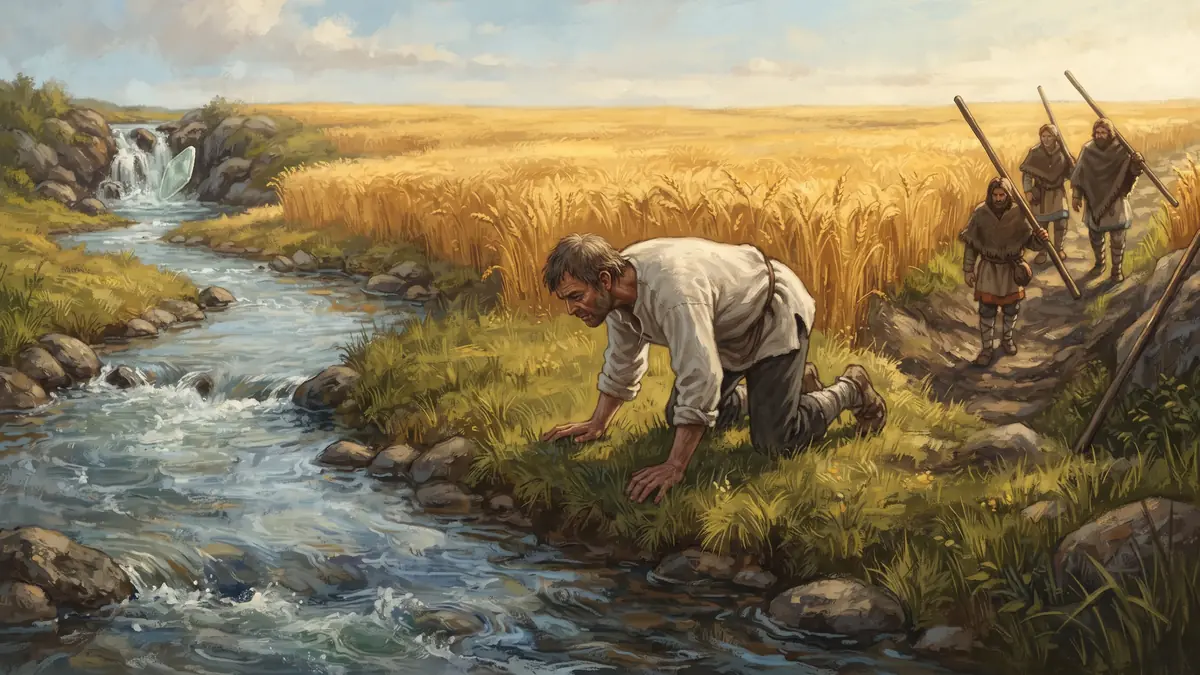
The Contrary-Minded Woman, in Norwegian Kjerringa mot strømmen, is a short, dry tale collected by Asbjørnsen and Moe. The article that serves as the base cites Norske Folkeeventyr, Ny Samling, of 1852. The collection was inspired by the Brothers Grimm and reflected a distinct Norwegian culture after Norway gained partial independence in 1814. This piece summarizes the plot, which includes a death, and so the tone is that of a report.
The plot
On a Sunday, a husband and wife look at their cornfield beside a river. He says they will reap it the next day. She insists it should be clipped with shears. The argument goes on, and she mimes the shears with her fingers. The husband holds her head over the water and asks whether the corn should still be clipped. She says yes, and he dunks her. This repeats, and she always gives the same answer. In the end, he drowns her.
The next day, the man feels that his wife is not at rest in Christian soil. He and the neighbours drag the river downstream, but do not find her. Then he remembers her contrary ways, searches upstream and finds the body above a waterfall, floating against the current. The tale closes with the remark: “There is nothing so dangerous as little knowledge.”
The names and the versions
The English titles vary: “Goody ‘Gainst-the-stream”, by Dasent, “The Old Woman Against the Stream”, by Iverson, and “The Contrary-Minded Woman”, by Braekstad. The article says stories of this kind appear in England, Germany, Finland, Spain, Russia and Pakistan, and links them to Shakespeare’s The Taming of the Shrew and to the Book of Esther. The article’s reading is about gender roles: the wife is always the contrary one, and the tale reflects old ideas of a wife’s obedience.
In short
It is a tale of black humour, with an ending that teaches by the logic of the absurd. For the story, contrariness is a trait so strong that it holds even after death.
Terms
Contrary here means one who always answers the opposite. Reap is to cut grain with a sickle. Waterfall is a drop of water in a river.
What remains uncertain
The article places the tale in type 901 of the Aarne–Thompson–Uther index, “obstinate wife who learns to obey”, and that number should be checked in other catalogues. The dates of the translations also differ inside the article: Dasent appears as 1859 in the text and 1874 in the citations. The age of the tale, before collection, is not known. The tale carries domestic violence and should be read as folkloric material, not as a model.
To row upstream against the current, alternating the sides of the boat, play Against the stream.
Sources.
- Wikipedia article "The Contrary-Minded Woman"
- Asbjørnsen and Moe, Norske Folkeeventyr, Ny Samling (1852), as cited in the article
- Translations by Dasent ("Goody 'Gainst-the-stream"), Braekstad and Iverson, as cited in the article