Aurvandil: the toe that became a star in the myth of Thor
Thor crossed a river of ice with Aurvandil on his back, in a basket. One toe stuck out, froze and was thrown into the sky. See what the Prose Edda tells and what scholars still debate.
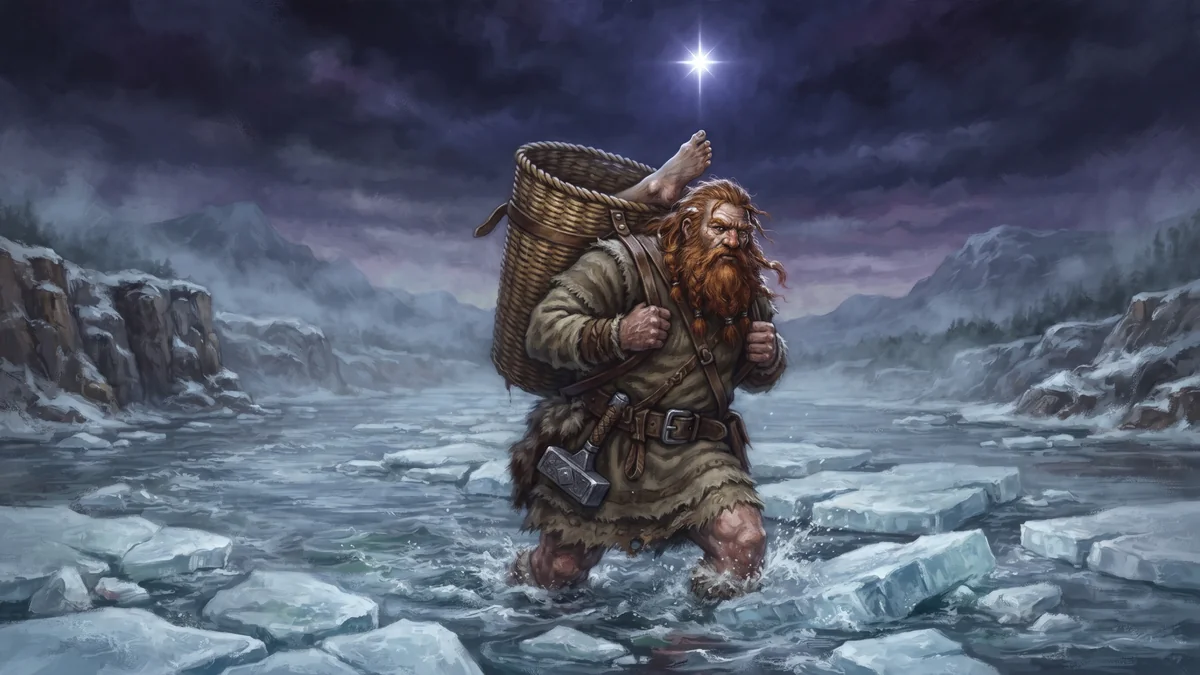
Aurvandil appears only once in Norse mythology, and it is a short scene. Thor crosses a river of ice with him on his back, Aurvandil’s foot sticks out of the basket and freezes, and Thor breaks off the toe and throws it into the sky. This piece follows the summary in the article “Aurvandill” and the article on Gróa, which cite the text of Snorri Sturluson, from the 13th century.
The scene in the Prose Edda
In Skáldskaparmál, Thor tells Gróa, Aurvandil’s wife, that he waded the rivers Élivágar, from north to south, carrying Aurvandil in a basket on his back. One of the toes stuck out of the basket and froze. Thor broke it off and threw it into the sky, where it became a star called Aurvandils-tá, “Aurvandil’s toe”. Gróa is a wise woman who sings spells. After Thor killed the giant Hrungnir with the hammer Mjölnir, pieces of the giant’s whetstone stayed lodged in the god’s head, and Gróa was called to free them. Delighted by the news of her husband, she forgot the spell, and the stone stayed there. The text ends with a taboo: no one should throw a whetstone across the floor, because it moves in Thor’s head.
A name that travels
The name is much older than Snorri. The article lists related forms: Ēarendel in Old English, Aurendil in Old High German, Auriwandalo among the Lombards and, perhaps, auzandil in Gothic. Old English uses Ēarendel to translate Latin words such as oriens, lucifer and aurora, tied to the light of morning. For that reason many scholars think of the morning star, Venus. In the poem Crist, Ēarendel is a messenger of brightness sent to mankind. J. R. R. Tolkien read those lines in 1913 and took his Eärendil from them. In 2022, a team of astronomers gave the name Earendel to a distant star, WHL0137-LS.
Other readings
The article cites other stories with a similar name. In Saxo Grammaticus, around 1200, Horwendillus is the father of Amleth. In the German poem Orendel, from the late 12th century, the hero brings the Holy Mantle to Trier. But the article says Orendel and Horwendillus seem unrelated to Ēarendel and Aurvandil, although Georges Dumézil and Schaffner argue for a common origin.
In short
Aurvandil is a man carried by Thor in a basket, whose frozen toe became a star. It is a short myth, told only by Snorri, tied to a very old name in the Germanic languages.
Terms
Élivágar are the icy rivers of the myth. Seiðr is a Norse magic, and Gróa practises it. Gothic is the ancient Germanic language.
What remains uncertain
The article says the star is not identified: Sirius, Venus and Rigel, the foot of Orion, have been suggested. The meaning of the name is debated, with several proposals. It is not known whether Snorri invented the toe scene or gathered an older tradition, nor whether the stories from other regions come from the same root.
To cross a river of ice by hopping from block to block, without falling into the water, play The river of ice.
Sources.
- Snorri Sturluson, Prose Edda (Skáldskaparmál), as summarized in the Wikipedia article "Aurvandill"
- Wikipedia article "Gróa"
- Gesta Danorum by Saxo Grammaticus, as cited in the same articles