Tanngrisnir and Tanngnjóstr: the goats that pull Thor's chariot
Two goats pull Thor's chariot, are eaten at night and return to life in the morning, as long as no bone is broken. See what the Poetic Edda and the Prose Edda tell and what remains in doubt.
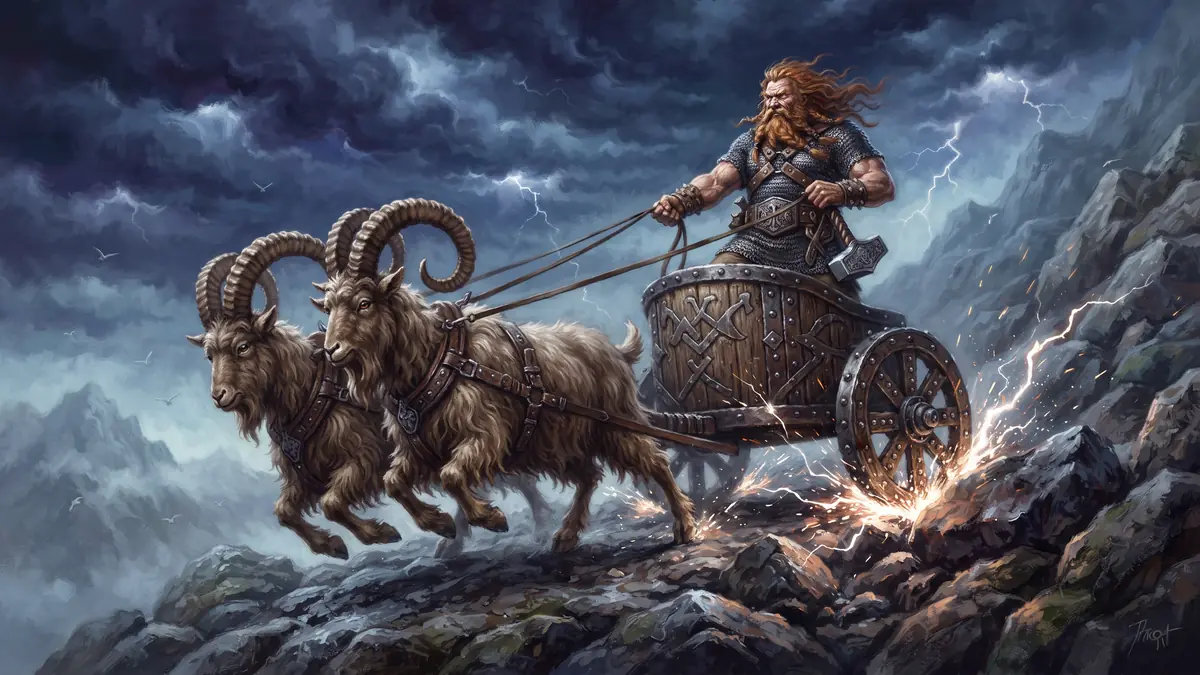
Tanngrisnir and Tanngnjóstr are the two goats that pull the chariot of the god Thor. The names are usually translated as “teeth-barer” or “one that snarls” and “teeth-grinder”. According to the article that serves as the base for this piece, Rudolf Simek notes that these names are young in the sources and may have been invented by Snorri Sturluson.
Where they appear
In the Poetic Edda, the goats appear in two poems, but unnamed. In Hymiskviða, Thor leaves the goats with a man called Egil, in Midgard, before going on with Tyr to the hall of the giant Hymir. The goats have “splendid horns”. After Thor kills Hymir and his army, the animals collapse, half-dead, lame, and the poem blames Loki. In Þrymskviða, a stanza describes the ride by chariot to Jötunheimr, with the rocks shattering and the earth ablaze.
In the Prose Edda, Gylfaginning mentions the goats in chapter 21, with both names, and in chapter 48, when Thor sets out for Midgard disguised as a boy, without goats or companions. Skáldskaparmál lists them among the names of goats, in chapter 75.
Eaten and revived
Chapter 44 of Gylfaginning is the best known. Thor and Loki stay at the house of a peasant family. Thor slaughters and skins the goats, cooks the meat and invites the household to eat. He orders them not to break the bones, and lays the skins near the fire, for the bones to be thrown onto them. Þjálfi, the peasant’s son, splits a thigh bone to get at the marrow. In the morning, Thor blesses the skins with the hammer Mjölnir and the goats stand up, but one of them is lame in a hind leg. Thor realizes that a bone was broken and grows so furious that the family trembles and offers everything it has. Thor calms down and accepts the children, Þjálfi and Röskva, as servants. The four go on to Jötunheimr, and the goats stay behind.
Two explanations for the limp
The article notes that the Poetic Edda blames Loki for the lameness and the Prose Edda blames Þjálfi. Simek links the goats to Sæhrímnir, an animal that the gods and the dead warriors eat every night and that returns the next day, and suggests a reflection of sacrificial rites. In Scandinavian folk tales, witches replenish food, usually herring, and breaking the bones ends the renewal, which Reimund Kvideland and Henning Sehmsdorf see as a parallel to the goats.
In short
Thor’s goats are both mount and meal. The rule is simple: the meat may be eaten, but the bones may not be broken. When the rule is broken, the animal comes back hurt.
Terms
Marrow is the soft fat inside bones. Midgard is the world of humans. Mjölnir is Thor’s hammer.
What remains uncertain
The names may be late and Snorri’s. The two sources disagree on who caused the limp. The article presents the link with Sæhrímnir and with the herring tales as interpretations, not as facts.
To drive Thor’s chariot, jump the obstacles and gather bones without breaking them, play The goat chariot.
Sources.
- Wikipedia article "Tanngrisnir and Tanngnjóstr"
- Snorri Sturluson, Prose Edda (Gylfaginning and Skáldskaparmál)
- Poetic Edda (Hymiskviða and Þrymskviða)