The witch in the stone boat: an Icelandic tale of King Sigurd and the chain
In an Icelandic tale, a troll-woman arrives in a stone boat, takes the queen's place and binds the true queen under the floor with a chain. See Jón Árnason's story, how Sigurd breaks it and what is debated in the name.
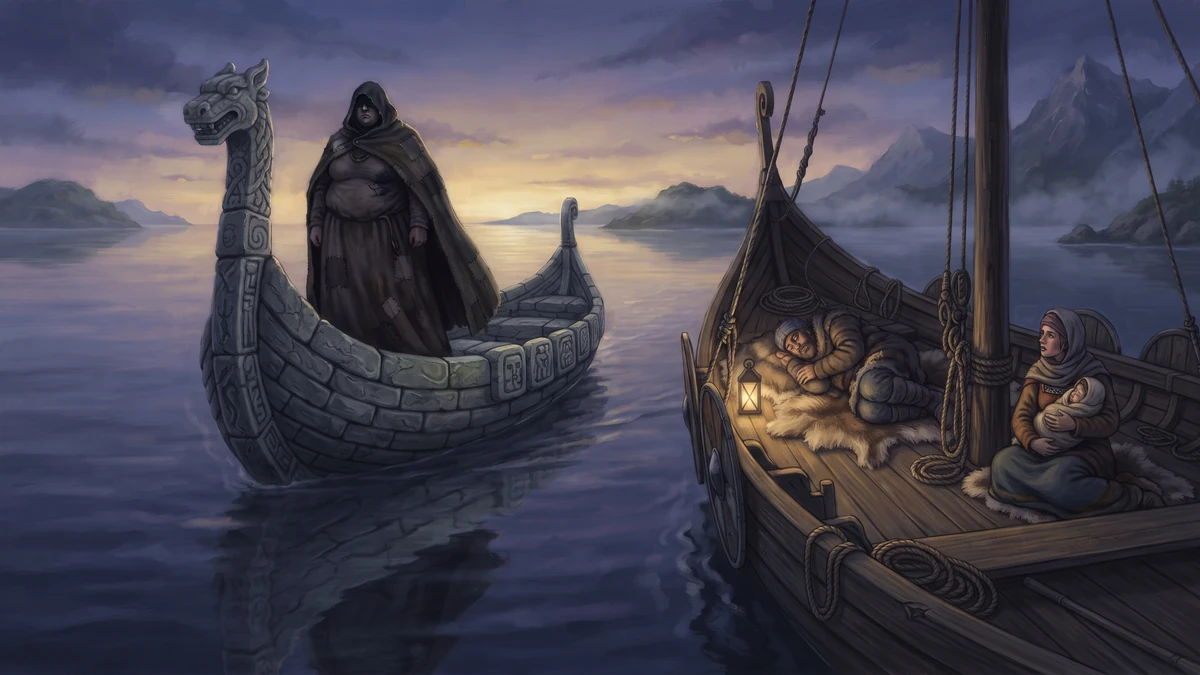
Almost everyone knows the stepmother who disguises herself as a mother, but few tales do it from a stone boat on a calm sea. It is a tale from Iceland, collected by Jón Árnason in the 19th century, and the violence of the ending does not hide what is most striking: the figure of the queen bound by a chain beneath the floor.
The voyage home
King Sigurd, at his father’s wish, goes to another kingdom to marry a king’s daughter. He is accepted on condition that he stays to help the bride’s father until he hears of his own father’s death. When he gets the news, he sails home with his wife and their two-year-old son. One day from home, the wind drops and Sigurd falls asleep. The queen and the child are left alone on deck.
The stone boat
Then a stone boat approaches, carrying a frightening figure: a witch, in Lang’s version, or a tröllkona, “troll-woman”, in the Icelandic original. She boards, takes the child, strips the queen of her fine clothes and takes on her appearance. She puts the true queen on the stone boat and chants a verse that it should carry her without straying to her brother in the underworld. The boat vanishes.
The false queen
The child cries without stopping. The false queen scolds Sigurd for leaving his wife alone on deck. At home, Sigurd becomes king, and the child cries all the time, so a court lady is hired as his wet nurse. He notices that his wife has become haughty and stubborn. Two courtiers playing tafl in the next room spy through a crack and hear the queen say that the wider she yawns, the more she turns back into a troll. As she yawns, she reverts to a hideous troll-wife, and her brother, a three-headed giant, rises through the floor with a trough of meat, which she devours.
The chain
The nurse lights a light at night, the planks of the floor lift and a beautiful woman in white linen appears, with an iron belt around her waist and a chain running down into the earth. She embraces the child for a moment and sinks back down. On the second night, she laments: “Two are gone, and one only is left”. The nurse concludes that the third night will be the last. On the third night, Sigurd waits with a drawn sword, recognises his wife, cuts the chain in two, and loud noises are heard beneath the earth.
The ending
The queen tells how the giant wanted to force her to marry him. She agreed on condition that she could visit her son for three days in a row, hoping to escape. The giant seems to have fallen to his death, and the crash was his. The true queen is restored, and the false one is captured and punished.
The name of the boat
The original title word, steinnökkvi, is debated: one dictionary gives it as “painted boat” and others as “stone boat”. Mrs. Hall, in 1897, titled the tale “The Giantess and the Granite Boat” and invented names for the characters.
In short
A troll-woman arrives in a stone boat, takes the queen’s place and binds the true queen under the floor. On the third night, King Sigurd cuts the chain with his sword and frees her.
Terms
Tröllkona is “troll-woman”, in Icelandic. Tafl is a Nordic board game. A wet nurse is a woman who nurses another woman’s child.
What remains uncertain
The meaning of steinnökkvi is uncertain. The tale type, ATU 462, has relatives in other countries, and it is not known when the Icelandic version was composed.
To cut the glowing link of the chain as it passes under the sword, play The queen’s chain.
Sources.
- Jón Árnason, "Skessan á steinnökkvanum", in Íslenzkar Þjóðsögur og Æfintýri, volume 2 (1864)
- Andrew Lang, "The Witch in the Stone Boat", The Yellow Fairy Book (1894)
- Wikipedia, "The Witch in the Stone Boat"