Grógaldr: the nine spells Gróa sings to her son Svipdagr
In the poem Grógaldr, a young man calls his dead mother from her grave and she sings nine spells for his journey: against fear, mockery, water, foes, fetters, storm, cold, the dead and giants.
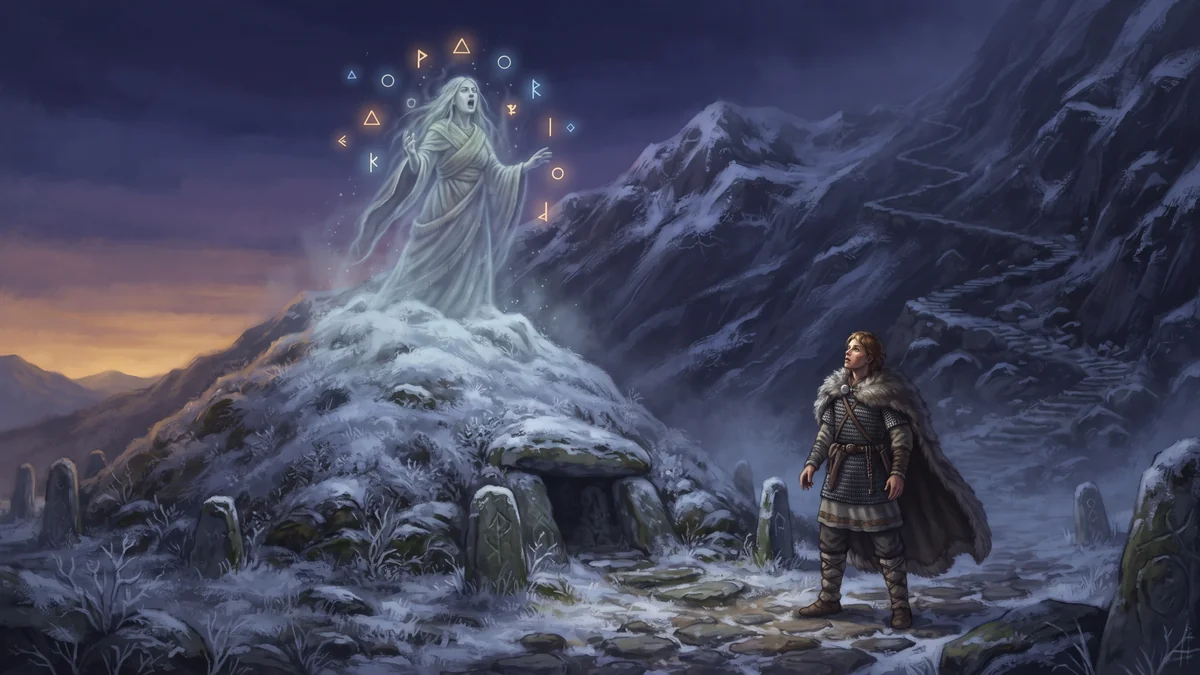
Among the poems of the Poetic Edda, few have a scene as strange as Grógaldr: a son goes to his mother’s grave and wakes her to ask for help. The mother is Gróa, a seeress, and what she answers is a list of nine spells for a journey nobody wanted to make.
The request
Svipdagr, the young man, calls his dead mother, who had told him to do so if he ever needed her. Gróa, a völva, or seeress, rises from the grave and asks why he woke her. He explains that his stepmother has set him a task: to win Menglöð, a woman whose hall lies in a place where, the stepmother says, “one cannot travel”. Gróa admits the road is long and hard, but does not try to talk him out of it. He asks for spells of protection, and she sings.
The nine spells
In Lee Hollander’s translation, stanzas 6 to 14 hold nine “heeds”. The first is a general charm against fear: what seems shocking must be shaken off, and the way will make itself. The second guards the weary traveller from mockery. The third calls on the rivers that run to the realm of the dead, so that the deep waters run dry before him. The fourth protects from foes who surround him to kill him: their hearts will hold back their hands. The fifth loosens bonds, if he is fettered hand and foot. The sixth calms the sea, if the weather is wilder than men know. The seventh guards against deadly cold on the fells. The eighth protects, on misty moors, from the wraith of a Christian woman, and Hollander notes that the original reads “Christian woman”, a sign of the belief that such ghosts were even more dangerous to a heathen hero. The ninth puts words in the traveller’s mouth when he contends with giants.
The poem and the scholars
The text survives in several 17th-century paper manuscripts, together with Fjölsvinnsmál. For a long time nobody saw that they were parts of one story. In 1854, Svend Grundtvig linked Grógaldr to the first part of the medieval Scandinavian ballad Ungen Sveidal. In 1856, Sophus Bugge saw that the end of the ballad matches Fjölsvinnsmál, and in 1860 he called the pair Svipdagsmál, the name scholars adopted. Grógaldr is one of six Eddic poems that involve necromancy.
In short
Svipdagr wakes his mother, Gróa, and she gives him nine spells of protection: against fear, mockery, waters, foes, fetters, a wild sea, cold, the dead and giants.
Terms
A völva is a seeress who speaks with the dead and foresees the future. Necromancy is the practice of speaking with the dead. The Poetic Edda is the collection of mythological and heroic poems in Old Norse.
What remains uncertain
The second spell is hard to translate, and Hollander admits doubt. The date of composition is debated. It is also debated whether the Gróa of this poem is the same one who treats Thor in the myth of Hrungnir, as some scholars propose.
To drive off each danger with the charm of the same shape and colour, play The nine charms.
Sources.
- Grógaldr, stanzas 6 to 14, Poetic Edda (translation by Lee M. Hollander, 1962)
- Wikipedia, "Grógaldr"
- John McKinnell, Meeting the Other in Old Norse Myth and Legend (2005)