Hrafna-Flóki, the forgotten hay and the name of Iceland in the Landnámabók
According to the Landnámabók, Flóki, "Raven-Flóki", fished so much in his first year that he never gathered hay, and the sheep died. In spring he saw a fjord full of ice and gave the land the name Ísland.
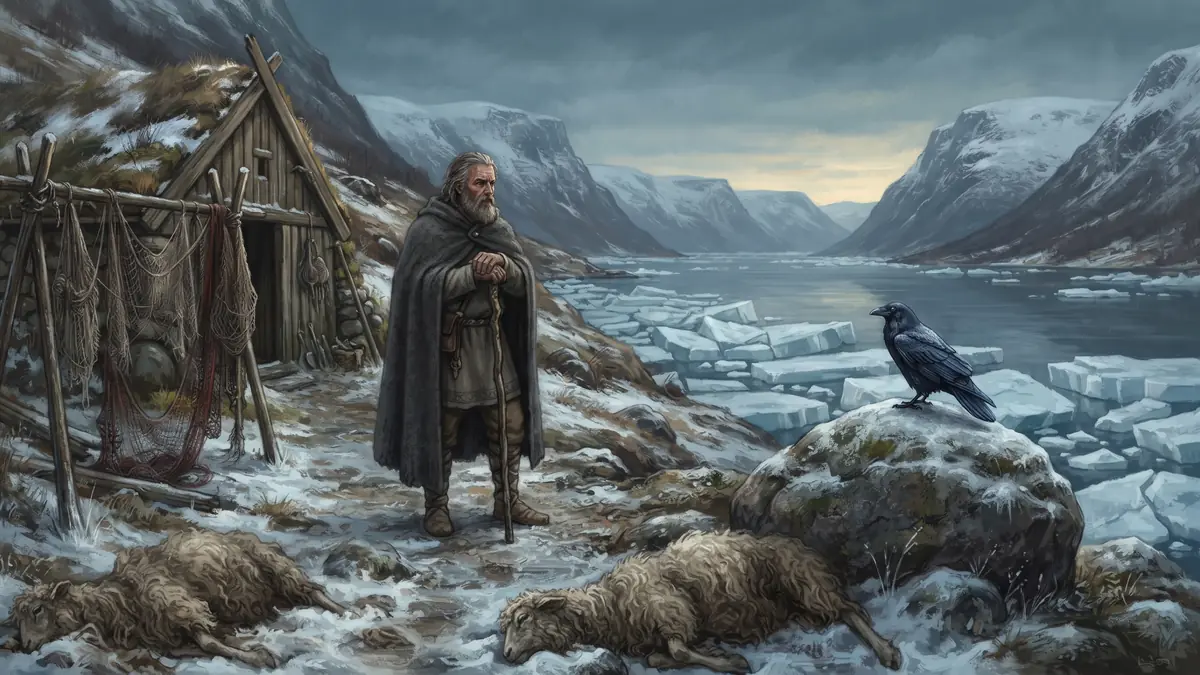
The name Iceland, “land of ice”, was given by someone who had a bad winter there, according to tradition. It is a short and slightly comic story that the Landnámabók tells of a Viking named Flóki. What makes it interesting is what it shows about the life of people who reached an island without knowing what winter would be like.
The man of the ravens
Flóki Vilgerðarson was a great Viking from Norway and, according to tradition, the first Norseman to spend a winter in Iceland. He brought three ravens and released them from his ship to find land. Because of them he got the nickname Hrafna-Flóki, “Raven-Flóki”. If the Landnámabók account is true, he was there around 860 to 870.
Too much fish, too little hay
Flóki arrived at Vatnsfjörður, near Barðaströnd, a fjord full of fish. He is believed to have lived where the ruins called Flókatóftir stand today, above the harbour of Brjálslækur. His men were so busy fishing that they never gathered hay. That winter, all the sheep died. For people who live from livestock, having no hay in store is the gravest mistake there is.
The name
In spring, Flóki climbed a mountain and saw to the north a fjord full of drifting ice. That was when he gave the land the name Ísland, “Iceland”. Locals think the mountain may be Lónfell.
What the story teaches
The account contrasts the abundance of the fjord with the ruin of the flock. The land had plenty of fish, but winter demands work that cannot be seen in summer: cutting, drying, storing.
Why hay matters
On an island with a long winter, sheep do not graze for months and must eat indoors. Hay is the reserve cut and dried in summer for that time, and there is nobody to buy it from when the neighbours have only just arrived. That is why the account is so blunt: there was fish in plenty, but it was not what fed the flock.
In short
Flóki of the ravens fished too much, forgot the hay and lost his sheep. From a mountaintop he saw a fjord with ice and called the island Ísland.
Terms
Landnámabók is the “Book of Settlements”, which lists the first settlers of Iceland. A fjord is an arm of the sea between mountains. Tóftir are the remains of walls of old houses, in Icelandic.
What remains uncertain
The Landnámabók was written centuries after the settlement, and the account holds only if it is true. The date around 860 to 870 depends on that. As for the mountain from which Flóki saw the ice, locals only say it “may” be Lónfell, and the ruins called Flókatóftir are attributed to him by tradition, without proof.
To catch the falling hay and let the fish go by, play Hay before winter.
Sources.
- Landnámabók (Book of Settlements), as reported by the Environment Agency of Iceland (Umhverfisstofnun) on Vatnsfjörður
- Umhverfisstofnun, "Hrafna-Flóki and Flókatóftir"
- Wikipedia, "Settlement of Iceland"