The Kylver Stone: the whole futhark carved on Gotland around 400
Found in 1903 over a grave on Gotland, the Kylver Stone carries the 24 runes of the Elder Futhark in order, the oldest known sequence, and a word that reads the same in both directions, sueus.
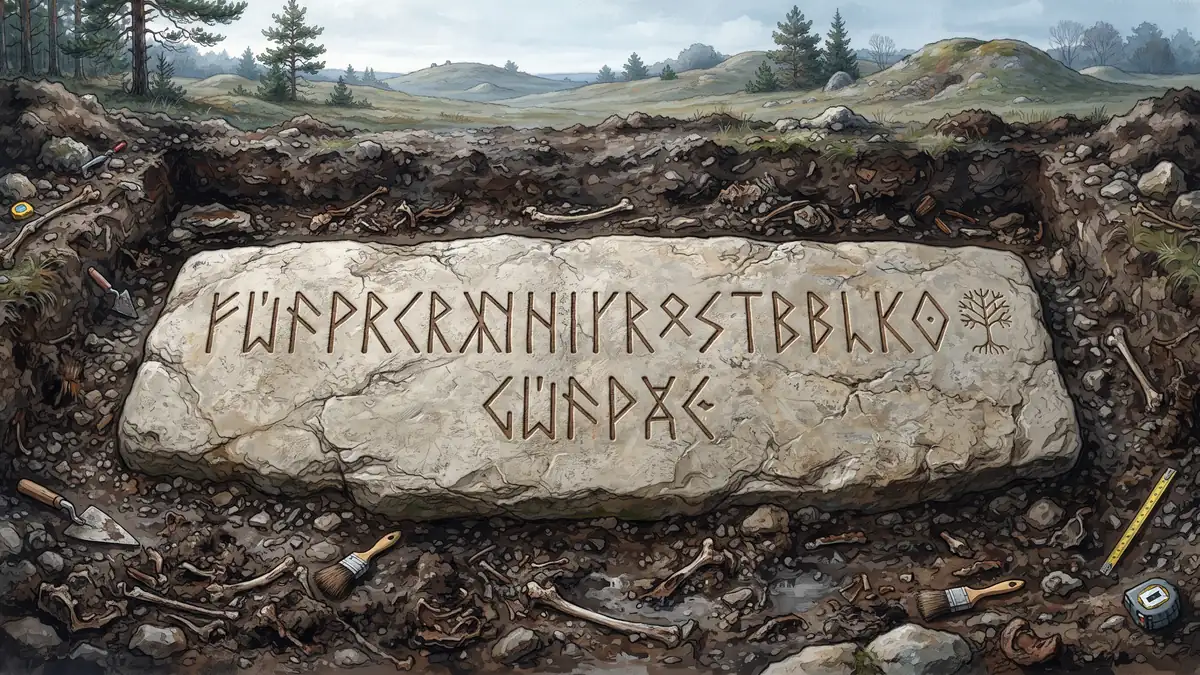
When someone recites the alphabet by heart, they are doing what someone on Gotland did about sixteen hundred years ago: reciting the order. The difference is that this order was scratched in stone, which is why we know it.
The stone
It was found in 1903, when a cemetery near a farm at Kylver, in the parish of Stånga on Gotland, in Sweden, was being excavated. It is a flat slab of limestone that served to seal a grave. The inscription is on the underside, so it could not be read from above. The dating, to about AD 400, comes from the graves where it lay. Today the stone is in the Swedish Museum of National Antiquities, in Stockholm.
The 24 runes
It is the oldest known listing, in sequence, of the 24 runes of the Elder Futhark. The order is: f u þ a r k g w h n i j p ï z s t b e m l ŋ d o. The name futhark comes from the first six, f, u, þ, a, r, k. The runes f and w are only partly cut. The runes a, s and b appear mirrored compared with later use, and the rune z is upside down.
The tree and the word
After the last rune there is a bindrune in the form of a small tree, with six twigs on the left and eight on the right of a single stave. It reads as stacked Tiwaz runes, or perhaps six Tiwaz and four Ansuz, an invocation of Tyr and the Æsir for protection. In another space stands the word sueus, which reads the same forward and backward. Nobody knows what it means. It may be magic. Marstrander suggested a magical writing of eus, “horse”, but Antonsen criticised that as linguistically impossible for the period. It may also refer to the Suiones, a Germanic people of the region.
What it was for
Some said the runes were meant to pacify the dead. The explanation has no support: nothing indicates that the inscription was made to cover a grave, and the reuse of stones for other purposes is common. The most likely purpose is practice, or a model for teaching how to carve the futhark.
In short
The Kylver Stone, from Gotland, from about 400, shows the 24 runes in order. It is the basis for knowing how the Elder Futhark was recited.
Terms
Futhark is the runic alphabet, named after its first six letters. A bindrune joins several runes into one figure. Tiwaz is the rune of Tyr and Ansuz that of the Æsir.
What remains uncertain
Nobody knows the meaning of sueus, or whether the tree of runes was magical. The use of the stone as a grave cover may be mere reuse.
To tap the runes in the same order as on the stone, play The order of the futhark.
Sources.
- Terje Spurkland, Norwegian Runes and Runic Inscriptions (2005)
- Klaus Düwel and Wilhelm Heizmann, "Das ältere Fuþark" (2006)
- Wikipedia, "Kylver Stone"