Why the bear has a short tail: the fox, the ice and the fish
In a tale by Asbjørnsen and Moe, the fox teaches the bear to fish with his tail in a hole in the ice. The tail freezes and breaks. See the tale, the "tail-fisher" type and versions from other countries.
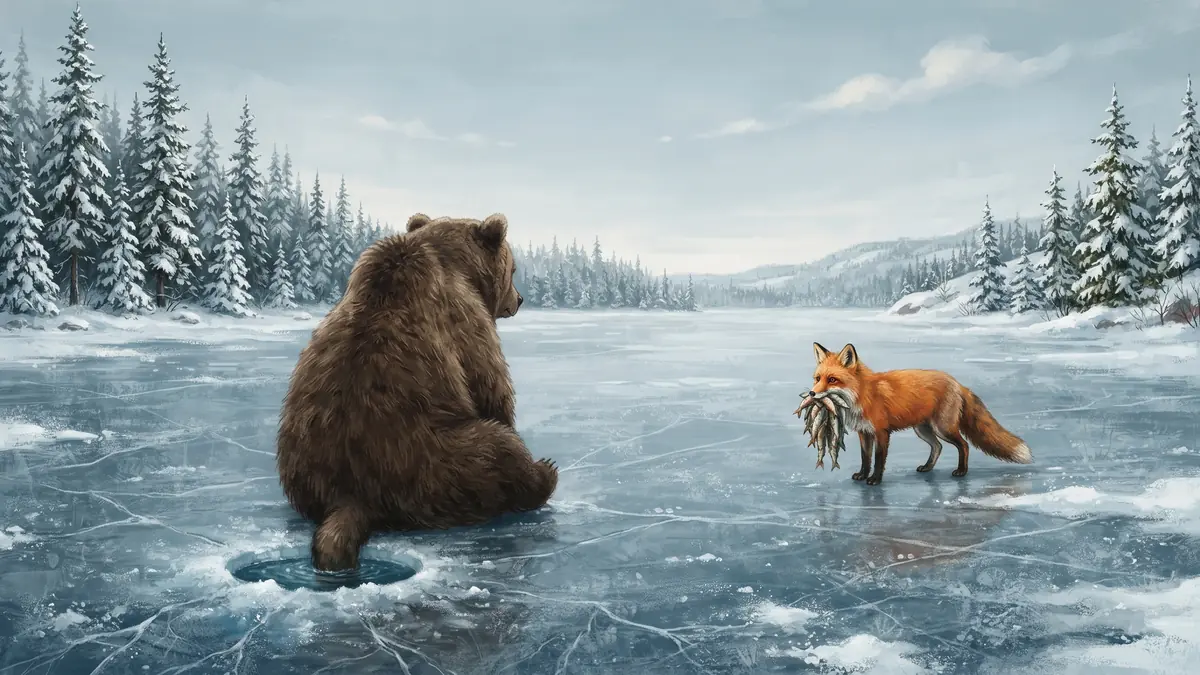
The explanation is short and mean, which is why the tale caught on: the bear has a short tail because he trusted the fox. It is in the collection of Norwegian folk tales by Asbjørnsen and Moe, and was translated into English by Dasent in 1859.
The fox and the bear
The bear meets the fox, who is sneaking along with a string of stolen fish. He asks where she got them, and the fox says: “Oh, my Lord Bruin, I have been out fishing and caught them”. The bear wants to learn, and the fox says it is easy. He should go out on the ice, cut a hole and keep his tail in the water for as long as he can.
The advice
The fox warns that the bear should not mind if the tail stings: it is a sign the fish are biting. Then he should pull the tail out sideways, with a hard jerk. The text does not say that the fox’s fish were taken from a man, only that they were stolen.
The ice
The bear follows the advice and leaves his tail in the water so long that it freezes fast. When he pulls, the tail snaps off short. The tale ends by explaining why the bear goes about with a stump of a tail “to this very day”.
The type and its variants
The story belongs to type 2 of the Aarne–Thompson–Uther catalogue, “The Tail-Fisher”, in which an animal, usually a fox, a wolf or a bear, fishes with its tail in a hole in the ice and the tail freezes. In some versions a fish bites the tail off instead. The type turns up in many places: in Scotland, in a tale of the wolf who lost his tail; in Flanders, with the bear himself; in Germany and Poland, with the wolf; and in the United States, with the rabbit, in Joel Chandler Harris’s tale of Mr. Rabbit.
The pair of the animal tales
In the European tradition of animal tales, the fox and the bear are a well-known pair: the clever one and the strong one. The catalogue even records a composite tale, “Reynard and Bruin”, which includes the tail-fisher type. The Norwegian version is short and goes straight to the point. There is no written lesson, but the conclusion is plain: whoever wants the fish without understanding the ice pays with his tail.
In short
The fox tricks the bear into fishing with his tail on the ice. The tail freezes and breaks, and so, says the tale, the bear came to have a short tail.
Terms
A tale type is a pattern catalogued by folklorists. An etiological tale explains the origin of a feature, here the bear’s tail. Bruin is the traditional name of the bear in European tales.
What remains uncertain
The tale does not say where or when it takes place, and the same plot exists with other animals in other countries. It is not known which version is the oldest.
To put the tail in the hole and pull at the moment the water bubbles, play Fishing through the ice.
Sources.
- Peter Christen Asbjørnsen and Jørgen Moe, Norske Folkeeventyr, tale "Hvorfor bjørnen er stubbrumpet"
- George Webbe Dasent, Popular Tales from the Norse (1859)
- Aarne–Thompson–Uther, type 2, "The Tail-Fisher"